




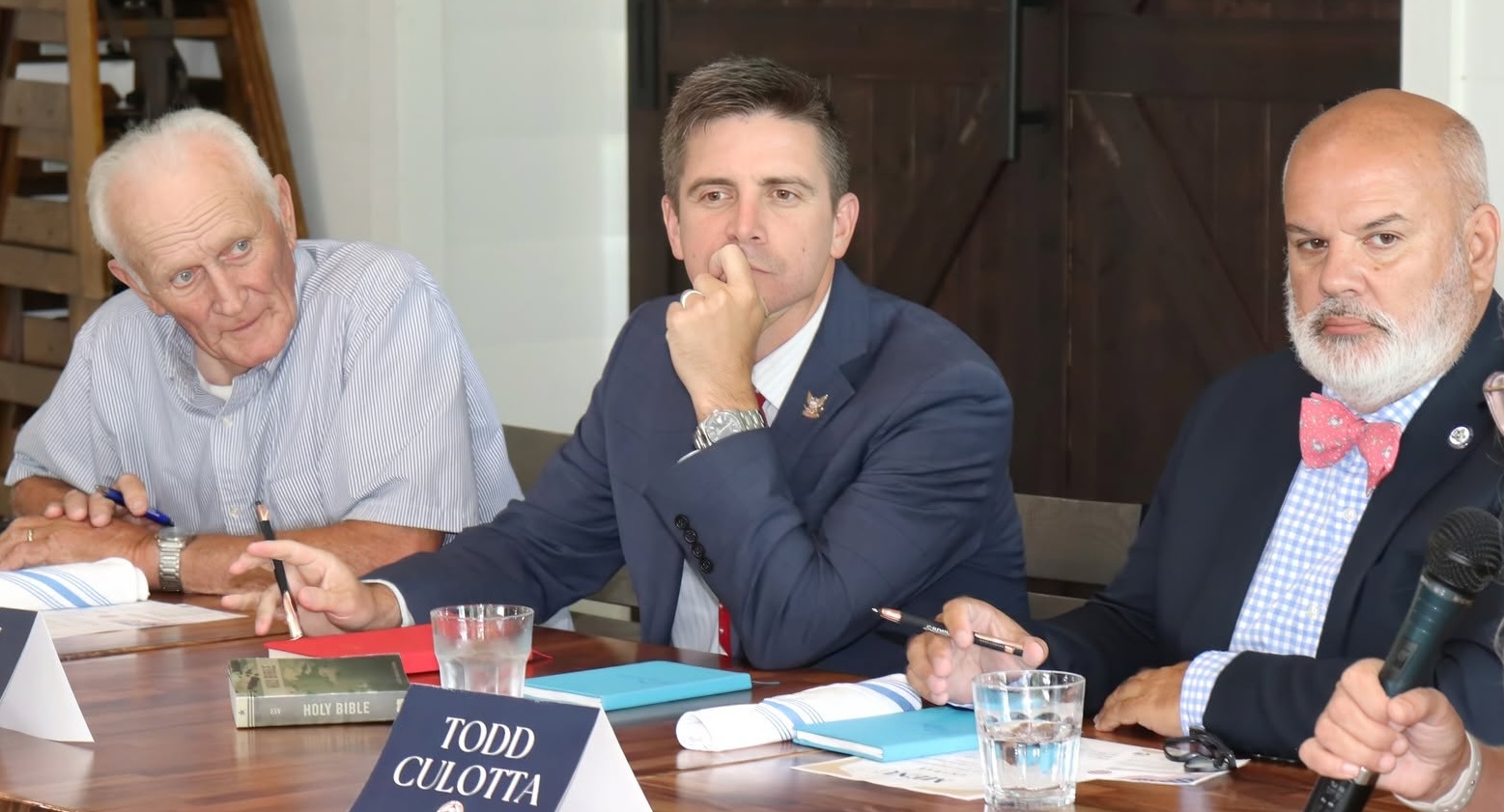

 Affordable housing, economic development, business taxes, infrastructure and workforce growth were among the topics discussed during the Chamber of Commerce for Greater Milford’s annual legislative forum held at Big Oyster Brewery.
Unlike a town hall or city council meeting, the annual Chamber luncheon is designed to focus primarily on business and economic issues affecting the greater Milford area. As a result, questions centered on topics such as workforce housing, attracting employers, business taxes, infrastructure and policies impacting economic growth, while also touching on how those issues affect Milford residents and the surrounding community.
Mayor Todd Culotta joined State Rep. Bryan Shupe and State Sen. Dave Wilson in answering questions provided by the Chamber before turning the microphone over to business leaders and audience members.
The discussion began with the growing shortage of affordable housing and how local and state governments can increase housing opportunities while ensuring infrastructure, schools, public safety and quality of life keep pace with Milford’s rapid growth. Culotta acknowledged that “affordable housing” means different things to different people but said Milford is well positioned to accommodate future growth. He noted that Milford currently has approximately 5,000 approved housing units already on the books and adds roughly 200 homes each year.
“We are the fastest-growing municipality in the State of Delaware right now,” Culotta said. “We’re seeing the growth come from other areas and that is putting pressure on housing prices, which, if you own a home, that’s a good thing. But if you’re trying to buy a home, sometimes that can be a hurdle. I think the administrative process to get things approved needs to be simplified more. That’s something I’ve always worked toward. I think economic growth, bringing good jobs to the area so people can afford housing, is important. Those are my two-pronged approaches — economic development and easing the administrative process.”
Shupe approached the issue from the perspective of a business owner, explaining that finding affordable housing has become one of the biggest challenges facing many employers trying to recruit workers.
“As a small business owner myself, we deal with this on a regular basis,” Shupe said. “Between our several small businesses, we employ between 30 and 40 individuals depending on the season, and some of them come to us with challenges of finding housing. Sometimes we have to help them personally because they cannot always traverse the unaffordable housing here in lower Delaware by themselves. I think the goal should be affordable homes, not more government control.”
Shupe criticized Senate Bill 23, which requires municipalities and counties to include affordable housing goals within their comprehensive plans.
“It forces municipalities and counties to have 20 percent of their plan be affordable housing,” he said. “If that 20 percent is not met, it actually denies funding from the Delaware Housing Department. I’ll give a lot of credit to the mayor and City Council for doing one thing,” Shupe said. “One thing that has worked in the City of Milford is local land-use decisions, including the ADUs they approved years ago.”
He also advocated for greater investment in organizations such as Milford Housing Development Corporation and suggested Delaware consider creating shared-risk loan pools that would help homebuyers qualify for mortgages without artificially driving up home prices through direct subsidies. Wilson agreed that housing affordability continues to be one of Delaware’s greatest challenges, particularly for working families.
“What is affordable?” Wilson asked. “Average person working for $18 or $20 an hour — what is there in Milford that is really affordable? There’s nothing still affordable here in Milford. A $300,000 home is not going to be affordable for someone working at Walmart, working at Redner’s.”
Wilson also praised Milford Housing Development Corporation’s efforts but said economic development must accompany housing growth.
“If we don’t figure out a way we can put people to work in the local area, housing is something that is very serious, but there’s a lot of other issues that we’re going to have to address.”
The panelists were later asked whether they supported updating state or county zoning regulations to allow developments such as tiny home communities and other innovative housing concepts. All three agreed local governments should retain authority over those decisions.
“I think first and foremost it’s up to a community to decide what they want and where they want it,” Culotta said. “The reason these projects get held up or shut down is because of what people don’t want next to them. If you don’t want high density — which is the solution to affordable housing — then we’ve got to decide where we want that density.”
Culotta said public hearings remain critical because they allow residents to weigh in on projects before decisions are made.
“It’s imperative that local governments decide how to do that,” he said. “When we get in each other’s way or we disagree and nothing gets done, that’s when the state legislature decides, ‘You know what? You can’t figure it out. We’re going to figure it out for you.’ That’s where we lose local control.”
The conversation then shifted to economic development, with panelists discussing what Delaware and Milford can do to attract industries that provide family-sustaining wages and long-term career opportunities. Speaking from the state perspective, Shupe said Delaware must become more competitive if it hopes to retain existing employers and attract new investment.
“I think it needs to start with its own house,” Shupe said. “It needs to start with responsible government and having a balanced budget so we can put money back into economic development without taking it from businesses themselves.”
He pointed to recent legislation affecting research and development tax incentives, LLC fees and business licensing costs as examples of policies he believes have made Delaware less competitive.
“We need to allow businesses to understand that we want them here,” Shupe said. “We’re willing to make sure they have every available resource to create jobs here in Delaware.”
Wilson agreed Delaware must remain competitive if it hopes to retain businesses and continue attracting new employers.
“When you look at our corporate law, we’ve benefited from these corporations for over 100 years,” Wilson said. “If we get a trend where they start leaving, I can see this in the making. At some point we’re going to see corporations looking for other states to incorporate in, and what happens then to Delaware?”
Culotta said attracting quality employers has been one of his primary goals as mayor and pointed to Milford’s new industrial park as evidence the city is preparing for long-term economic growth.
“One of the biggest primary reasons I wanted to be mayor is to drive economic growth,” Culotta said. “That’s something near and dear to my heart. We’re looking at 30 or 40 possible companies coming to Milford in the new industrial park and setting up shop. We’re going to work with them and incentivize them to come here and create jobs. That could be 1,200 to 1,500 jobs at the end of the day, and for a town of 14,000 that’s a big chunk of growth. When we get judges in place that make rulings against what a board of a company wants to do, those companies lose trust in the system. States like Texas and Florida are saying, ‘Come on with open arms,’ and they’re seeing record growth.”
He urged state leaders to continue strengthening Delaware’s reputation as a business-friendly state. When asked later about businesses that may locate within the industrial park, Culotta said discussions are already underway but declined to identify potential tenants publicly.
“We’ve had a great deal of interest about growth there and having a presence,” he said.
Culotta emphasized that the city views the industrial park as an investment in employment rather than simply a land sale.
“We borrowed the money from ourselves to make this investment,” he said. “It is taxpayer money, so it’s imperative that we get a return on our investment as quickly as possible. The idea is to create jobs, not to make a lot of money doing it with the properties. So we want to turn that around as quickly as possible, and that’s where I think we as city leaders can step in and help that process along. I am telling businesses that if you want to write a check to come to Milford, I’ll damn sure help you spend it.”
The comment came during a discussion about recruiting businesses to invest in Milford’s industrial park and was made in the context of encouraging private investment that would generate local employment opportunities.
During the audience question-and-answer session, Milford City Councilwoman Nadia Zychal asked whether Delaware lawmakers have considered eliminating or reforming the state’s gross receipts tax and replacing any lost revenue through another method. Shupe immediately agreed the tax deserves another look.
“The gross receipts tax does not take into account all of the money that’s going out the door,” he said. “All your rent, your payroll, your utilities—anything of that nature. The gross receipts tax is really a tax on the business before they get to take out any of the things that actually run the business itself. I personally feel that it does not need to be replaced. The money being put back into the business itself is going to see growth in people working… ultimately to the state that’s going to mean more taxes.”
He added that increased employment would naturally generate additional tax revenue while strengthening local economies.
“People don’t just automatically save all that money and put it in the bank,” Shupe said. “They need to use it in order to live their lives.”
Wilson agreed.
“The gross receipts tax is something that is considered to be an unfair tax,” Wilson said. “People are in business, small businesses, they get nailed with the gross receipts tax, and there’s no way to recover that.”
He acknowledged, however, that there is little support in Dover for eliminating the tax.
“I can tell you, on the side of the aisle that I sit, there’s no appetite to do anything with gross receipts tax.”
An audience member also asked how the planned industrial park would handle truck traffic and freight movement. Culotta said the location was intentionally selected to provide convenient access to multiple transportation corridors.
“The idea is that you can go east and hit Route 1 South, which can serve the entire Eastern Shore, or you can go west and hit Route 13,” Culotta said. “If you go north and south, we’re really well placed where it’s going to be.”
He said the city worked closely with DelDOT during the planning process to ensure the site would accommodate future truck traffic while remaining accessible to nearby commercial areas.
“It’s a really good design,” Culotta said. “It’s going to be really attractive.”
He also pointed to Baltimore Aircoil Company as an example of the type of manufacturer Milford hopes to continue attracting.
“They’re looking for more space,” Culotta said. “There’s so many things that go into that. Staff wants good schools, staff wants good places to live—that’s where we can help.”
The final major topic centered on whether Milford should pursue data center development.
Culotta said he believes data centers represent an opportunity if properly managed.
“I personally am for trying to bring data centers to our area to create jobs, to create growth, to bring technology—the next layer in industrial growth—to Milford,” he said. “However, those companies should pay for any infrastructure improvements required to support those facilities. It can’t abuse the infrastructure that will create a disadvantage for individual taxpayers and ratepayers. Microsoft data centers in Indiana have contributed millions to local schools and suggested similar partnerships. We know it’s coming. The technology revolution, the AI revolution—it’s going to need places to go.”
Shupe said his greatest concern is not economic but environmental.
“My biggest concern is the environmental impact,” he said. “We are in a unique space here in Delaware with so many waterways and how they impact our daily lives.”If I was governor, that’s the first thing I would do with these data centers, go to the other states and say, ‘What are we doing together as a region?'”
Wilson agreed data centers represent part of the future economy but cautioned Delaware must first address existing infrastructure challenges.
“We don’t have the infrastructure for what we’ve already invited here,” Wilson said.
He pointed to crowded highways, hospital capacity, emergency services and thousands of acres of approved solar farms as examples of growth already placing pressure on public resources.
“I’m not against it,” Wilson said. “But I’m telling you that’s the way of the future, and I think we need to take a hard look at what impact it’s going to have.”
The final audience question focused on who is moving to Milford and what impact that growth is having on the community.
Local business owner Gary Downs asked whether the city’s rapid growth is being driven primarily by retirees relocating from metropolitan areas, younger families or immigration.
Culotta said retirees from neighboring states make up the largest share of Milford’s recent population growth.
“I think what we’re seeing in Milford is a lot of what you just said,” Culotta replied. “A lot of the retired population is moving from places like New Jersey, New York, Philadelphia and the D.C.-Baltimore area because what’s nice about Milford is you’re a two- to three-hour drive away from all those places.”
He said Delaware’s lower taxes and Milford’s proximity to major metropolitan areas make the city attractive to retirees who want to remain close to their children and grandchildren.
“People that want to retire from those high-tax states come to Delaware, live much more affordably, yet still be within a two- or three-hour drive of their children and their grandchildren,” Culotta said. “We’re seeing a great deal of retirees come to Milford.”
At the same time, Culotta said retirees are not the only people choosing Milford.
“We’re seeing a lot of young families too because we’re seeing economic growth,” he said. “We’re seeing growth at the hospital, and I think Milford alone has the opportunity to be the medical capital of not just Sussex County, but Delaware in its entirety because we have room to grow. We have good technologies here, and so we want to encourage that.”
Culotta estimated that retirees account for approximately three-quarters of the city’s new residents, adding that their spending also supports local businesses and the service industry.
Downs followed up by asking whether retirees arriving with proceeds from the sale of homes in higher-priced markets contribute to rising housing prices in Milford. Culotta said increasing demand, regardless of where it originates, naturally places upward pressure on home values.
“I think that’s a demand question,” he said. “Whether it’s immigration or folks coming here from another state, it’s the demand that’s creating the housing pressures and prices going up. That’s just Economics 101. We’ve got to focus on affordable housing for people that make those entry-level salaries to support those industries,” Culotta said.
Shupe agreed that retirees relocating from neighboring states represent the largest segment of newcomers he encounters while campaigning and meeting constituents.
“I always ask individuals where they’re from originally,” Shupe said. “They’ll say New Jersey or New York, and I always ask the question, ‘What brought you to Milford? What brought you to Delaware?’ One hundred percent of the time—I’ve never gotten another answer—it’s always taxes.”
Shupe said Delaware’s comparatively low tax burden remains one of its strongest competitive advantages but cautioned against allowing that advantage to erode.
“Don’t let that be used against you when they try to raise your taxes just one or two percent because it’s still less than back home,” he said. “Let’s keep these taxes as small as possible.”
He acknowledged, however, that continued population growth places increasing demands on healthcare providers and other public services.
“It does put a lot of pressure on our healthcare system because retirees do need to see their healthcare providers more,” Shupe said. “That is something Delaware definitely needs to deal with sooner rather than later.”
Wilson echoed those concerns, describing Milford as a desirable retirement destination because of its location, quality of life and favorable tax climate.
“I think a lot of people have chosen this area to retire in because of the low taxes,” Wilson said. “Every time you ask anyone, ‘Why did you decide on Delaware?’ the answer is, ‘I heard about your low taxes.’ When you look at Route 113 this past weekend and see traffic backed up for two and a half miles, I don’t consider that to be rural anymore.We keep putting that burden on the State of Delaware and wonder how we’re going to fix it.”You’re not going to fix it until you raise taxes, and no one wants to do that.”
Throughout the hour-long forum, housing affordability and economic development repeatedly emerged as intertwined issues, with all three panelists emphasizing that Milford’s continued growth will require balancing new housing, quality employment opportunities, infrastructure investment and local decision-making.
Although the panelists often differed on how the state should address those challenges, they found common ground on several issues, including the importance of maintaining local control over land-use decisions, supporting workforce housing initiatives and creating an environment that attracts employers capable of providing long-term, family-sustaining careers.
The annual legislative forum provided business owners and residents an opportunity to hear directly from their elected officials on many of the issues expected to shape Milford’s future as one of Delaware’s fastest-growing communities.