


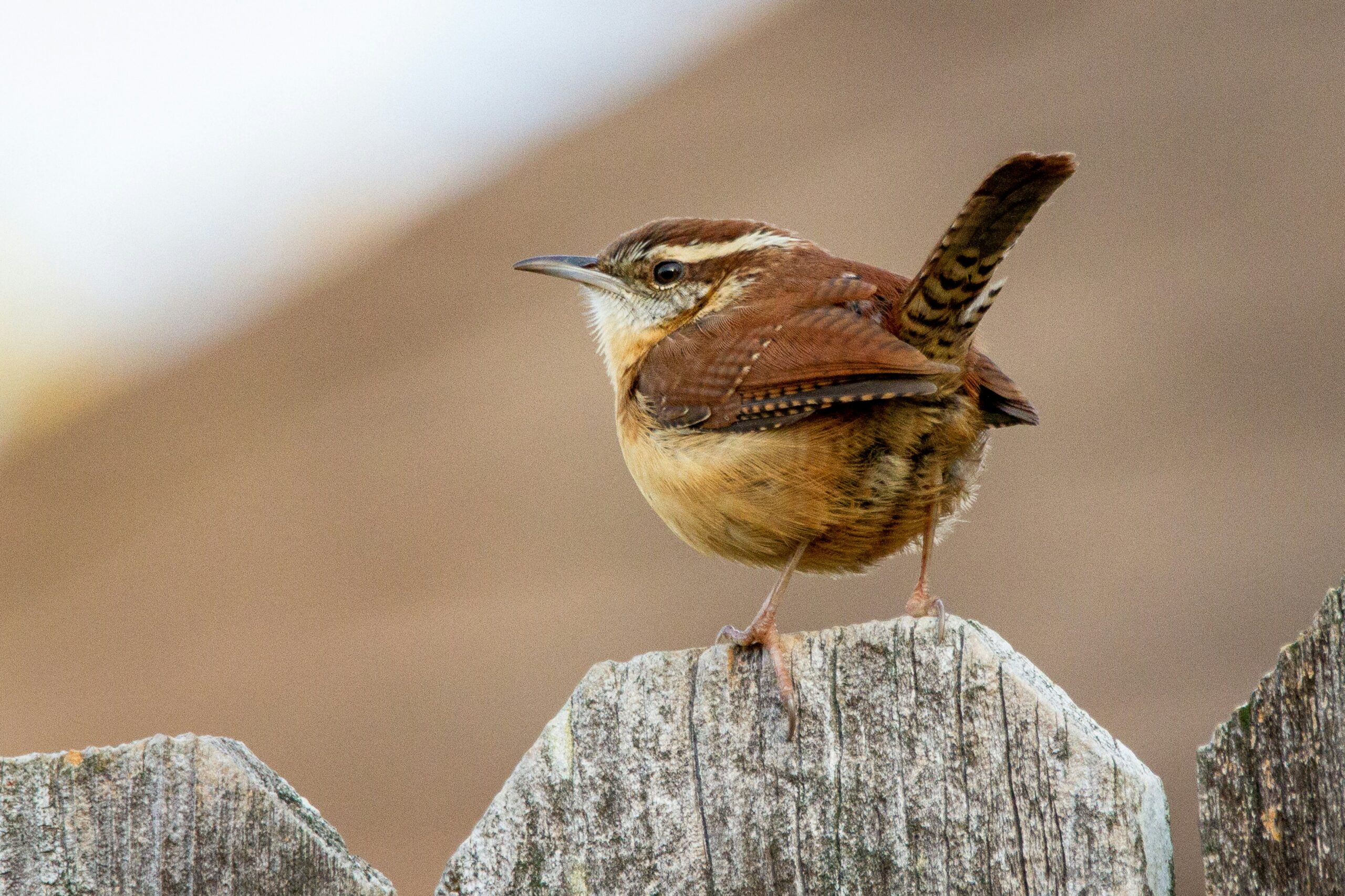



A spirited, cinnamon colored songbird, the Carolina wren has a voice that far exceeds its size. Carolina wrens are found year-round in Delaware, and they prefer dense underbrush, tangled vines and backyard gardens. Their scientific name is thyrothorus ludovicianus and it is the state bird of South Carolina.
Carolina wrens are chunky with a sturdy, down curved bill. Plumage is ruddy, deep brown on top, cinnamon below. The bird has a bold white stripe above the eye and white throat. They can be mistaken with Bewick’s wren, but those are rare in the east. Males and females look similar as are juveniles and adults.
The wren scurries through foliage or hops along woodpiles searching for insects. Their diet consists of insects, spiders, fruits and seeds. The Carolina wren is one of the only wrens that regularly visit feeders. They prefer suet but will also eat sunflower seeds.
It’s call sounds like “teakettle, teakettle, teakettle.” They often sing duets with their partners. Their call can be heard up to a half mile away despite how small the wren is. Males can sing over 40 different song types.
Carolina wrens mate for life and maintain permanent territories. They can grow to almost six inches tall and weigh over a half pound. In the wild, they live up to five years.
Nests are in unusual spots, including flowerpots, mailboxes and even boots left outside. They line the nest with bark, moss and feathers. Nests are shaped like bulky, domed cups which are rarely higher than 10 feet in a tree.
Carolina wrens lay four to six eggs that are white with reddish spots. The eggs are incubated by the female for 12 to 14 days and fledglings leave the nest in between 14 and 16 days.
Although they do not migrate, their population can dip after harsh winters. Predators are cats, snakes, racoons and jays.
Agile, curious and vocal, these wrens provide year-round entertainment with boundless energy and endearing behavior.
Next is the Eastern bluebird.