

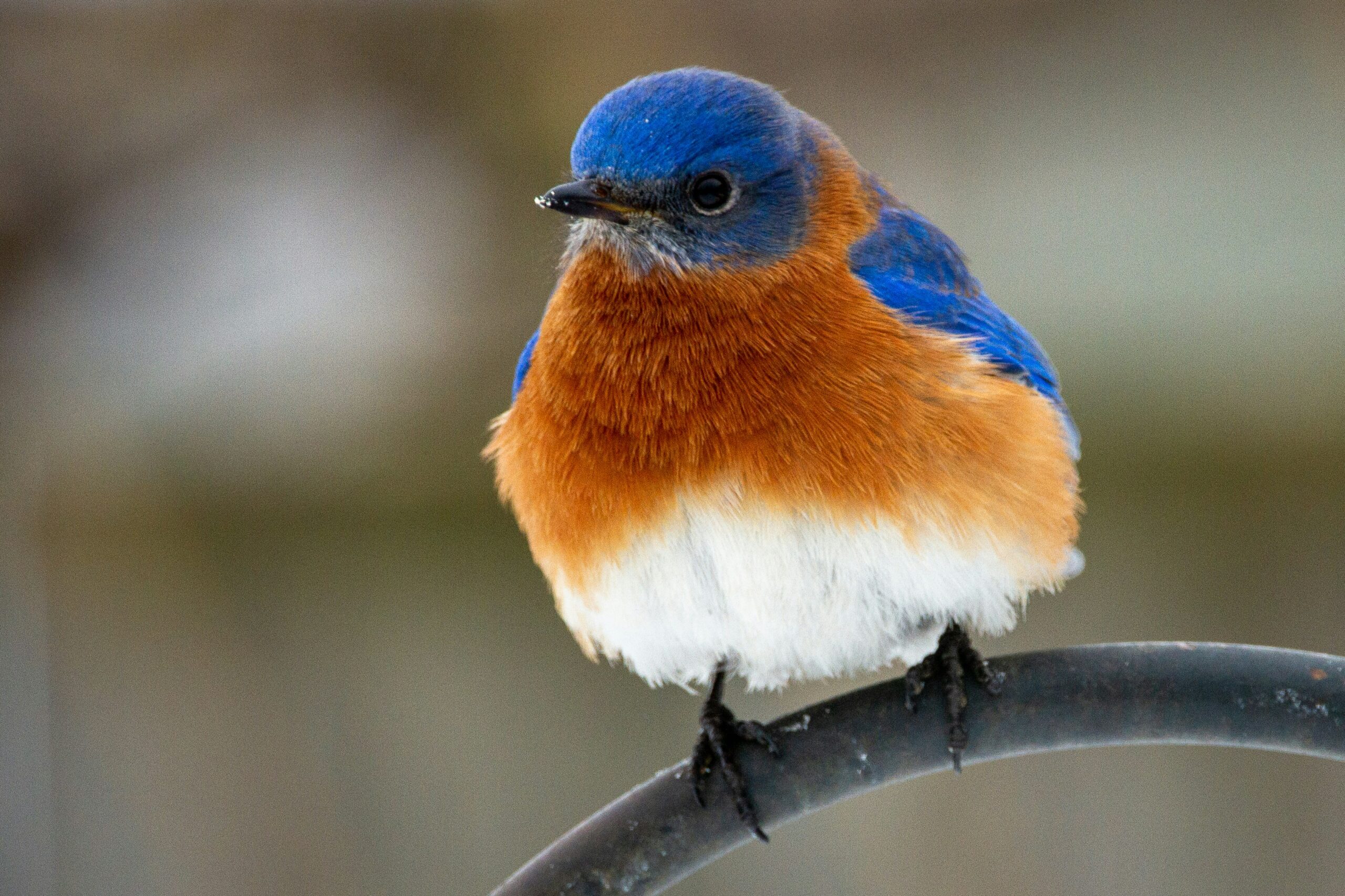


The next in our series about birds you can find in your backyard focuses on the Eastern bluebird. Glowing with colors of blue and orange, Eastern bluebirds can be found in open fields, orchards and woodland edges.
The scientific name for the Eastern bluebird is sialia sialis and the bird is actually part of the thrush family.
Plumage on males are vibrant sky-blue with a rusty red chest while females have softer colors with gray-blue wings and pale bellies. Juvenile bluebirds are heavily spotted, but the wings are blue.
The bluebird can grow to be 7 inches tall and weighs around an ounce. In ideal conditions, they can live up to 10 years.
The birds perch on wires and fence posts, scanning the ground for insects before swooping down to grab them. Their diet consists of insects, berries and small fruit. Eastern bluebirds allow close approach by humans. To attract them to backyard feeders, offer live mealworms, fruiting trees or vines.
Nests can be found in natural tree cavities or nest boxes. The bird fills the next with grass and other plant material. The Eastern bluebird often returns to the same area year after year. They lay between four and six pale blue eggs each year. Eggs are incubated by the female for 11 to 19 days and the babies leave the nest ata bout 19 days.
Males perform a fluttering courtship of flights, singing rich, warbled phrases to attract the females. Their song is a rich warble, sounding like chur chur-lee chur-lee.
In winter, Eastern bluebirds form small family flocks. They are year-round residents in the east although some do migrate from much colder areas.
The birds were once in steep decline, but community next box efforts have helped the population recover. Predators include snakes, raccoons, house sparrows and starlings. Non-native house sparrows and European starlings, introduced in the late 1800s, aggressively compete with bluebirds for nesting cavities.
In the 1960s, conservationists created bluebird trails where dozens, even hundreds, of birdhouses were planted at intervals along roads, paths or fence lines where they can be monitored. This has led to many Eastern bluebirds nesting in man-made houses. Adding a bluebird house is another way to attract them to the yard. Place the houses along hedgerows and fence lines with short grass to allow a place to perch. Bluebirds also look for birdbaths with drippers.
The bird has a gentle behavior, vivid colors and are happy living near people which makes them a popular species for bird lovers and conservationists.