
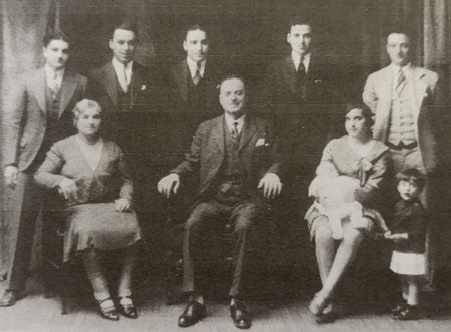

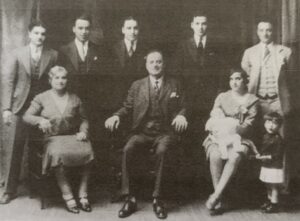
The story of the Pack family begins in Zohtmer, Ukraine, where Samuel Shupak was born in 1875. He and Golda Lisnitzer, who was born in 1880 in Berdytchev, Ukraine, were paired through a matchmaker just before Sam was to go off to the army. Sam and Golda married in Russia, making their home in Odessa. Their son Herschel “Harry” was born March 13, 1903, in Russia.
Just before the birth of their second son, Meyer “Mike” in 1904, the family moved to America and settled in Long Island, New York. The city was a location here many immigrants began building a new life in their adopted country. While going through the immigration process at Ellis Island, the family’s last name was changed to “Pack,” as officials thought their Russian name was too long.
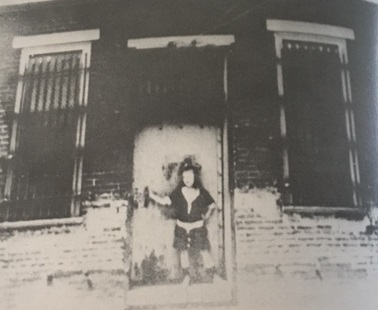
The Pack family was Jewish and Sam began his mercantile career in a small poultry shop in the Astoria section of Queens. The shop sold kosher chicken to residents.
“My father was a good man, and he worked like a slave,” his son Harry, was quoted as saying in an interview in 1950. “He never let up. We were desperate most of the time, but I don’t think he ever heard Pop complain. ‘When your time comes to make money,’ he used to say, ‘nobody can stop you.’”
Eventually, Sam opened his own shop, Pack’s Live Poultry, before 1910. By this time, the family had grown to five boys. Mike was born August 4, 1904, followed by David on August 6, 1905, Mendel “Manny” on Augsut 22, 1907 and Louis J. on July 6, 1910. All five of the boys worked in the poultry market when they were not attending Bryant High School near their home.
The five boys were industrious workers as well as good students. Four of the five Pack brothers would graduate from college or an equivalent. All of them achieved outstanding recognition in their respective fields, but all of them eventually gravitated back to the chicken business.
Harry graduated from Bryant High School in 1922 and studied accounting at New York University from 1925 to 1926, working with his father as he attended school. Mike graduated from high school and enrolled at the New York State Institute of Applied Agriculture at Farmingdale, Long Island, graduating in 1922. He continued his studies in poultry husbandry at Cornell University but only attended one year.
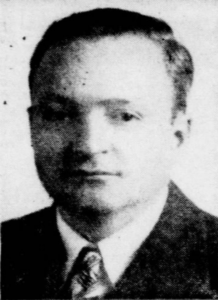
In 1925, Mike purchased eight acres of land near Cranbury, New Jersey, raising poultry and farming. In 1926, he installed an egg hatchery. His broiler farm became one of the largest in New Jersey with all the latest improvements and methods of equipment and growing. Eventually, Mike increased his holdings until he owned 30 farms in New Jersey.
Harry and David continued working with Sam until 1930 when they branched out on their own. They opened a new market and store in the Williamsburg section of Brooklyn, New York. In 1936, Mike convinced his brother, Harry, to join him in the New Jersey poultry operation.
“Mike had a little processing plan and a shipping business on the side,” Harry said later. “He couldn’t grow enough chickens to keep is plant going and he wanted me to go out in the field and buy for him.”
Dave remained in New York to manage the poultry shop opened with his brother. He kept up with the activities in New Jersey throughout 1936 and 1937. During this time, Harry explored North Carolina as a possible source of chickens for the processing plant. However, he was not satisfied with the potential in North Carolina, commenting that all they wanted to do was “raise moonshine.”
Returning from North Carolina in 1938, Harry stopped in Sussex County, Delaware, to learn how the poultry industry was progressing on Delmarva. This stop changed the course of his business and personal life. Harry found the people of Sussex County to be hard-working, honest and straight-forward, not inclined to trickery and deceptive business dealings like many of those he had encountered in New York.
Chickens had been a commodity in Delaware for many years, but as a local food. The commercial industry actually began by accident when Mrs. Cecile Steele of Ocean View placed an order for 50 chicks for her small farm but received 500 in 1923 due to a clerical error. The Steele’s built chicken houses raised broilers to a weight of about two pounds and sold the finished product locally for 62 cents a pound. Her earnings on one two-pound chicken would have netted her $24.14 today.
Because this profitable return on investment could be managed on a home farm, it was an incentive for others to attempt the same endeavor. By the early 1930s, the Steele poultry operation was producing 200,000 chickens per year. Her first broiler house is preserved at the Delaware Agricultural Museum in Dover. By the end of the Great Depression, the broiler industry was producing two million birds per year.
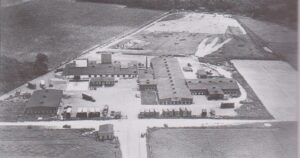
In 1938, Harry decided to move to Dagsboro and cultivate the source of supply for the processing company in New Jersey. He rented several farms and became the overseer of large poultry raising operations. He soon determined that Delaware would make the Pack family poultry business successful, but Harry was heavily in debt, relying on the sincerity and honesty of local business supporters to carry him through.
By 1940, Harry was contracting and raising over 300,000 chickens annually, but, at one point, was indebted to the hatcheries and feed companies by $300,000, the equivalent of $7.6 million today. However, his faith in the underlying security of the industry allowed him to move forward. In the summer of 1941, Harry and his brothers, Mike and Dave, built the largest chicken processing plant in the world in Milford, Delaware.
Dave was a solid manager, and his brothers knew they needed him to streamline day-to-day operations. At the time, H&H Poultry was in operation in Selbyville. The brothers decided that Dave would join that company for a short time to assess the processing business as it was developing. Dave only worked with the owners of H&H, Homer Pepper and Helen West, for about four months as the relationship between Homer, Helen and Dave did not develop.
The Milford plant came to be after Harry, Dave and Mike met I.D. Short. The four men had mutual interests as I.D. owned a lumber yard which would provide all the materials for a large chick processing plant. In 1941, Sussex Poultry began on six acres of land along South Marshall Street which was previously a meat packing plant owned by Charles S. Ingram. Milford City Council was supportive of the effort and agreed to connect both water and sewer to the plant.
The plant was a success almost from the beginning. In 1946, Manny, the next to youngest Pack brother, joined the company. A brilliant mechanical and aeronautical engineer, Manny graduated from New York University and M.I.T. in 1931. He joined the Curtiss-Wright aircraft manufacturing company and was involved in the development of many aircrafts used in the war effort. Manny was also a reserve officer in the Army Air Corps from 1930 to 1941.
The Sussex Poultry Company did have its share of disasters and scandals. In 1954 after Hurricane Hazel crossed the peninsula, the company suffered an estimated $15 million in damages, the equivalent of $185.7 million today. In 1962, the plant suffered a fire that caused an estimated $90,000, the equivalent of $1 million today, in damages. In 1953, David and Harry Pack were charged with tax evasion for the second time and, in 1945, workers at the poultry plant threatened to strike over low pay. It appears a settlement was reached before the strike and there was no record found of the result of the tax evasion charges.
In 1950, the Chamber of Commerce acted as a go-between for the city and the Sussex Poultry Company after the city accused the company of emptying their flux into the city sewer system, overtaxing the system in the area and causing it to back up during heavy rains. But probably the worst tragedy was the loss of Harry and David’s younger brother.
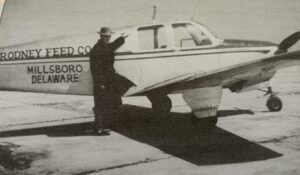
When he joined his brothers, Manny became the chief engineer of the poultry plant. He was an avid aviation enthusiast and a founding member of the Civil Air Patrol Unit formed in 1946 at Drummond Field outside Milford. In 1947, Manny was killed when the company’s Beechcraft Bonanza crashed in a thunderstorm near Millville, New Jersey on June 13, 1953.
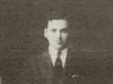
Manny was only 45 when his plane disintegrated in mid-air during a violent thunderstorm. His body was found in a heavily wooded area about 200-yard northeast of a gravel pit. The plane had taken off from Georgetown Airport at 3:04 PM and, at 3:30 PM, Manny radioed the Rehoboth Airport he was within 25 minuets of Millville. He was instructed to go on instrument flight and climb 9,000 feet. He was also told to contact the Millville Airport, but nothing more was heard from him. Manny was survived by his wife, Sara Kuhn, and four children, Elaine, Richard, Linda and David.
Harry married Anna Obzut in 1927, and they had two daughters, Charlotte and Blanche. He died at the age of 91 in March 1994.
Mike married Ida and they had three children, Phyllis, Irwin “Sonny” and Muriel. Mike died at the age of 92 in September 1996.
Louis never joined the poultry business. He was an Army veteran, rising to the rank of lieutenant colonel in World War II. He worked for 25 years for Shearson American Express. In 1994, Louis moved to Palm Harbor, Florida with his wife, Gertrude. The couple had four sons, Charles, Samuel, Manuel and Gregory. He died in 1997.