




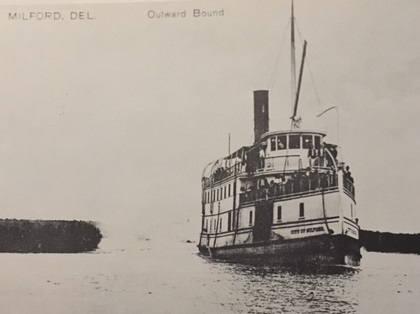

As early as the 1850s, Milford offered a steamboat service along the East Coast and to Philadelphia. However, bringing reliable service to southern Delaware was met with some challenges. The first mention of a steamboat service in Milford is in the Delaware Gazette and State Journal on May 14, 1852.
“The steamboat Milford of Milford has arrived and is now being furnished and, in a few days, will make an excursion trip for the amusement of those who chose to avail themselves of the opportunity,” the article reads. “There are some additions to be made to her accommodations which will cause a short delay before she can commence her regular trips.”
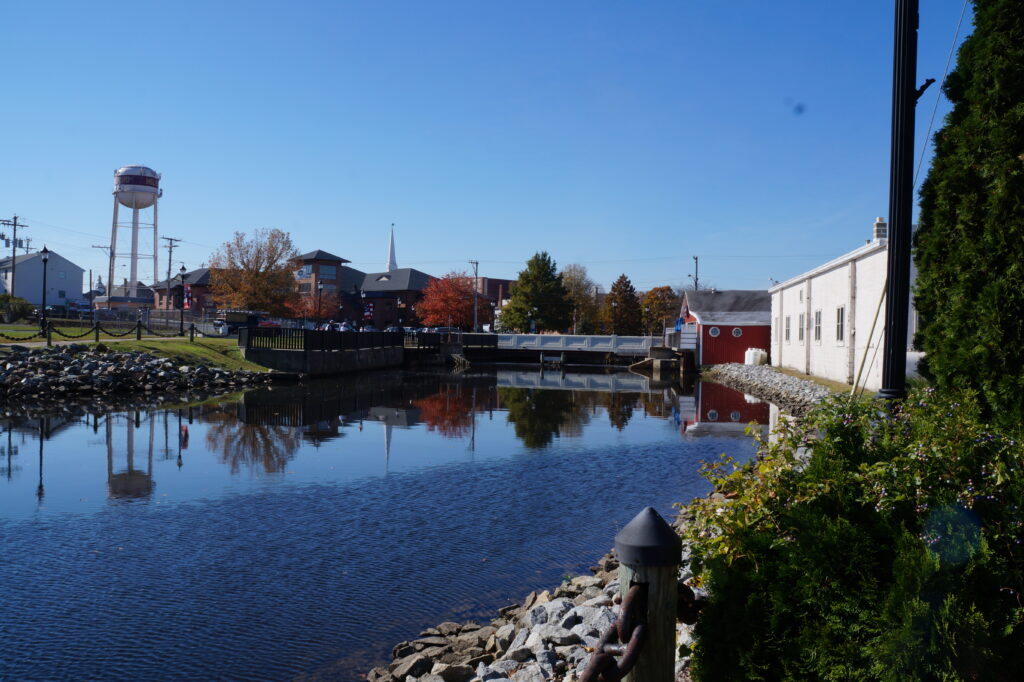
It is important to remember that when steamboat service existed in Milford, the Mispillion was significantly wider and deeper than it is today. Over the years, the river has changed significantly. When it was first discovered around 1638, the mouth of the river into the bay was farther north than it is today and was about 200 yards farther out into the water. According to Milford Etchings and the Milford, Delaware Vicinity by George P. Hynson, which was written in 1899, “the beach was close to a bar, formed abyt he waters of the deep and crooked stream then called “Strunkill” which flowed through the island and into the bay.”
Hynson wrote that the bars remained in 1899, but the streams filled in so they no longer could be seen. To encourage maritime travel, the river’s crooks and shoals were dredged to make the river deeper and wider.
The steamboat industry began in Milford when Henry Fiddeman and Daniel Currey created a dock on the north bank of the Mispillion River. The two formed the Milford Steamboat Company. Initially, the boats were used to haul freight, but it was soon discovered that they could be used to carry passengers to Wilmington and Philadelphia.
In 1869, travelers from Milford were provided the opportunity to use steamboat travel to New York City when Captain J. W. Hancox expanded the New York and Troy Steamboat Company in Wilmington. Eventually, Hancox earned the navigation rights to waters off of Venezuela, allowing those on the East coast to expand travel options.
When talk about bringing the railroad began, there was resistance from steamboat operators. An article in The Daily Gazette mentions a meeting about the Junction and Breakwater Railroad where “steamboat men were in attendance.” The article ends with the statement “a steamboat is to be put on the Lewes and New York line soon.” It is likely steamboat operators were aware railroads would greatly impact their business.
As the industry grew, it became apparent additional routes would be needed. In 1872, an article in the Peninsular News and Advertiser mentions the attention needed to keep the river navigable.
“Gen. Julius Stahel, Director, and Gen. Brown, Engineer, for the Ship Canal Company, visited Milford on Saturday last,” the article said. “In the evening, a number of our prominent citizens met these gentlemen at News and Advertiser office, and the merits of the route by, or near Milford were discussed. Messrs. Stahell and Brown were favorably impressed with this route, and the arguments in its favor, will report it favorably to the Company.”
A new line was added to Smyrna in 1875 with the steamboat Falcon traveling to Philadelphia every Monday, Wednesday and Friday at 3 PM with stops at Rothwell’s Brick Stroe, Eagle’s Nest, Hay Point, Fleming’s, Deakyne’s, Bombay Hook and Pennsville. Fare from Smyrna to Philadelphia was $1 one way, the equivalent of about $30 today.
Milford’s steamboat service expanded in 1886 with the addition of the William R. McCabe which launched in November. The need for steamboat service was especially important during summer harvests, especially peach season.
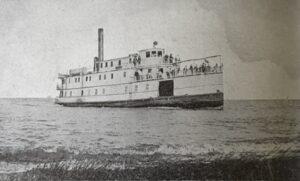
“Captain H.M. Smith proposes to run two steamboats between Milford and Milton in Delaware and Philadelphia during peach season,” a notice in the Morning News on April 30, 1887, stated.
Other issues faced steamboats as well. The need to transport more passengers and freight led to steamboat companies purchasing larger ships. Unfortunately, some were much to large to manage the narrow areas and low tides of the Mispillion River.
On October 8, 1891, the Delaware Gazette and State Journal reported that the steamer Atlantic City, sailed from Milford but that it would not be returning as it was too large for the stream. Instead, the company was replacing the steamer with a smaller one. The Atlantic City remained in use but was transferred to waters that would accommodate its size. The smaller steamer added a stop at Cape May as well.
This was a common problem with the Mispillion River, however. An announcement was made that a new steamship, the Mary U. Gothens made her first trip Philadelphia and, if the trip was a success, the boat would be permanently placed on the line. This was a larger ship that could carry passengers and freight. The announcement in the Morning News on July 23, 1884, suggested that Wilmington could be added to the line, bringing trade to that town as well.
However, on August 4, 1894, the News Journal reported that this project may not happen.
“Milford is somewhat disappointed over its steamboat line, which it was proposed to run from that town to Philadelphia,” the article read. “The boat has not yet been able to get up the river to the town. The river is small and crooked and there are shoals in some portions of it so that it has been impossible for the boat to yet make a landing. Another attempt will be made and if the boat is not successful in landing this time, the project will have to be abandoned.”
On August 28, 1894, it was announced that the steamboat line had been abandoned, indicating the larger ships could not be used on the Mispillion. Smaller ships continued to travel, carrying passengers and freight to Philadelphia as late as 1910.
Much of the steamboat business shifted to Milton and Frederica who had wider, deeper access to town. In 1895, Milton’s steamboat industry was so successful, a stock company was organized and a boat added permanently. This line was also making it possible for Milford’s steamboat service to improve.
“It is possible that the improvements now being made by the National Government to the Mispillion River may make ti possible for the people of Milford to run a steamboat to Philadelphia,” an article in the Morning News, stated.
In Frederica, a steamship carried much freight and passengers to Philadelphia. Farmers were using freight wagons to carry produce to Frederica to use the steamship by 1897.
In 1898, Ex-Congressman Willis, chairman of the Farmer’s Committee on the improvement of the Mispilion announced he had received a permit from the War Department to complete dredging of the Mispillion which would improve steamboat service in Milford. By June of that year, the steamboat Endeavor began regular trips between Milford and Philadelphia along with the steamer New Delaware.
“This has been made possible by reason of the improvement of Mispillion Creek, which heretofore has not been navigable for large craft,” an article in the Delaware Gazette and State Journal read. “The shoal at the mouth of the creek have been cleared away, thereby giving sufficient water to enable both of the vessels to reach Milford without difficulty.
Many of the steamboats only carried freight, including the George Pierce, operated by Captain Billy Walls and the Harry Davis operated by Captain Hoey Farrow. The
Delaware and the City of Milford were passenger liners. Even after the arrival of the Junction & Breakwater, many continued to use the steamboats even though the train was faster. However, by the time they arrived in Philadelphia, they were tired and sooty. In addition, train travel was more expensive.
“You arrived rested and clean, always provided you didn’t run into a storm and arrive seasick,” an account in History of Milford, Delaware, published by the Milford Historical Society, reads. “Sometimes you embarked in town, at other times at the New Wharf depending on the tide.”
Steamships served dinner at a cost of 25 cents, about $7 today. Often, the steamships offered excursions with lower rates, filling the boat with pleasure seekers.
Trips were not always pleasant, however. On one excursion, the Endeavor encountered a storm so powerful the ship barely escaped capsizing, according to the Milford Historical Society.
“The saloon windows were broken out, the deck chairs washed overboard, and the boy who had the lemonade concession lost his entire stock in trade over the side,” the book read. “The captain had to run before the storm as far up as Woodland Beach before he dared turn the ship about. This experience caused some of the passengers to resolve never to go on the bay again.”
Interestingly, the industry sparked rivalries between towns. The Morning News reported on December 21, 1907, that a steamboat race for a prize may be in the future.
“A steamboat race may be the attraction here during the holidays if the present spirit of rivalry keeps up between the towns of Frederica and Milford as to which of the twain has the fastest steamboat plying up the Delaware to Philadelphia,” the report reads. “The announcement that the City of Milford beat the steamboat Frederica in a race has been flatly contradicted by Chief Engineer August Wolquist of the Frederica, who declares that the Frederica was not in a race at all or he would have gotten busy as would also the stoker.”
The article described Wolquist’s indignation.
“The City of Milford never beat the Frederica, nor can she do it,” says the engineer.
The article continued, stating that Wolquist is ready for a tryout, free of charge, whenever the matter can be arranged. There were no reports of whether the race ever took place.
By 1908, rumors were circulating that the steamboat industry was shutting down, although many tried to dispel them. A report in the Smyrna Times claimed that the Smyrna Transportation and Manufacturing Company was running a regular schedule, but at a loss. As a result, the board of directors chose to discontinue service during the winter months, but it appears the line ended the following year.
Milford and Frederica discontinued their steamship lines around 1910. The industry ended as train travel became more reliable, cleaner and less expensive.