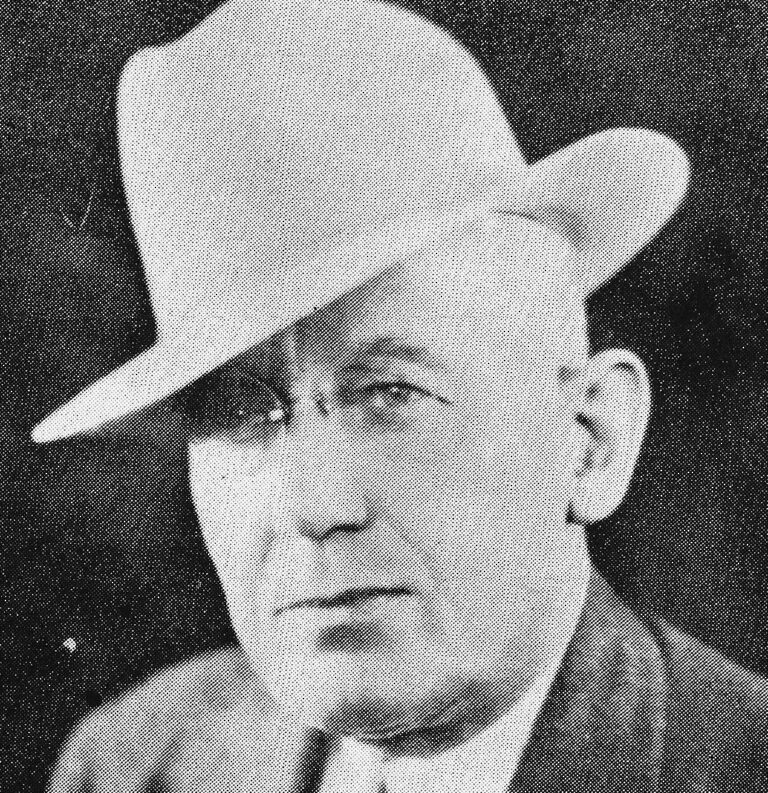


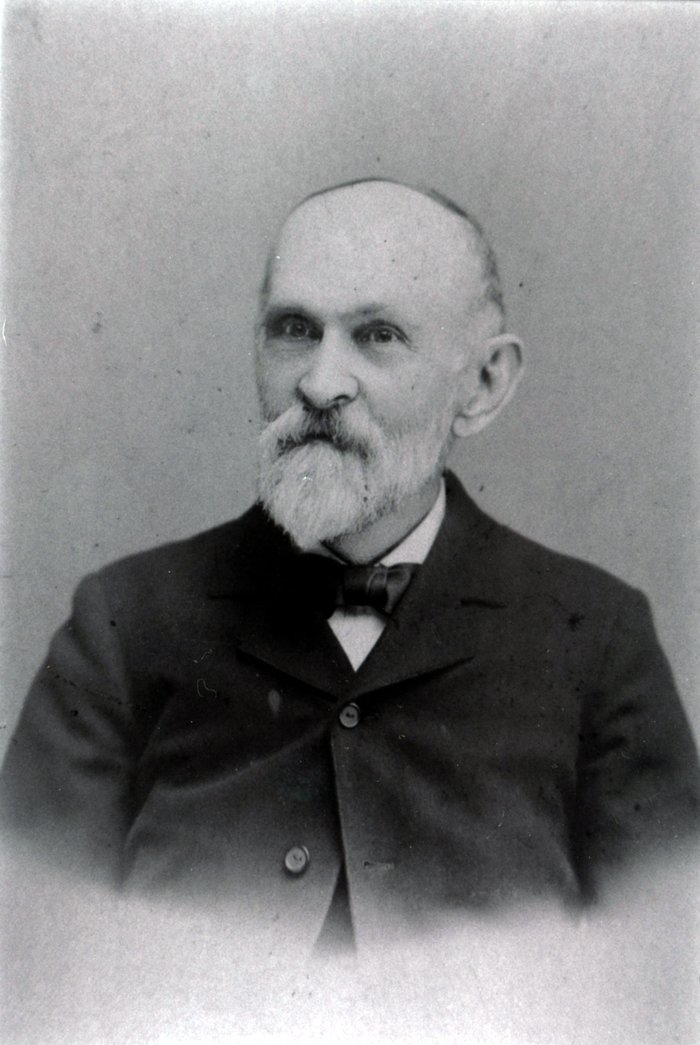


Solomon Matthews was one of the early rugged individualists born during the Industrial Revolution, according to Dave Kenton, author of Images of America: Milford. Yet his life was filled with excitement, a search for gold and a tragedy.
Born on December 13,1826 near New Bedford, Massachusetts, Matthews was the son of Solomon and Sarah Nye Matthews. Matthews had three siblings, but only one lived to adulthood. One who was unnamed likely died at birth in 1818. His brother, Nye Matthews was born in 1820 and died the same year. His sister, Desire, was born in 1822 and died in 1865. Matthews attended Paul Wing Boarding School in Sandwich, Massachusetts, in 1941 and, in 1844, Solomon attended Gorham Seminary, Gorham, Maine.
In 1849, Matthews was living on Belville Street, near Acushnet Avenue in New Bedford. That same year, the Gold Rush struck and Matthews is shown as a member of the Mount Washington Company from Boston, leaving for California on April 14, 1849. He was joined by his cousin, Alfred Nye.
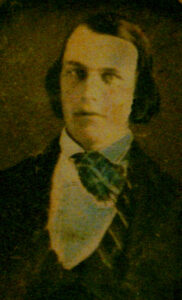
Matthews and Nye are next seen on a census for El Dorado, California, near Placerville. A letter from Nye to his sister dated September 24, 1853, talks about the sailing of the ship Mary Merril that was sailing to New Bedford. This letter places Nye along Weber’s Creek near Placerville and it is likely he mined alongside Matthews in that area. However, the letter does not mention Matthews, as he had returned to Massachusetts.
Matthews appears on the census on September 25, 1850, Matthews was living with his sister and mother in New Bedford, employed as a clerk. A city directory shows Matthews still in New Bedford in 1852. While living in New Bedford, his neighbors, James and Emeline Brown, decided to move to Milford. Matthews decided to follow them to the small town.
Once in Milford, Matthews took up “the stove and tinware business which he carried on for several years,” a city directory of Milford read. A notation in the local paper indicated that Matthews “went to Washington with others to see about voting for Fremont, electors or no electors.”
There are conflicting reports about their marriage. One report is that Matthews “ran off” with Isabella Brown, the 17-year-old daughter of his business partner. In 1859, Matthews would have been 33. Sarah
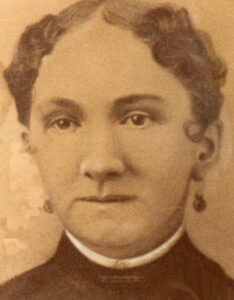
Nye Matthews’ Bible, handed down through Matthews to Cora Matthews Bowers to Roland Bowers, her son, reads “Solomon Matthews and Isabella Brown were married in New York City by Rev. John R. Steward on 27th January 1959.” The Bible was given to Douglas Jones by Roland and was in possession of Harry Matthews, but according to accounts, its location is now unknown.
Before his marriage, Matthews worked in the tin can manufacturing business at 33 North Walnut Street with Brown as his partner, where the Stone and Sage retail store stands today. The business grew rapidly and Matthews created cans used in the growing canning business in the area. It is not clear what the relationship was between Brown and Matthews after the marriage, but he is listed as living on Belville Road in New Bedford in 1859.
However, by the 1860 census, Matthews and his wife were living with Brown in Milford. A Civil War registry reads “Know ye that Solomon Matthews private of Capt. Alex N. Hall, Co. 17th Reg of Delaware enlisted 13th day of July 1864.” The enlistment records show he served 30 days and was discharged August 12, 1864, at Wilmington.
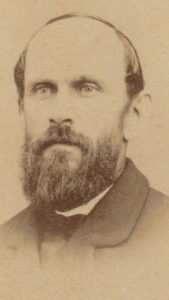
Matthews and Isabella had eight children. Harry E. was born in 1860; Edward Oscar was born in 1862; Eudora E. was born in 1864 but died two years later; Cora E. was born in 1867; Garrett E., known as “Garrie” or “Garry,” was born in 1869; Bessie B. was born in 1870 but died in 1875; Leonard J. was born in 1875 and Solomon Nye was born in 1876. All five of the boys entered the business with their father, becoming machinists or ironworkers.
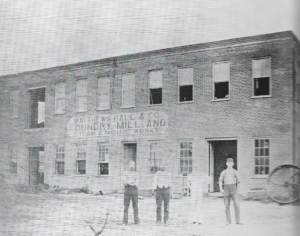
In 1870, Matthews had started his own foundry with a partner, Robert Russell, which stood on Maple Avenue between the present post office and what were then the Caulk warehouses. In 1871, the original foundry burned. Matthews temporarily took up mercantile pursuits until 1873. Yet an article in the Wilmington Daily Commercial published on July 1, 1872, it appears that the foundry business remained Matthews’ passion.
“A town meeting was held at Milford, on Monday evening last, by the Immigration Society, to consider the feasibility of organizing a stock company there to establish a foundry and machine shop with the view to making a specialty of manufacturing the new patent Turbine Water Wheel recently invented by Mr. Charles Mills, and patented and owned by him and Mr. Solomon Matthews,” the article read. “This wheel has been tested thoroughly in Hoffecker’s Woolen Mills there and found to be all that its patentee claims for it. The meeting was well attended, and a committee appointed to solicit the cooperation of the capitalists. The Committee is meeting with much encouragement.”
This seems to be the case as, in 1873, Matthews returned to the foundry business as a senior partner in Matthews, Hall & Co. His partners were James Russell, Cornelius J. Hall and Charles M. Miles.
His father-in-law apparently passed away by 1875 as there is a note that Matthews bought “goods and chattels of James Brown, this 1st day of March 1875 under Execution process.” In 1879, Matthews bought out his partners and became the sole proprietor as well as manager of Matthews Foundry and Machinery Shop.
The Smyrna Times on January 21, 1891, included an article that mentioned Matthews.
“At a meeting of the citizens of Milford in favor of water works, it was moved that the chair appoint a committee of five to investigate the different systems at Dover, Smyrna, etc. and report as to which in their opinion was the best, and also what would be the probable cost of a plant in Milford,” the article read. “The chairman appointed Dr. N. Pratt, Charles Barker, Robt. Russell, Solomon Matthews and Geo. C. Abbott.”
On April 10, 1899, the Peninsula News and Advertiser suggested that Matthews was suffering from Parkinson’s Disease.
“Mr. Matthews remarked to a friend he would rather be dead than suffer the racking of his mind and body,” the article read. “His nervousness at times was very noticeable and he was disposed to keep his own counsel and often was found in deep study.”
On April 13,1899, Matthews committed suicide by hanging himself inside the foundry. The Daily Republic on Friday, April 14, 1899, reported the death.
“Solomon Matthews one of the firm of Matthews and Co. the owners of the large iron foundry here was found this afternoon hanging from a rafter on the second floor of the machine shop,” the article read. “He came to the foundry at 9 o’clock this morning and was not missed until one of the mill boys was sent upstairs and found him. He had made a rope of packing such as is used in engines. Mr. Matthews was wealthy and leaves a large family. He as a prominent Odd Fellow in this state. No cause can be given for his suicide as he had no troubles.”
The Delaware Gazette on Thursday, April 20, 1899, also reported the death. The article, entitled “Found Hanging From a Beam: An Aged and Respected Citizen of Milford Ends His Life by Suicide.”
“Solomon Matthews, aged 74 years, a highly respected citizen of Milford and part owner of the iron foundry of this place, was found by his son, Harry, yesterday afternoon, shortly after dinner, hanging from a beam in the loft of his foundry, which is opposite depot. He was dead,” the article read. “No cause is assigned for the act, as Mr. Matthews was one of the most respected and industrious citizens of the town. He leaves a wife and several children.”
The estate of Matthews was apparently a difficult one. His wife was named Administratrix. On May 9, 1902, a newspaper account discusses Matthews’ estate.
“An important case in the Superior Court of Kent County was postponed until October by motion of Attorney Alexander M. Daly,” the account reads. “It was that of Peter L. Lofland, defendant below, against Isabel Matthews, administratrix of Solomon Matthews, deceased, the postponement was vigorously opposed by W. Watson Harrington for Mrs. Matthews. The court was about to decide the trial must go on when Mr. Daly produced proof that Mr. Lofland was now in New York under medical treatment for a severe illness and could not defend his rights in court.”
The estate appeared to be settled in 1913 when a report, dated May 13, 1913, in the News Journal, reported that the sale of the real estate of Solomon Matthews was sold.
“At the sale of real estate of the late Solomon Matthews, last Saturday, the vacant lot adjoining the foundry opposite the Milford freight depot, was purchased by the L.D. Caulk Co. for $2,000,” the account reads. “The foundry building was apportioned as the dower of Mrs. Isabelle Matthews. The tract bought by the L.D. Caulk Co. will be utilized in connection with the company’s large dental plant here and another large building will be erected there.