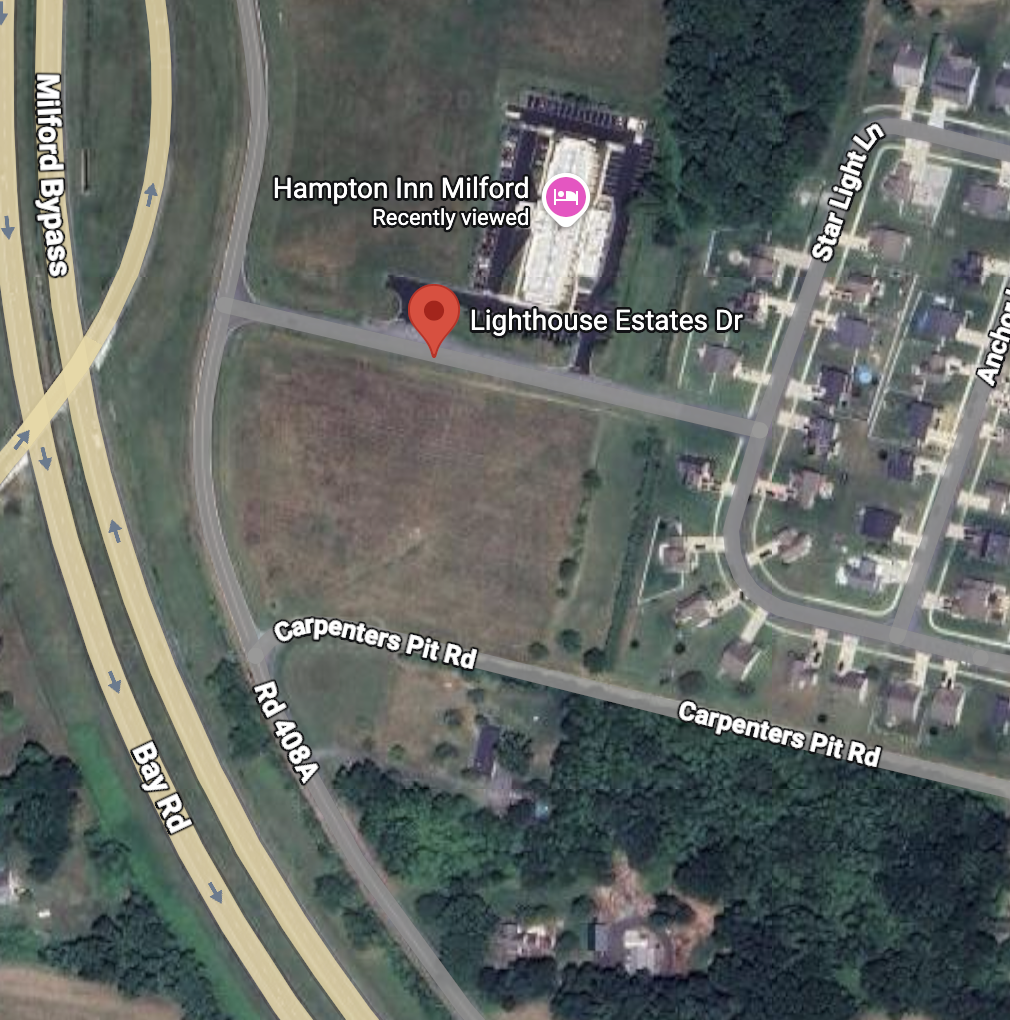

 At a recent Board of Adjustment meeting, two variances requested by Ashley Furniture for a new store they plan to build on Route 1 near the Lighthouse Church. One was to increase signage from a height of 28 feet to 40 feet and the other was to allow their building to be 40.7 feet which was 1.7 feet higher than the permitted 29 feet.
“Part of the reason we need our sign to be higher is that we are trying to make it visible from Route 1,” Edwin Tennefoss of Siteworks Engineering said. “If our sign was only 20 feet high, it would not be seen over the highway. Although this is highway commercial, we are not right on the highway with access only from Carpenter Pit Road.”
Tennefoss also explained that this would not be a super bright sign and would have a net brilliance of 1,250 while 8,000 to 10,000 were permitted under the sign ordinance. The sign would be only 160 square feet which is 30 percent smaller than is permitted in the ordinance. It would also face away from the residential area behind the store, so it should be a nuisance to them. Much of the lamination would be blocked by the store building itself.
During public hearings, several homeowners in Lighthouse Estates expressed concerns.
“I really don’t understand why the sign has to be so high,” Rachel Melton who lives on Starlight Lane. “When I moved here and needed furniture, I just Googled furniture stores, put it in my GPS and went there. There doesn’t seem to be a problem with people finding the church or the hotel. I just don’t want to feel I am coming home every evening and feel like I am entering a shopping district.”
Greg Secora was also concerned with the height of the sign and felt it was not just illumination at night, but also a nuisance during the day.
“We’re surrounded by Leland cypress that are not nearly tall enough to block the view, and we’re going to have this sign sticking up in the middle of it which really destroys the aesthetic,” Secora said. “I think 28 feet is more than generous and I just don’t see why any reasonable jurisdiction would push that to the extreme of 40 feet.”
Julie Morris, who gave an address of Cedar Beach Road, accused the furniture store of threatening residents.
“I find it kind of offensive, insulting and a little threatening for them to say “well, we could have put a bright glowing 10-second changing sign which would have been much more intrusive,” Morris said. “So, we decided to do this. That is a little threatening to say, “oh if you don’t approve this, then we’ll do that.” But that sign would not be nearly as high, and it also wouldn’t be 40 feet. So, if you want to be really great neighbors, that sign wouldn’t be nearly as high.”
Morris’ reference to being good neighbors came from a comment made by Justin Barnes of Ashley Furniture when he spoke in favor of the application.
“Speaking to the concerns of the neighborhood, which we certainly appreciate, we want to be great neighbors and we run a high-class business that is going to add value,” Barnes said. “You mentioned a shopping district or not wanting to look disruptive, if you would look at the code of the town and the 225 square-foot sign, we definitely didn’t want to do that.”
After the public hearing was closed, Joe Wiley made a motion to approve the permit but limit the height of the sign to 35 feet. That would place the sign higher than the parapet on the building but keep it lower than 40 feet. Wiley felt that the height of 35 feet would keep the sign from disturbing the neighborhood but still place it high enough above the highway for drivers to see. The motion was seconded by Ron Rizzo.
The motion passed with a vote of three to zero.
The second request for the height of the building. Morris and Secora spoke again during the public hearing for this request.
“I didn’t hear a reason in the record for the previous motion, I just heard someone say it was a hardship,” Morris said. “Calling something a hardship doesn’t make it one, so I would just like for the record to know what that hardship was. Now we are discussing the building height. I think we need to pause and ask what the actual hardship is here. When you look at the property, there’s nothing about the land itself that prevents compliance.”
Morris continued, wondering what topography or physical constraint made it impossible to meet code.
“Instead, what we are hearing comes down to design choice,” Morris said. “Design choices, ow much parking feels appropriate, how visible the sign should be, how the building should look from the road, how we can improve sales, for the building height. The only impact of denial would be the applicant would have to lower the parapet by 1.7 feet. That is not a hardship when tied to the land. It is a design adjustment and that’s what you guys are put here to do, to listen to he constituents. The residents have already spoken about a sign they don’t want, and this building is even higher by 1.7 feet. Might sound small, but that’s not small. If it was next to you, ow would you feel?”
Morris felt that making the code fit the design of a building should not be permitted as it begins to make the code feel like a suggestion than a requirement.
“Saying “oh, similar relief has been granted so there is precedent,” well, precedent doesn’t replace the requirement to demonstrate real hardship for the property. Each request is supposed to stand on its own, but it does not appear that way.”
Secora agreed with Morris, that it seemed the Board of Adjustment was making concession after concession for the business regardless of code. He also asked about the trees around the property as opposed to a fence. City Planner Rob Pierce stated that the trees were not part of the variance do it could not be discussed.
“I just would like to point out that we are next to a 60-foot hotel, so part of having an entrance that stands out when it’s in a skyline that now has another hotel coming that will presumably be allowed to max out a higher height code,” Barnes said. “They are allowed to do that within code. WE didn’t want our business to get lost in that. So, that would be the hardship. So, a one foot eight-inch concession next to a 60-foot building that has a 40-foot entrance, that was the reason we are looking for that aesthetically looking skyline. There is a demonstrable hardship there.”
Pierce confirmed that Barnes was correct.
“The C3 highway commercial says height of buildings cannot exceed 35 feet with the following exception, a motel, a hotel or aquarium may be erected to a height not exceeding 60 feet,” Pierce said. “So, if a hotel, motel or aquarium were to be situated on any of the properties in a highway commercial zone, they could go up to 60-feet in height. I can’t confirm or deny the height of the Hampton Inn. I don’t have those measurements with me, but I just wanted to point that out. That is the code.”
Joe Wiley again made a motion to approve the height variance. Ron Mascola seconded the motion, and it passed by a vote of three to zero.