




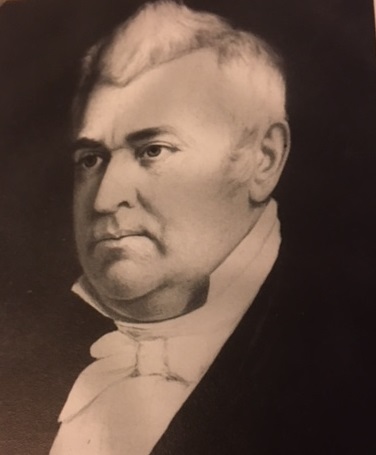

 Although many people are aware that Delaware was the home of several state governors, few are aware that a man who grew up in the Parson Thorne Mansion became the United States Secretary of State under President Zachary Taylor. John M. Clayton not only served in that capacity, but he was also famous for signing the Clayton-Bulwer treaty that was a precursor to the United States constructing the Panama Canal.
Born in Dagsboro, Delaware, on July 24, 1796, John Middleton Clayton was the son of Sara Middleton and James Clayton. His uncle, Dr. Joshua Clayton was Governor of Delaware and a cousin, Thomas Clayton a prominent lawyer, U. S. Senator and jurist.
John attended schools in Berlin, Maryland, but accounts are that he ran away from the boarding school to Milford after his parents moved there. The family resided in the Parson Thorne Mansion and John was then sent to a boarding school in Lewes. Again, he was unhappy and eventually completed his early schooling in Milford. In 1815, John graduated from Yale University with the highest honors of his class, and he was a member of the Brothers in Unity, a literary and debate society. He studied law at Litchfield Law School, apprenticed in his cousin, Thomas’, law office, was admitted to the bar and opened a practice in Dover in 1819.
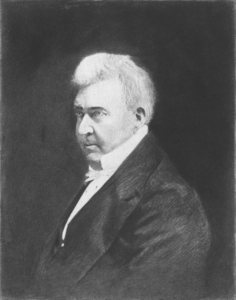
Described as tall, graceful and handsome with sharp gray eyes and dark eyebrows, which contrasted with his hair that had turned white at a young age, John was imposing. He was known to argue cases eloquently and successfully. In his later years, even those who disagreed with him politically found his methods fascinating and his arguments so cogent that his opponents would forget their party ties. His power with the people was marvelously strong as well.
As an attorney, John dissected, most thoroughly, every case that engaged his attention and made his client’s cause his own. The influence of John Clayton with juries was very extraordinary, reports said. The late Honorable James A. Byard was quoted by the Wilmingtonian in 1882 that “he did not believe that a jury lawyer superior to Mr. Clayton had ever lived in this country.”
John’s father died soon after he entered his law practice and he became the sole supporter of his mother, two sisters and brother. He walked from Milford to Dover to attend to their needs. John’s father died in debt, and, in those days, families were required to resolve those debts. James was an enslaver as in 1803, his tax assessments listed one negro man, 25 years; one negro boy, aged 16; one negro woman and two children. At the time of his death, John’s father did not have a will, but there are records that he was still an enslaver at the time of his death.
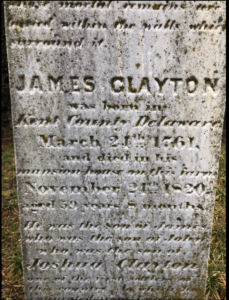 The Clayton family, including John’s father, James; sister, Elizabeth and his wife, Sarah are buried in the Parson Thorne Mansion cemetery along with the grave of Parson Sydenham Thorne who the mansion is named after. Colonel Benjamin Potter purchased the mansion property at a sheriff’s sale after the death of John’s father.
Despite being raised by an enslaver, John was opposed to slavery, something he remained opposed to his entire life. At the time of his father’s death, because James died in debt, any slaves he owned were scheduled to be sold at sheriff’s auction. John purchased the enslaved that his father owned with the specific understanding that they would be emancipated as soon as he repaid the money he borrowed for the purchase. There are records of manumission of those slaves in the Delaware Public Archives.
In 1822, with his law practice growing, John married Sally Ann Fisher, the granddaughter of former governor George Truitt. They lived in Camden for a few months before moving into Henry M. Ridgely’s home on The Green in Dover. The couple had two sons, James Fisher, born July 11, 1823, and Charles Middleton McClymont, born February 3, 1825. Tragically, Sally Ann died two weeks after the birth of Charles. John never remarried and raised his sons on his own. John called the loss of his wife the greatest loss he had ever experienced. After 20 years, he wrote to his friend, Joseph Comegys.
“I am still very unwell and most accountably depressed in spirits and melancholy,” John wrote. “I have lately dreamed again of seeing my wife. Time will not do its office. Righteous years are but a day. I am unfit to go to Kent or anywhere else. I often feel when I think of my wife that I wish I could lay down and die.”
His only solace was work and he threw himself into politics, having been elected to the Delaware legislature.
In 1824, John was elected to the Delaware House of Representatives and appointed Delaware Secretary of State in 1826. He served in that capacity until 1828, quickly becoming a leader of the Adams faction which eventually became the Whig party. John was also a driving force at the Delaware Constitutional convention, helping to develop the Delaware Constitution of 1831.
At the age of 33, John became the youngest member of the United States Senate when he was elected in 1829. While serving, he became a close ally of Henry Clay. Six years later, he declined re-election, but the General Assembly elected him despite his request against it, leading John to resign. It was during this term that John set himself apart in the U.S. Senate during the Foot Resolution. Senator Samuel Augustus Foot of Connecticut proposed limiting the sale of western public lands to allow land already on the market to be sold first. Although this seemed more like an administrative decision, it sparked a heated debate among two Senators that eventually went far beyond the sale of western lands and delved into nullification, states’ rights, slavery and the power of the federal government.
 In 1832, South Carolina declared federal tariffs unconstitutional and threatened to secede from the United States. President Andrew Jackson was strongly opposed and threatened military action. When the dispute over the sale of public lands exploded in the Senate in 1830, Robert Y. Hayne of South Carolina and Daniel Webster of Massachusetts clashed over both nullification and slavery. Hayne accused abolitionists of “systematically working to seduce the slaves of the South from their masters.”
Webster’s response was repeated often over the next decade, “Liberty and Union, now and forever, one and inseparable.”
Several weeks later, John attacked the heart of the South Carolina nullification doctrine as he believed that would lead to a civil war over slavery.
“The storm of civil war will howl fearfully through the land, from the Atlantic border to the wildest recesses of the West, covering with desolation every field which has been crowned with verdure by the culture of freemen, and now resounding with echoes of our happiness and industry,” he is quoted as saying.
His speech was wildly circulated across the country and made him a rising star in politics.
In 1831, John launched an investigation into the United States Postal Service, demanding a full inquiry into executive abuses and partisan removals. The investigation and ensuing political battles lasted until 1836. The investigation found systematic corruption and mismanagement with post office funds used for political patronage rather than public service. The abuses found led to the overhaul and restructuring of how the department operated financially and administratively as well as increased oversight.
While in the Senate, John favored the extension of the charter for the Second Bank of the United States during the Bank War when President Andrew Jackson controversially vetoed the charter of the bank in 1832. After winning the election that year, President Jackson bypassed Congress by withdrawing federal funds from the bank and depositing them in selected state-chartered banks, leading to a severe credit shortage, business downturns and, ultimately, the expiration of the bank’s charter in 1836. This left the country without a centralized bank for decades.
John served on the Military Affairs, Militia, District of Columbia and Post Office committees, but his highest-ranking position was as the Chair of the Judiciary Committee in the 23rd and 24th Congress.
After resigning from the Senate, John returned to Delaware where he was appointed Chief Justice of the Delaware Superior Court, replacing his cousin, Thomas who had been elected to John’s vacant United States Senate seat. John served in this capacity from January 1837 to September 1839 when he resigned to support the presidential candidacy of William Henry Harrison. After retiring, he was involved in important legal cases, including the Delaware vs. New Jersey controversy over Pea Patch Island.
In 1842, the Clayton family moved to the Read House in New Castle until he purchased land.
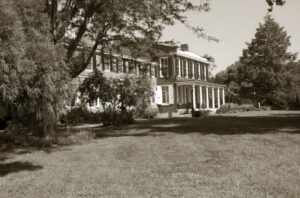
In 1844, he moved into a new mansion built on the land which he called Buena Vista in honor of one of his hero’s victories beyond the Rio Grande. He created an estate that stands today. That same year, he was named as a candidate for vice-president under Henry Clay but declined the nomination. Many in Delaware were upset that he declined the nomination based on a quote from The Delaware State Journal which reads “no man stands higher in our affections and esteem than our own distinguished fellow citizen, John M. Clayton.”
John had visions of becoming an agriculturalist, tilling the land himself and setting his mind to creating a working farm. He lived at Buena Vista and, at one time, told Timothy Childs that letters “directed to me by mail do not arrive with much expedition” at Buena Vista.
During this period, manifest destiny was a widely held belief as settlers began to expand westward across the country. From 1846 to 1848, the Mexican American War raged and John, who had been elected to the United States Senate in 1845, opposed the annexation of Texas. He did support the war after it began, however.
In 1848, with the Treaty of Guadalupe Hidalgo, Mexico ceded parts of what is now Texas to the United States. This led to a debate on whether slavery should be allowed in new territories as it was understood they would later become states. The Wilmot Proviso in 1848 also attempted to resolve the question of slavery by banning it outright in the new Mexican territories.
Oregon had become a territory in 1848 which meant the United States now had land south of the 49th parallel line. When established, this territory included what would become Oregon, Washington, Idaho along with parts of Montana and Wyoming.
The Clayton Compromise, headed by John, was a plan created in 1848 by a United States Senate committee. Clayton attempted to create a committee of eight, equally divided by region and party, to consider questions relating to the extension of slavery. The goal was to recognize Oregon’s existing anti-slavery laws while prohibiting the territorial legislatures of New Mexico and California from enacting laws that allowed slavery. The committee would also provide appeal of all slavery cases from the territories in front of the United States Supreme Court.
The Clayton Compromise passed the Senate on July 27, 1848, but was tabled by the United States House of Representatives due to the efforts of the Southern Whig party, led by future Confederacy Vice-President Alexander H. Stephens, who felt that the compromise would completely surrender rights to the territories. It was Stephens’ belief that the United States Supreme Court would rule against slavery in the territories.
The 1850 Compromise directly borrowed language from the Clayton Compromise, assigning adjudication of the slavery issue to the courts. It also added California as a free state and allowed popular sovereignty to decide the slavery issue in the Mexican territories. The Compromise also created stricter fugitive slave acts as well as abolishing the slave trade in Washington DC. That same language was used in the Kansas Nebraska Act of 1854, further indicating the power John Clayton held when it came to slavery in the United States.
Tragically, John’s youngest son, Charles, died in Havana on January 26, 1849, of pulmonary consumption at the age of 24. A newspaper account of his death reads “he was highly accomplished and traveled greatly in Europe.”
“The youngest son, who died in his twenty-fourth year, was of great worth, both morally and intellectually,” The Wilmingtonian wrote after John’s death in 1882. “To him was the father especially inclined, as he fondly hoped his mantle would fall on his idolized boy.”
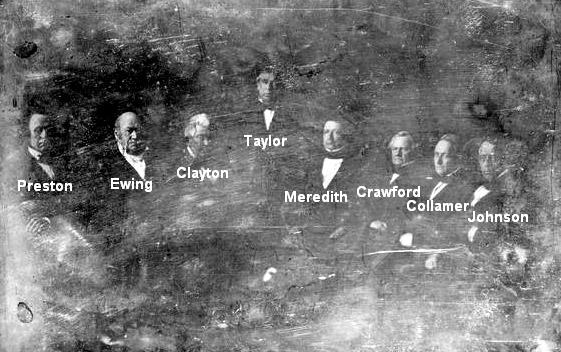
John only served four years in the Senate as he was chosen to serve as United States Secretary of State. Kentucky Governor John J. Crittenden recommended John for the position. Initially, President Zachary Taylor chose Crittenden for the position, but Crittenden chose to remain governor. Clayton assisted the president with choosing his cabinet which included a newly formed Department of the Interior, led by Thomas Ewing.
John was sworn into that position on March 8, 1849, under President Taylor. While serving in that capacity, he negotiated the Clayton-Bulwer Treaty of 1850 with British Prime Minister, Sir Henry Bulwer-Lytton. This treaty guaranteed neutrality and encouragement of lines of travel across the Isthmus of Panam, laying the groundwork for the eventual construction of the Panama Canal.
The initial plan was to construct the canal in the Republic of Nicaragua, but it never passed the planning stage. It was eventually constructed in Panama.
As the Secretary of State, John was extremely nationalistic and an ardent advocate of commercial expansion. His strict interpretation of international law led to crises with Spain, Portugal and France.
Unfortunately, John’s service as Secretary of State was short-lived. John resigned his position as Secretary of State in a letter to President Taylor, dated June 18, 1850.
“During the last sixteen months, I have been able to devote not a single day, scarcely a single hour to my own private affairs, the derangement of which resulting from this neglect, now absolutely requires my attention. This is the reason, and the true reason, for my resignation; and I state it because I do not wish to leave room for any possible inference, that I am dissatisfied with the measures of your administration. I desire to add that the uniform kindness and confidence, which you have exhibited toward me, while engaged in the arduous duties of my laborious office, have merited and now receive my most grateful acknowledgements.”
His resignation was a mere few weeks before the death of President Taylor.
Tragedy struck again when John’s oldest son, James, died on March 4, 1851. His death notice reads “James F. Clayton the only son of the Honorable John M. Clayton and a young man of promise, died Tuesday night in New Castle after a short illness.”
Although John had full intentions to retire to Buena Vista after serving as Secretary of State, he was shocked when General Lewis Cass attacked the Clayton-Bulwer Treaty, accusing John of compromising the government. Cass believed that Article I of the treaty compromised American sovereignty and hindered expansion in Central America.
John knew that the proper place to address this criticism was in the Senate and, in 1853, for the fourth time, he was elected and faced his accusers. John came out of the discussion with his “reputation unsullied – yea an increased luster had been given his fair name” the Wilmingtonian wrote on September 23, 1882.
Former Marshall Henry McMullen was a neighbor of John’s in his later years, and he remembered his simplicity of manner as well as his thoughtful care for those with whom he associated. Those traits endeared him to fellow citizens.
“He was the grandest, noblest form of manhood,” McMullen was quoted as saying. “That neither before nor since have I met a man who possessed so many of the elements of the nobility as my unassuming neighbor.”
Close to his nephew, James Clayton Douglass, a purser in the U.S. Navy, John offered the Buena Vista farm to him and his young wife, Ellen Sinclair, who he had marred in 1849.
“I feel some apprehension that he may decline farming, I shall offer him every inducement to stay him for the rest of his life,” John wrote to a friend.
On February 12, 1853, James Douglass signed the deed to Buena Vista and resigned his commission in the Navy. Constance Margaret Douglass, born March 20, 1852, was baptized in New Castle with the Honorable James M. Clayton named as her sponsor. The couple had a son, Clayton Douglass, born April 26, 1854. Seven months later, Ellen died, leaving James with two small children.
John remained at Buena Vista with James after the death of his wife as James often travelled to Philadelphia with his children to visit his mother-in-law. John was a prolific writer and corresponded with many people while keeping Buena Vista running in his nephew’s absence.
“I am a modest man; though I know you always tell me my modesty has not got about much. I am industrious man – at least I am not a lazy one (‘though by your smiling you seem to say so’) – for I go to bed at 12 and rise at 8, and any man who gets up before that hour will (according to an old friend of mine in whose opinions I have great confidence) take the advantage,” he wrote to one colleague.
His health began to fail, and he wrote to Charles I. duPont that he was having “attacks of a painful nature in the breast.”
John died in Dover at the Fisher/Comegys/Terry House, then owned by his nephew, Joseph P. Comegys, on The Green on November 9, 1856. Behind the home was a yew tree given to him from the British ambassador, Sir Henry Bulwer. He is buried in the Old Presbyterian Cemetery. Considered one of the most skilled orators and debaters in the Senate, John was known to be accessible with a genial disposition and was a brilliant conversationalist.
After his uncle’s death, James continued to farm Buena Vista but found the distance from civilization difficult with two young children. When both his children came down with whooping cough, he wrote to a friend that he was closing the house and moving to Wilmington or Philadelphia.
Clayton Douglass died of typhoid fever at the age of 18 in 1872. James’ daughter, who was known as Maggie, remained by her father’s side running Buena Vista until his death three years later. She inherited Buena Vista at the age of 23 and married Francis Nixon Buck in 1884. Eventually, Buena Vista was sold to a member of the duPont family who kept it until 1965 when it was sold to the State of Delaware by then Governor Clayton Douglass Buck.

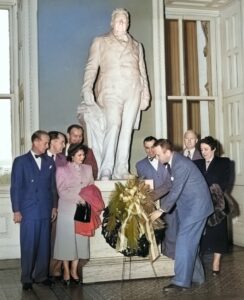
In his honor, the University of Delaware named Clayton Hall for John M. Clayton. Clayton, Delaware; Clayton, New York; Clayton, North Carolina; as well as Clayton County, Iowa, were named for John Clayton. In 1934, a statue of John Clayton was donated by the state to the National Statuary Hall Collection where he stands today with a statue of Caesar Rodney. When the statue of John was dedicated, Congressman Robert G. Houston gave the following description of him.
“Physically, he was described as a remarkably handsome man, 6 feet 1½ inches tall, well proportioned, impressive in appearance, a splendid head, a benign countenance which bespoke the greatness of his soul, as his portraits reveal.”
The Clayton-Bulwer treaty was eventually replaced by the Hay-Pauncefote Treaty on November 18, 1901, and gave the United States the exclusive right to build, manage, and fortify a canal in Central America without British involvement. While the Hay-Pauncefote Treaty formally nullified the 1850 Clayton-Bulwer Treaty, it carried over and codified the principle of neutralization outlined in Article VIII of the earlier agreement. Both treaties required the canal to remain open and free to vessels of all nations without discrimination