




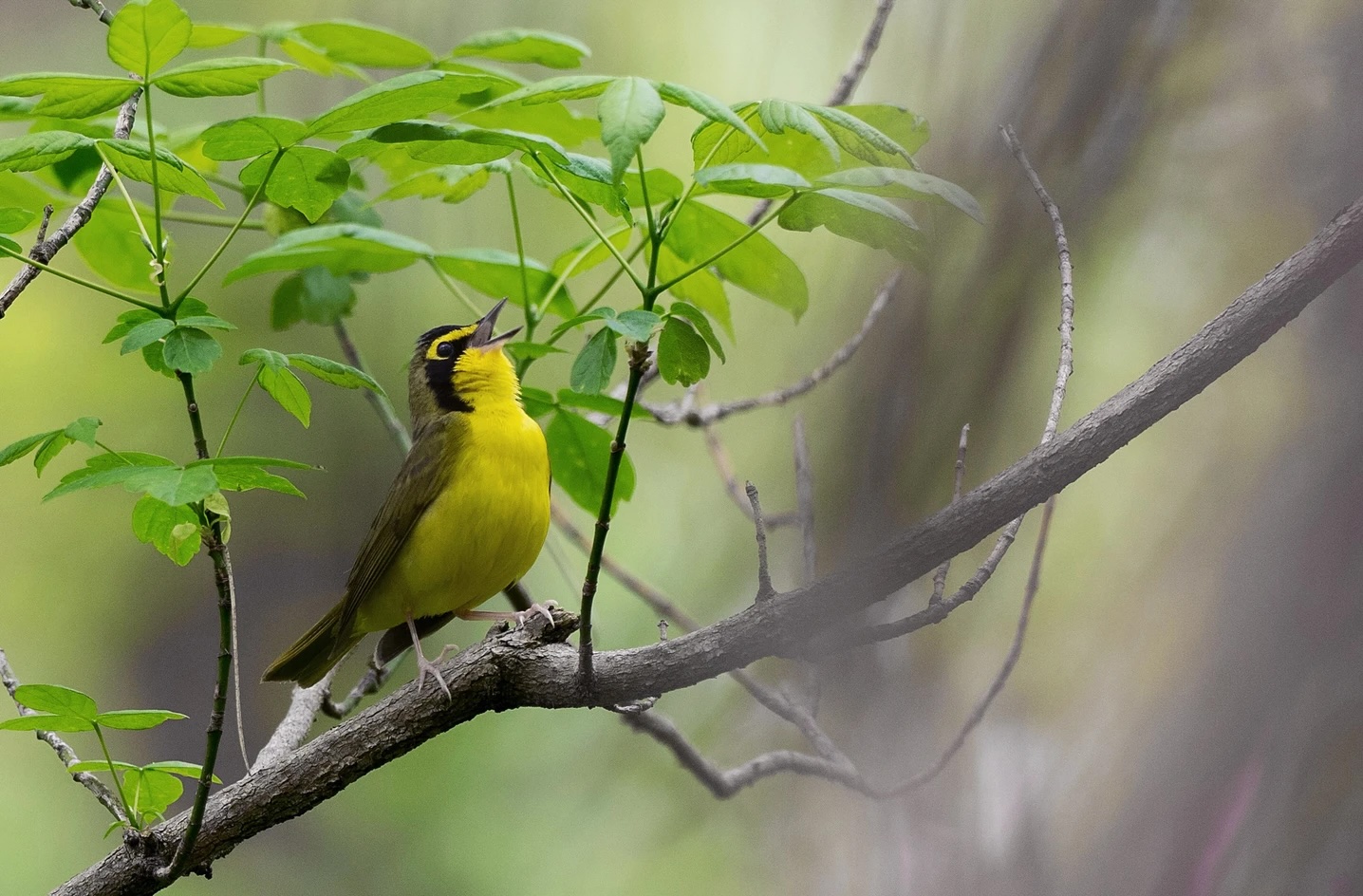

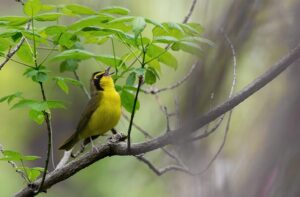
If you live near a forest or shaded area with water, you may have seen a Kentucky warbler, scientific name geothlypis Formosa, around your yard. This secretive songbird often blends into the undergrowth despite its vivid colors.
The male bird has an olive-green back with a bright yellow underside, black sideburns and crown. The female is similar in coloring. They are often confused with the Common yellowthroat warbler which does not have the black spectacles the Kentucky warbler has. The wings are rounded and the tail is rounded with a square tip. They grow to about five inches and weigh about a half ounce.
Kentucky warblers forage low in dense vegetation, flipping leaves to search for food. Their diet consists of insects, spiders and caterpillars.
Their loud “churree-curree-curree” echoes through woods in late spring. The sound is also described as a loud, penetrating rich “tur-dle, tur-dle, tur-dle, reminiscent of the song of the Carolina wren Kentucky warblers migrate at night, leaving the area in mid-August.
Nests are built near the ground and may be found concealed in tall herbs or leaf litter at the edge of the woods. Both sexes build the next which is a bulky, open cup of leaves with a core of weeds, grass stems, lined with rootlets and hair. During breeding, males are persistent singers to ward off predators.
The birds lay between three and six white eggs with reddish spots. Eggs are incubated by the female for 12 to 13 days. It is not unusual to find the eggs of brown-headed cowbirds in the same nest. Nestlings are fed by the female, rarely the male, and the young Kentucky warbler leaves the next 8 to 10 days after hatching. Both the male and female continue to feed the fledglings for up to 17 days.
Kentucky warblers are widespread but rarely breed in Delaware. Reclusive, they thrive in thick, leafy cover. They spend much of their time on the floor of forests and woods with the ability to completely vanish into dense underbrush almost immediately after being seen.
The lifespan of a Kentucky warbler is between four and six years. Predators include snakes, raccoons, blue jays and opossums.
Next, learn more about the yellow-throated warbler.