



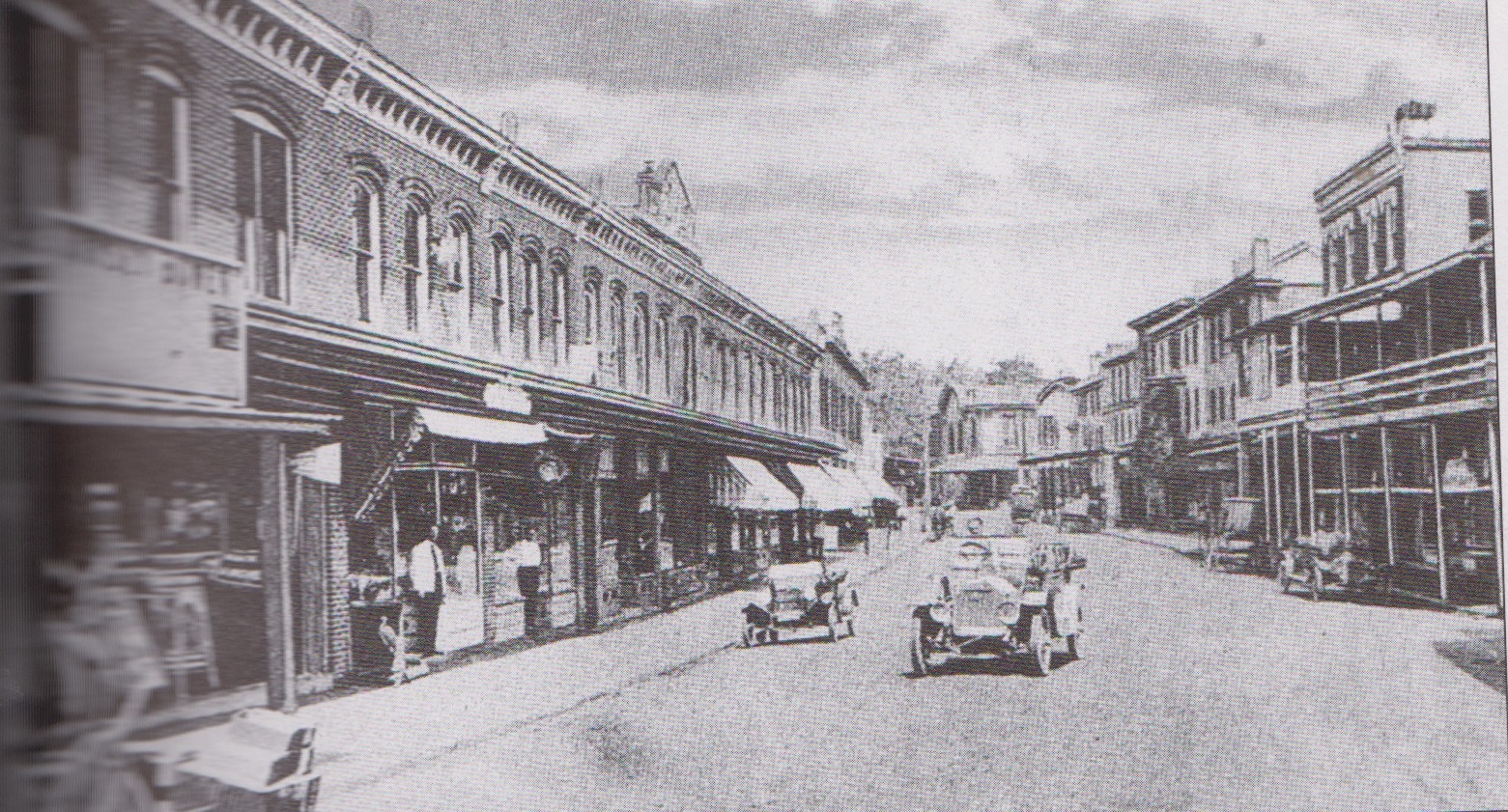

Once a thriving business section in downtown Milford, the Jump Block no longer exists, demolished in 1995. The block extended from the Mispillion River to the alley next to what is now Milford Antiques and Friends.
The block was constructed by John William Jump, born in Kent County on March 2, 1831. There is not much information on John William other than his parents were William L. and Ann Moore Jump. Ann was John William’s father’s third wife, and he had children by all three.
William’s first wife was Sally Murphy and they had four children – Levi, born in 1825; William L. born in 1827; Anna born in 1842 but died in 1853; and Catherine E. After Sally, William married Sarah Ann Stuart and they had five children – Albert born in 1839; Nancy born in 1842; Samuel Johnson born in 1846 and James Lister born in 1846. Sarah Ann died in 1873.
After Sarah Ann’s death, William married Ann Moore and they had three children – John William born in 1831; Sarah Ann born in 1833 and Narcissa E. born in 1835. Both Sarah Ann and Narcissa died young. Both died in 1876, Sarah Ann at 43 and Narcissa at 41. There is no information on why the sisters died the same year, but there was a smallpox epidemic in Delaware in 1876, so that could have been the cause.
The 1850 census shows the Jump family living in Milford William is listed as a farmer and he is married to Sarah Ann. John William is 20 and listed as a farmer as well. Narcissa was 15, Albert 10; Nancy 8; Samuel 6; Isaiah, 3; and James, 1. The younger children may have been the grandchildren of William’s older children. Also listed with the family were Carolyn Clarkson, 12 and Joseph Williams, 14, both listed as black.
In 1863, John William married Lydia Ann Chase and they had four children – John, born in 1866; John Clarence, born in 1869, Frank Leslie born in 1871 and Herbert Chase Jump Sr. born in 1878. The first John died at the age of three on August 18, 1860, at the age of three.
Before their marriage, it appears that Lydia owned a millinery business in Georgetown, which she gave up when she married John William.
“Mrs. Lydia C. Jump, formerly Miss Lydia C. Chase, having retired from the Millinery Business in Georgetown, gives notice that her books are now in the hands of Mr. G. A. Rogers, who will attend to all such accounts as remain unpaid,” an account in a local paper read in October 1863. “All persons indebted on said books are requested to call the Georgetown Post Office and settle. All accounts not settled by the first of November, will be given to an officer in Milford for collection.”
This notice gives a look into the future as to Lydia’s business sense.
Information on John William’s businesses appears for the first time in Milford, Delaware and the Milford Area After 1776 by E. Millis Hurley and E. Dallas Hitchens.

“At the lower end of the west side of Walnut, the first lot going north from the river had been acquired by William Stapleford by 1853,” the account reads. “In 1868, it belonged to W. Gray. The second lot going north belonged to Isaac Steward in 1853. IN 1868, it was still owned by Steward. A third had been established by J.W. Jump. This accounts for seven of the ten lots. It is possible that the other three were owned by Jump and later came to be known as the Jump block.”
The 1870 census shows the Jump family living in Milford. John is 39 and is listed as a merchant with Lydia 28 listed as “keeping house.” John Clarence is the only child listed and he is eight months old. Also listed with the family is William Willoughby, a clerk; Sarah Vann, 14; Anna Long, 18; and Sarah Spanish, 20. Sarah Vann was listed as a servant while Anna Long and Sarah Spanish were domestics. All three are noted as black.
John William had a near-death experience in January 1879. According to report in the Smyrna Times stated that on New Year’s Day just after a train had left Dover heading north, Joseph H. Primrose discovered John William caught on the car steps.
“Primrose discovered John W. Jump, a merchant of Milford, swinging from the car steps, unable to get in (the speed all the time increasing) and if letting go in danger of a terrible accident,” the report read. “Though running considerable risk, he grabbed him by the coat collar with one hand, holding on to an iron bar with the other. Jump’s weight and partial helplessness made it too great a task for one man. Primrose held on, however, until Jump and his coat began to separate.”
The account continued that just as the coat began to pull off, assistance arrived to save John William from certain death under the train car wheels.
“He was bound for Middletown and thought Dover was Middletown and that the cars were carrying him beyond his place of destination,” the reports said. “It was the more singular he should have made the mistake for a moment before he had been off the cars walking about the depot, but after his rescue affirmed, and wanted to bet he hadn’t.”
The 1880 census showed the Jump family still living in Milford with John William listed as a merchant. He was 49 and Lydia 38. There were now three children – John Clarence, 11; Frank Leslie, 9; and Herbert Chase, 2. A child, Rose L., who was listed as 8 months old, is also counted with the family, but she is not named as a daughter. It may have been one of John William’s many nieces or nephews visiting at the time.
A notation in the Delaware Gazette and state Journal on November 4, 1880, makes mention of John William’s businesses.
“John W. Jump is putting up, refitting and remodeling another new block of stores on Walnut Street,” the account reads.
Another account in Industries of Delaware by Richard Edwards in 1880 speaks highly of John William.
“Mr. Jump is one of the foremost men of Milford, both as a substantial citizen and an enterprising merchant. For about a quarter of a century, he has been carrying on business here, and is one of the most widely known men in this section of the country,” Edwards wrote. “His store is about 25 by 50 feet in size, and he keeps a large assortment of dry goods, notions, boots, shoes, hats, caps, queensware and groceries, which he disposes of on very liberal terms to his many customers in town and country. In the course of a year, he handles large quantitates of grain and produce, which he takes in exchange for goods. A native of Milford, he has always been closely identified with every movement calculated to promote its interests. He is a shrewd, careful, upright businessman and an active, influential citizen.”
Tragedy struck the family again on July 9, 1883, when Frank Leslie passed away at the age of 12. The cause of death was listed as ileo-colitis by Dr. William Marshall, MD in Milford.
The Sun reported on January 9, 1898, that John William was making major improvements to his businesses.
“John W. Jump is very much improving his property on Walnut Street, occupied by W. H. Davis and Mrs. Annie Jump, by painting them and making one storeroom out of the two recently occupied by Mr. Fred Arnold and Mrs. Leon,” the account read. “When finished it will be occupied by Cecil Mulliken and brother of Baltimore, Maryland, as a jobbing house for drugs.”
 The town narrowly escaped destruction by fire. At about 9:30 PM, the stables belonging to the Central Hotel, located on the northern bank of the Mispillion River, caught fire. The hotel’s chief clerk, Harry Satterfield, discovered the fire and citizens responded to assist. Horses and carriages were removed without injury.
“The burned building is located not 50 feet from the very business center and less than 20 feet from another stable, owned by Mrs. Ruth Carlisle, which is immediately adjoining out buildings attached in the rear of Jump’s Block,” The News Journal reported on January 27, 1891. “The crowd realized the danger of the stable owned by Mrs. Carlisle and as soon as possible were trying to keep it wet. The excessive heat, however, got the best of them at one time, and it was only the desperate efforts of the men that it did not get beyond their control. They managed to save it, thought the roof was burned off in many places.”
The fire also burned a small stable across the driveway from the stable, threatened the liquor room at the Central Hotel. Luckily there was no wind and men set up two lines with buckets to reach the river, keeping the building roof wet. Flying sparks still ignited roofs on several buildings but did not ignite as the community was able to keep the roof wet. The damage was estimated at around $3,500, approximately $130,000 today. There was an insurance policy worth $2,000, approximately $73,000 today.
“It appears it was only an act of Providence coupled with the tireless efforts of the 300 men who fought the flames that saved the town,” the news account continued. “Nearly all the occupants of the Jump Block moved their goods out into the street. The origin of the fire is unknown. The great need of water works, and fire apparatus is now manifest in every citizen.”
In September that same year, fire again impacted the town when James Sapp’s stable and carriage house along with Major Theodore Townsend’s stable were destroyed by fire. John William’s residence was slightly burned and a horse owned by Sapp perished. Sapp’s losses were $500, just under $20,000 today while Townsend’s losses were $600, just under $25,000 today.
On July 5, 1904, John William passed away. On his death certificate, he is listed as a “retired merchant.” Dr. William Marshall MD noted that his cause of death was “paralysis.” His wife, Lydia, took control of the family business.
Fire again impacted the Jump Block on Tuesday, January 16.
“One of the most disastrous fires in the history of Milford occurred about midnight Tuesday night when four business houses located in what was known as the Jump Block were destroyed together with their contents, entailing a loss estimated at between $10,000 and $15,000 ($ 350,000 to $550,000 today) which is partially covered by insurance,” Smyrna Times reported on January 17. “The buildings destroyed were as follows: No. 22 North Walnut Street – John F. Houseman’s grocery store; No. 24 North Walnut Street – Harry Jackson’s restaurant and confectionary store; No. 20 North Walnut Street – Miss Minnie W. Sipple’s millinery store; No. 28 North Walnut Street – William Warren’s Jewelry Store.”
The report stated that the origin of the fire was not known but was thought to have started in the kitchen of the restaurant.
“As Walnut Street is the chief business thoroughfare of the town, extending through both north and south Milford and the buildings on that street nearly all join each other in the heart of the town, the situation was alarming, and had it not been for the good work of the firemen, under the direction of Chief William Pierce, and the efficiency of the new water supply which gave a pressure of 125 pounds, the entire business section would undoubtedly have been obliterated.”
The account stated that all the buildings burnt were of frame which added to the rapid spread of the fire. The weather was also bitter cold, leading to difficulty for the firemen. Water froze in some of the hose and it froze wherever it fell.
“The mercury was down to eight degrees below zero,” the report continued. “The fire equipment on the ground, which comprises the entire departments, included three hose companies and a hook and ladder company, and all of the equipment used to good effect. The blaze was discovered shortly before 12 o’clock and the alarm, which was immediately turned in, brought out not only the firemen and their apparatus, but also hundreds of residents who hastened to the fire scene and many gave valuable assistance to the firemen.”
The report stated that the buildings were so badly damaged, they could not be rebuilt. They would be torn down in the spring to make room for three modern stores which Lydia planned to build.
The replacements did not come quickly, however. In November 1912, The Morning News reported that occupants of old stores remaining in the old section would not vacate which meant delaying the demolition and rebuilding. The fire did encourage other block owners to consider rebuilding. The report said that Dr. R.Y. Watson, owner of the Watson Block which adjoined the Jump Block, would demolish the current buildings and replace them with brick.
Further delays occurred when a boundary dispute over the Jump Block developed in 1913. Old deeds surfaced that required Lydia to negotiate with Temple Lodge No. 9, A.F.A.M. for the purchase of a small plot of land at the rear of one of Jump Block lots. Once this was resolved, Lydia hoped to erect “one of the finest moving picture theatres on this Peninsula,” the account read.
The issue was resolved in July 1913 when Lydia reached an agreement with the Temple Lodge and Robert Y. Watson.
Apparently, construction was completed on the new buildings in the Jump Block by July 1914. The News Journal announced that William Murphy removed his green fruit and vegetable store from the Watson Block to the Jump Block while Brown B. Topping moved his jewelry store from the old Jump Block to the new brick store constructed for him by Lydia.

In 1916, reports were that two more sections of the Jump Block were vacated and that Lydia planned to tear them down and build brick stores.
Herbert Chase Jump married Edith Wiley Ball on Saturday, June 21, 1919. He took and his brother, John C., took over management of the Jump Block as well as the family’s other business interests from his mother when she retired. Lydia passed away on May 2, 1927, at the age of 84.
“Reputed to be one of the wealthiest residents in lower Delaware, Lydia Jump died Saturday night at her home on North Second Street in Milford,” her obituary read. “Two sons, John and Herbert Jump, survive her. She was noted for her keen business ability and hse built the block of brick stores on Walnut Street here, these properties being valued at $100,000 (over $3 million today).”
Lydia’s death certificate lists her cause of death as chronic nephritises and she is buried in Odd Fellow’s Cemetery.
On June 29, 2929, Herbert, who was reported to be a deaf-mute, was struck by a vehicle while crossing the street. The driver of the car blew the horn to warn him, but because Harold could not hear it, was unaware of the warning. Herbert suffered a broken leg and face lacerations.
John C. Jump passed away from pneumonia in 1944. His obituary mentions he was the owner of the Jump Block and had worked at the Milford Chronicle for many years as a printer. It was also mentioned that he was a “crack” baseball player and fan. John C. had no children.
On June 28, 1946, Herbert’s daughter, Josephine Constance Jump was killed in a car accident near Fort Saulisbury at the age of 16. Josephine was thrown from the car as it left the roadway at a high rate of speed, causing her to break her neck and fracture her skull. The driver, Russell K. Griffith, 18, sustained possible skull fractures and severe scalp lacerations, but he survived the crash. Josepine was survived by her parents and her brother, Herbert J. Jump Jr. who served in the South Pacific and was then a clerk in a clothing store, as well as her sister, Bernice Mills of Cedar Neck.

“Miss Jump attended Milford High School and was recently confirmed as a member of the Christ Episcopal Church,” the news account read. “She has been working part time as a clerk in a Milford drug store. Her death brings the auto accident fatality toll in Delaware to 36, compared with 27 for the corresponding period last year.”
The Jump Block served as the principal business district for Milford stores until 1960 when many businesses began to relocate to outlying shopping centers. Some of the stores that existed in the Jump Block were Dorsey Bowen’s grocery store, Nixons Palace theatre, The American Store, a predecessor to the Acme Stores and Miss Stidham’s Hat Shop.
The block was demolished in 1995 to create the parking lot for the State of Delaware office building. Learn more about the history of downtown Milford by visiting the Milford Museum.