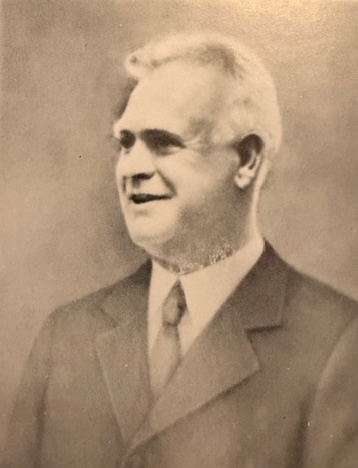


One of Milford’s prominent citizens, Louder Hearn, left a lasting legacy on Milford. The owner of Hearn’s Lumber, he also left money in his will to support the Milford Memorial Hospital and a scholarship fund for Milford High School students.
Louder Newbold Hearn was born July 20, 1878, the only child of Joseph Bernard and Alice Short Hearn. His father, born October 10, 1856, was a magistrate and, at one time, held the office of Recorder of Deeds. His mother, born in 1860, was the sister of Sheriff Robert Short in Georgetown and State Senator I.D. Short. She also had a sister, Edwin Dell Steel.
Louder was born in Gumboro and the family lived in Georgetown where his father was active in politics. It is believed that Louder attended the Conference Academy in Dover, what later became Wesley College.
As a boy, Louder began his business career as a fruit broker, selling apples and peaches. Soon after the turn of the century, Louder and his uncle, I. Dolphius Short, bought Alfred H. Powell’s lumberyard. The partnership lasted until I.D. sold his interest to Louder and started another business himself. Louder owned the lumberyard, called L.N. Hearn Lumber Company, until he died.
Very active in the community, Louder served as President of the DelMarVa Mortgage Company of Salisbury, and as a Director of the L.D. Caulk Co. On January 10, 1921, Louder was elected to the Board of the Milford Trust Company and, on January 30, 1930, elected to the seat of president, a position he also held until he died.
One of Louder’s leisure activities was sailing on his yacht, the Helen E. On June 27, 1912, the Evening Journal mentioned an excursion on the yacht.
“A party composed of William I. Cirwithien, Louder N. Hearn, George Grier, Norman Shaw, Pierce Simpson, Jay Pierce, Harry Pierce, with Frank Webb as pilot, and James Purnell as chef, left Milford early Sunday morning on the launch, “Helen E.,” owned by Louder N. Hearn and Harry Pierce for a day’s outing at Bowers, got lost in the bay and found themselves near the Jersey shore,” the account read. “They got to Bowers at midnight to be caught in the heavy fog and did not arrive home until 7 o’clock Monday morning.”
On September 1916, Louder was caught up in unusual city politics. According to an account in the Morning News on September 20, 1916, Milford City Council met in special session on the 19th.
“Before the business had progressed very far, the hottest fight for several years developed,” the account read. “Louder N. Hearn, one of the members of Council, was elected mayor by the other members to succeed Winter Moore, who had resigned. Mr. Hearn, a holdover member, and not in favor of the present policies of the Council, took the office only after he had received the assurance of the members that they would immediately employ competent police officers and a live alderman.”
The account continued that it was thought all had been resolved and that ex-Police Chief Baker would return to the police force. However, at the meeting, everything changed.

“Enough of the members who promised Mayor Hearn that they would get behind Baker, changed and elected Stanley Draper as chief of the force.
“Draper has no experience whatever as a police officer,” the report continued. “Following the action of the Council, Mayor Hearn immediately tendered his resignation. It was accepted. No successor was elected, and it is thought it will be hard to find a man who will accept the office under the present conditions.”
On October 14, 1916, the Morning News announced that Milford had the “third mayor since first of January.” The paper noted that Robert P. Pierce was named as mayor to succeed Louder.
“For the third time, since January 1, Milford has a new mayor, the latest one being Robet P. Pierce, wo was elected by the members of council at their regular monthly meeting this week,” the account reads. “The vacancies in council caused by the resignation of various members during the year, have had been filled yet. In January, H.W. D. Moore was elected mayor. He resigned during the summer giving his reason poor health.”
It appears that housing has been in an issue in Milford for much longer than recent years based on an account in the Morning News discussed how there was a scarcity of houses for sale or rent in 1919. This led to the formation of the Kent and Sussex Building and Loan with a capital of $500,000, approximately $9.5 million today, in an effort to help fund new home construction. Louder was elected president of the organization.
In 1921, Louder was part of a group of Milford businessmen who fought for a new road between Milford and Harrington to take priority over a road from Harrington to the Maryland line. Louder, Dr. Frank Grier, State Senator I.D. Short from Milford as well as J.C. Wharton of Houston attended the meeting.
During the Great Depression, not all Delaware banks came out unscathed. A news article in 1932 reported that Louder pledged aid for People’s National Bank which had closed. The bank was in line for funds from the Reconstruction Finance Corporation, but the bank would need to provide assets of the old bank as well as shares necessary to operate. Louder stated that as president of Milford Trust Company, his bank was willing to do everything in their power to assist in the reopening of the bank which was in Laurel.
Louder never married and lived his life in the New Windsor Hotel. On December 13, 1937, Louder was found dead in his hotel room at the age of 59. According to Dr. S.M.D. Marshall, his death was due to heart disease and that Louder had been in poor health for several years.
“Henry Schreffler, hotel manager, forced his way into the room after John Truitt, treasurer of the Kent and Sussex Building and Loan Association, was unable to get any response from knocks on the door,” the report of his death reads.
Louder was survived by his nephew, State Senator I.D. Short, an aunt, Mrs. Edward Steele and uncle, Robert Short. A funeral was held on Thursday at 1 PM in the First Presbyterian Church with Reverend John Jackson Brown, Jr., officiating. He was buried in the family plot in Georgetown.
On December 20, 1937, it was announced that Louder had divided his estate, estimated at between $250,000 and $300,000 (between $5.7 million and $6.8 million today), would be divided into two trust funds, one would aid what was then known as Milford Emergency Hospital, but then became Milford Memorial Hospital before becoming Bayhealth Sussex Campus.
The other trust fund was to educate boys and girls in Milford and the vicinity in compliance with the will of Louder Hearn. The estate was to be divided equally.
On January 28, 1938, it was announced that the L. N. Hearn Lumberyard was purchased yesterday by Thomas Reynolds Williams, son of the late Dr. Elmer T. Williams, and Logan Grier, son of Dr. Walter L. Grier. The business was sold by the executors of the estate. It remained Grier Lumberyard until 1980. The business was located on Causey Avenue.