



 One of Milford’s greatest benefactors was a man whose name does not appear on any public buildings and who is not memorialized for any of his charitable gifts. What is even more interesting is that he did not know what institutions would benefit from his death because his will did not specifically name them.
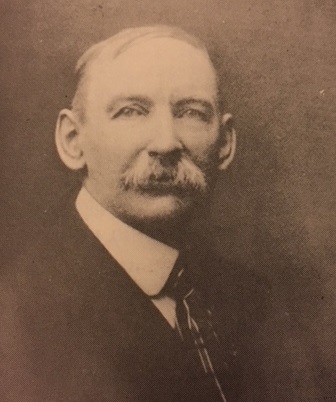
John B. Smith was born November 14, 1843, the son of Josiah Henry and Rachel Lofland Smith. Born and raised at Smith Mill, which later became Waples Mill, in Sussex County. Josiah Smith died when John was only a year old and he was adopted by an aunt, Mrs. Eliza Smith Scott who lived in Milford. John moved to the growing town and attended Milford schools. After completing his education, he was employed as a clerk in the Milford Post Office.
John’s mother, Rachel, remarried Edward Roach and the couple had five children, half-siblings to John. They were Mary Hester, Thomas, Elias, George and Charles Nutter Roach.
In 1876, John became associated with the Milford branch of the Bank of Smyrna. Soon after, he started working at the bank, he was appointed assistant cashier. When the First National Bank of Milford formed in 1876, he was one of the organizers of the institution and immediately became its cashier, a position he held until his death. He was also a member of the Board of Directors.
Well-known in banking circles, John was elected vice-president of the Delaware Banker’s Association and became president in 1915, the fourth to hold the office. A report in the News Journal after his death noted that John had been in the banking business since he was young and was regarded throughout the state as one of the best authorities in Delaware on stocks, bonds and investments.
John was also an active member of the Presbyterian Church of Milford, becoming an elder at the age of 35. He also taught Sunday School for many years and was a member of the Temple Lodge No. 9, Free and Accepted Masons. He served on town council, was a member of the Milford Rotary Club and the Rehoboth Country Club.
On October 20, 1880, John married Sarah Anderson, who was called Sallie, daughter of Benjamin and Elizabeth Goodwin Anderson. John and Sarah had three children, Benjamin, Henry Dale and Mary Elizabeth. Their son, Benjamin, drowned at the age of 10 in August 1891.
His nephew, J. Hall Anderson, became Lieutenant Governor, serving in from 1925 to 1927.
John died on June 22, 1926, and his funeral held a few days later. He was buried in Odd Fellows Cemetery. A notice in the News Journal on June 15, 1926, notes that he was one of the “wealthiest and best-known residents of lower Delaware. John died at his hime following a sudden attack of acute indigestion that morning. He was 83.
“Mr. Smith was stricken about 9 o’clock last night,” the notice in the paper read. “His daughter, Miss Mary Smith, with whom he made his home, summoned a physician but he expired about 1 o’clock despite all that could be done to save his life. “He was frequently consulted by residents of this part of the state before investing their cash,” the report read. “He was possessed of a large fortune and was the owner of several fine farms in Milford Neck.”
His will directed that a trust fund be established for the care of his son, Henry Dale. The remainder was bequeathed to the First National Bank of Milford, Delaware. The will instructed a named director of the bank place the funds in trust and the income paid to his daughter, Mary Elizabeth.
Upon his daughter’s death, the estate, free of trust, was to be paid to her children or grandchildren. Should his daughter leave no surviving children or grandchildren, his will read “my trustees shall assign, transfer and distribute the corpus and unused income of this trust fund to and among such Educational, Religious or Charitable institutions as they may deem wise and in whatever proportions they may determine.”
Mary Elizabeth did not have children or grandchildren, and the philanthropic provisions of the will were implemented. Mary Elizabeth married William Frederick Lofland, who died at the age of 41. She remarried Robert W. Kessler but had no children from either marriage.
Mary Elizabeth died in 1956, and, in 1958, the Board of Directors of the First National Bank of Milford distributed the John B. Smith Trust. In compliance with his wishes, Milford churches, the hospital and the Milford High School Athletic Association received gifts of money realized from the sale of securities.
On February 7, 1858, the Board of Directors announced a cash contribution that week from the trust in the amount of 4143,948.02, the equivalent of around $1.6 million today. The funds were from the sale of land in Prime Hook which had been in the Smith family since the time of William Penn. The title was obtained from William Penn through an original land grant in 1700.
With those funds, additional grants were issued to the hospital, Milford Memorial Hospital School of Nursing, Wesley Junior College and the Milford District Free Public Library with 75 percent of the funds given to the library, about $107,961, the equivalent of $1.2 million today.
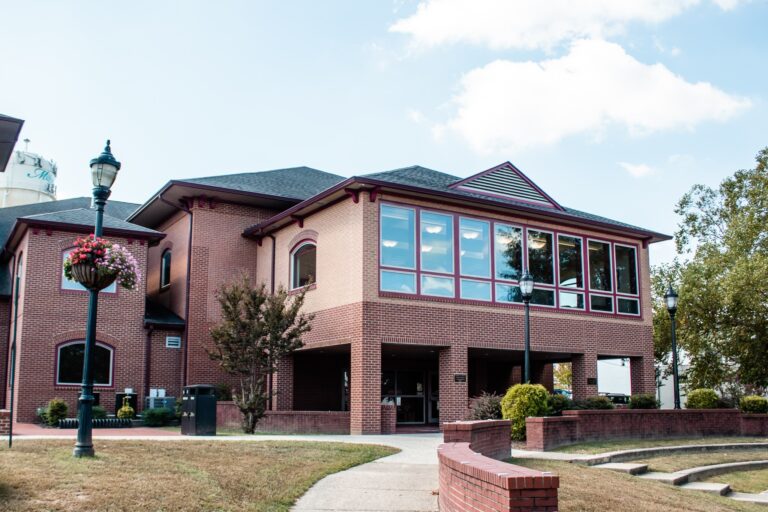
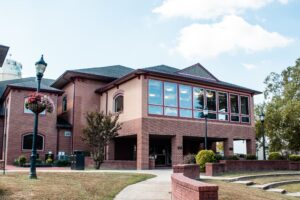
The cornerstone of the Milford Public Library was laid at 214 South Walnut Street on August 9, 1959, and the building officially dedicated on January 17, 1960. The site had been the home of the John B. Smith family. The spacious Victorian home that had been built on the property after it was purchased by Dr. J.D. Strong, the first homeopathic doctor in Milford, was razed to build the brick library that stood until 1996 and is now the office of Dr. Norman Steward, DDS.