


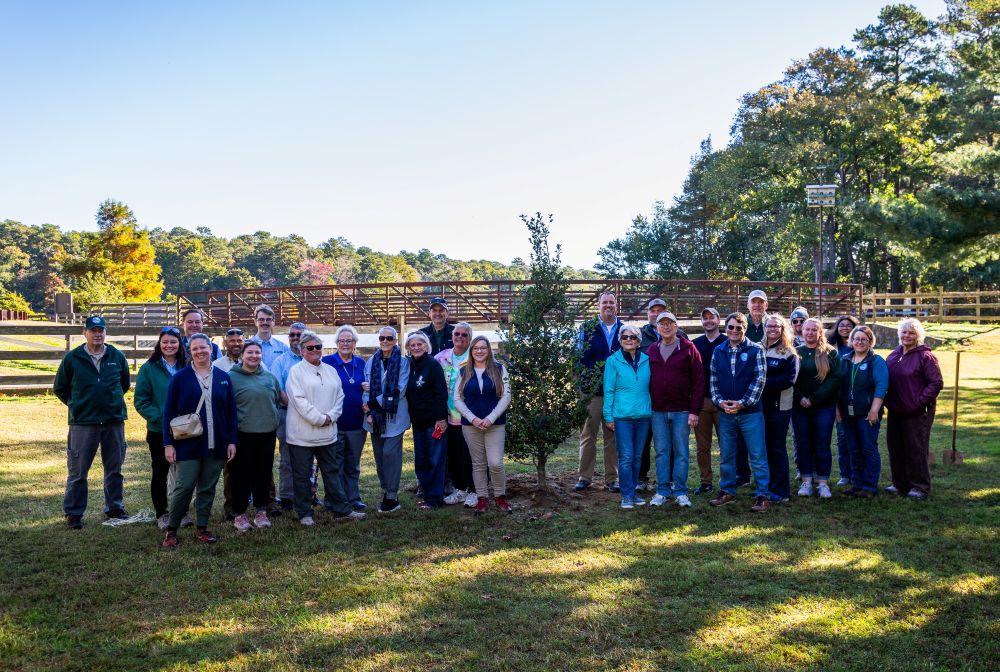

 Delaware State Parks planted a Liberty Tree at Trap Pond State Park to mark its 75th anniversary of the first state park. The tree marked the 75,000th tree planted this year, not only to celebrate the anniversary of state parks but also the 250th anniversary of the United States.
“Delaware’s state parks belong to all of us and this milestone shows what happens when neighbors come together to protect them,” Governor Matt Meyer said. “Every tree planted is a gift to the families who will walk these trails long after we’re gone. I’m grateful to DNREC, the Friends groups, and t he volunteers who made it happen. These parks are part of what makes Delaware home and we’re leaving them stronger for the next generation.”
Delaware launched A Tree for Every Delawarean with the goal of planting one million new trees, one for every resident in the state by 2030. As part of strategic planning, DNREC Division of Parks and Recreation committed to planting 75,000 trees by the end of 2026. The Trap Pond Liberty Tree, an American holly, also gives tribute to the state tree and is located near the Bob Trail by the causeway.
Trees are strategically placed throughout Delaware State Parks with 29,200 at Killen’s Pond State Park, 29,900 at Trap Pond, 10,072 at White Clay Creek, 5,110 at Auburn Valley and 447 at Bellevue. Trees were planted to enhance existing forests, improve habitat, create riparian buffers, control erosion, promote natural succession, diversify the understory, replace dead trees, expand native plantings and stabilize riparian zones.
“Liberty Trees were planted across the colonies as symbols of freedom before the American Revolution,” DNREC Secretary Greg Patterson said. “These trees served as natural landmarks and meeting places for colonists as well as signs of freedom. Today, these trees will stand as a commitment by the state to protect our natural resources and invite visitors to gather and enjoy the great outdoors.”
Funding for the project came from TEDI funds, environmental stewardship funds, Friends groups as well as public and private sources.
“We are grateful for the continued support we received from our dedicated volunteers and Friends,” said Matt Ritter, director of DNREC Division of Parks and Recreation. “Without these passionate Friends, corporate groups and individuals, we would have never been able to get this done in such a short timeframe. Of course, none of this would have been possible without our incredible staff that never back down from a challenge and always find a way to accomplish greatness.”
In addition to the American holly, a wide variety of native trees were planted, including cherry, oak, persimmon, maple, sycamore and pine. The Division of Parks and Recreation also included tree shelters to protect the trees from extreme weather and wildlife. Even with the goal accomplished, park staff, Friends and volunteers continue to improve park habitats, with additional plantings including 88 trees scheduled to be planted on October 28 at Fox Point State Park.
To date, more than a half million trees have been added in Delaware as part of TEDI. Trees improve air and water quality, preserve soil and support wildlife. The project is led by DNREC’s Division of Climate, Coastal and Energy in partnership with the Urban and Community Forestry (UFC) program in the Department of Agriculture’s Delaware Forest Service and other stakeholders.
To learn more about the TEDI program, visit the DNREC website. To volunteer for future tree plantings in Delaware State Parks, visit their webpage.