





A subtle beauty with a rich voice, the song sparrow, scientific name melospiza melodia, is one of Delaware’s most abundant and widespread native sparrows. They are often found at backyard feeders, and the male learns his songs from neighboring adults, often developing a local dialect that matches his community.
The birds are around six inches tall and weigh between one-half and one ounce. Their lifespan is between three to five years, although some live longer.
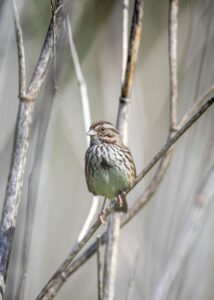
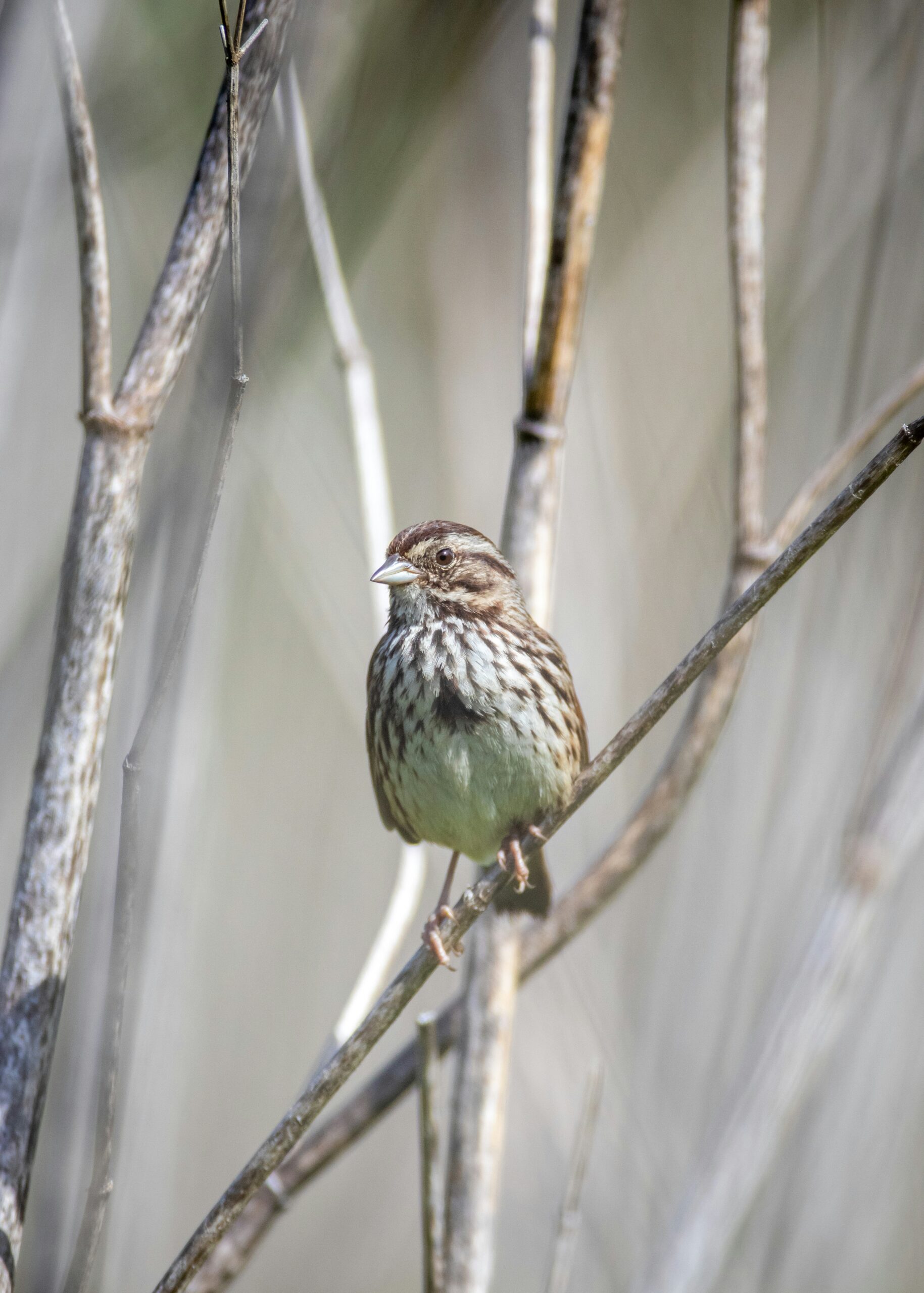
Song sparrows are a mix of warm browns and streaks with a distinctive dark central spot on the breast. They vary slightly in appearance by region, from blackish streaked in coastal California to paler in the desert Southwest. They have a long, rounded tail and backyard pairs are often tame. The song sparrow face is striped and exhibits a dark crown, pale eyebrow, dark line through the eye and two dark streaks or whiskers that almost appear as if they have a mustache. The underparts are variably streaked on the sides and the breast with the streaking commerging into a central breast.
Song sparrows have an undulating flight with a jerky quality, and its tail is constantly pumped up and down.
What does not vary is their song which is a series of cheerful, buzzy trills which is easily recognizable. They sing throughout the breeding season, with males holding tight territories.
The birds are found around marshes, fields, gardens and forest edges, often perched low or hopping through brushy cover. The male selects an exposed, eye-level perch and proclaims his territory with a loud and musical song each spring. In areas where they are resident, the male defends his territory year-round, individual territories are often small and it is not uncommon for multiple pairs to be present in large backyard with good habitat.
In winter, migrant song sparrows from farther north may join the resident birds that come to a feeder, but never in big flocks.
Nests are hidden in grass, shrubs or low trees, cup-shaped and built from grass and bark.
The birds lay three to five blueish eggs with dark specks. The eggs are incubated by the female for 12 to 14 days and the fledging leaves the next at about 10 to 12 days. They are able to fly five or six days later.
Song sparrows feed on insects and seeds, searching on the ground or at feeder trays.
Predators include snakes, cats, jays and chipmunks.
Next is the downy woodpecker.