




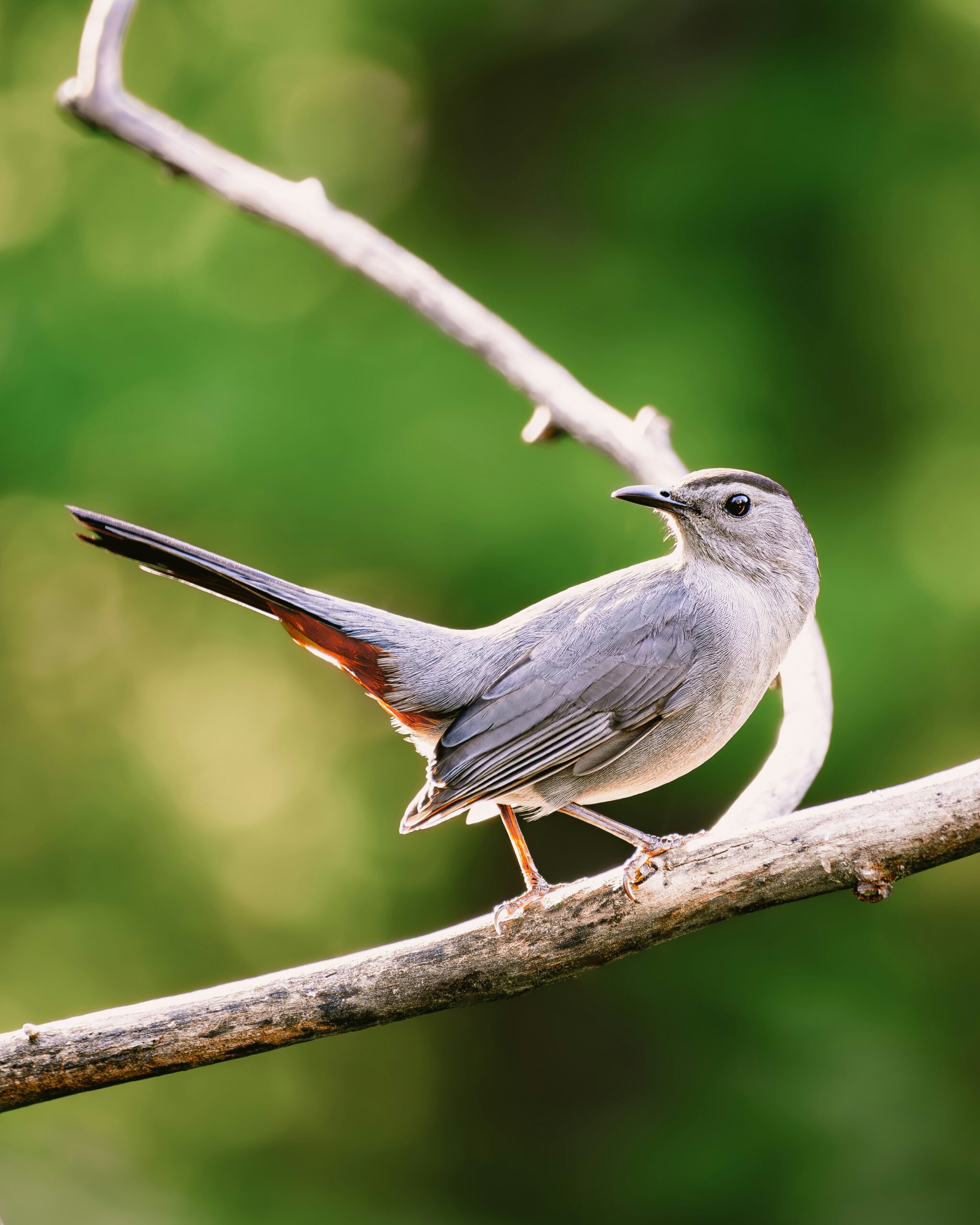

Vocal yet secretive, the gray catbird is a slate-colored, sleek songbird with a black cap, dark tail and ruffled patch beneath its tail. The birds are found in deep thickets, hedgerows and woodland edges throughout Delaware. Males and females look similar although a juvenile has a pale undertail with a hint of rust color.
The scientific name for the bird is Dumetella carolinensis, but the common name for the bird comes from its call that sounds like a cat’s “mew.” It also has incredible mimicking powers. The gray catbird is a member of the mockingbird family and has the ability to mimic other birds, frogs and even mechanical sounds that the weave into long, fluid songs. Catbirds sing in a linear sequence rather than just repeating other sounds. In fact, they can mimic over 100 different sounds in a single song, often stringing them together in complex, never repeated musical phrases.
The birds are between eight and ten inches tall. They weigh just over an ounce. Their lifespan is two to four years in the wild.
Their food source includes insects and berries, especially elderberries and dogwood fruits.
They build cup nests that are well-hidden low in shrubs which they guard with fuss and scolding. The birds lay between two and five blue-green eggs. The eggs are incubated for 12 to 14 days, and the fledging leaves the nest in 11 to 15 days.
The birds are curious and prefer dense cover which means you may hear them before you see them.
Predators are cats, snakes, jays and raccoons.
Next week, the northern mockingbird.