




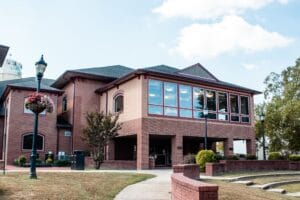
Celebrating their centennial anniversary this year, the Milford Free Public Library has been an important part of the Milford community even before it was officially a library. Considered one of the best libraries in the state, Milford’s grew from the collections of one woman and her sister-in-law.
In the late 1800s, collections of books were in private homes although schools and some local organizations had book collections as well. On March 20, 1882, the Milford Library Association was formed with Robert H. Davis as president and William F. Causey, Robert H. Gilman, the Reverend Henry L. Bunstein, Lynn Pratt, Millie Richards, James H. George, Dr. George W. Marshall, William V. Sipple, William F. Corsa and Miss Lydia M. Hall serving as directors.
Anyone who purchased stock in the association was given voting membership and the right to use books. Within two months of the organization meeting, the library set up in a room rented from the Grange. One committee was assigned the task of finding bookcases and furniture while another secured library supplies. A third committee began seeking books, either to purchase or donation. They reached out to organizations like the Farmer’s Library Association and the Temprance Association.

The directors voted unanimously for Miss Hettie Davis to be the librarian at a salary of $30 per year, about $980 today. On May 9, 1882, it was announced that the library room would be open soon.
Minutes of the meetings reveal how organized the library directors were as democratic procedures were followed and directors consulting with stockholders for important, and sometimes unimportant, decisions. Every penny of the treasury was carefully guarded with even the smallest bills submitted to the directors before the treasurer was authorized to pay them.
Directors were constantly worried that they would not have enough funds and the records show a consistent effort to raise money. Fundraisers included oratorio and the opera, “Patience.” They also provided Thanksgiving entertainment shows, a play by the Milford Dramatic Association, a “Mum Social,” a musical evening with the Kempa family, a supper a lecture, a rummage sale, the operetta “Guinevere,” and an annual strawberry festival. The association raised as little as $9.31, about $300 today, to $104.60, about $3,000 today.
Every dollar raised was spent on books as other expenditures occurred rarely. By 1889, Davis’s salary was increased to $40, just under $1500 today. The secretary noted that money was spent on paint and that they paid rent of $25, about $900 today, per year to Mrs. S.A. Collins. At this time, the library had moved to the second floor of the Godwin building on North Walnut Street, overlooking the yard of the National Hotel.

The need for books led the library to seek savings whenever they could, so when they received gifts, they were grateful. They published thanks in a local paper when William R. Phillips gifted them a load of wood. In 1889, Mr. Richard Johnson offered to put in electric lights and pay for the electricity for one year if the association would put in the wires. He agreed to take one year of the use of library books in payment. The minutes reflected small expenses for a pane of glass, labels for books, a chair, a stepladder and a broom, but the biggest expenses noted were for books.
On May 15, 1882, Bunstein was asked to make the initial purchase of books up to $100, just over $3,200 today. For six years, Bunstein served alone as the buyer of books until a committee was established in 1888. Only once did the minutes reflect displeasure at book choices when they noted that “Katherine and The Three Guardsmen” be expelled from the library. After reason for such action had been fully stated, the question was given and the motion prevailed.”
Membership drives and the resulting sale of stock added funds. Performers were sometimes offered stock rather than payment if they were over the age of 14. In 1886, non-members were permitted to uses the library upon payment of a fee of 50 cents for three months, about $16 today or $1.25 per year, about $40 today.
In 1897, the library created a magazine shares option, selling the ability to check out magazines like The Century, Scribners, The Atlantic Monthly and The Ladies Home Journal. The membership cost 50 cents per year.
After 1900, the library began to face financial problems, so they turned their attention to the Century Club and a new stock issue launched. By 1910, the library had only 65 subscribers compared to a few years before when stock certificates were printed in lots of 250. On January 25, 1911, the library faced a debt of $65.61, about $2,100 today. Minutes of the September meeting that year indicated that the library planned to move out of rented room by the first of the year.
In October 1911, a “Save the Library” effort was under way with the calling of a public meeting. At the meeting, stockholders were asked to make the library free under the laws of the State of Delaware, but the problem of the liquidation of debt had no answer. The library closed its doors and reverted back to housing collections in homes.
In 1913, the Methodist Episcopal Sunday School had a library and there were likely libraries in other churches who lent books to members. The public school had a library created from books given to them by the now defunct public library. More people could afford subscriptions to periodicals and, with the advent of paperback books, people could afford to buy books.

From 1912 to 1921, Mollie Brown Adkins conducted a library in her home on Northwest Front Street, making books available to children who stopped on their way to or from school. Adkins conducted a story hour regularly to help children appreciate the joys of reading and many began to borrow books. When Adkins decided to sell her home and leave Milford, she arranged to have her books stored.
Don Holzmueller and Charles Varney promised Adkins that when the Community Building, now known as the old fire hall, was competed, they would reserve a room for a library. Adkins came to Milford and spent several weeks cataloging and setting up the books in the new room as soon as the building was finished.
On May 31, 1926, an organizational meeting was held with Clara Grier Macklin presiding. In addition to Adkins’ library, Mrs. George Adkins of Philadelphia, a cousin of Mollie Adkins, had donated over 2,300 items. William C. Smith gifted furniture, but the library still faced the need to raise funds. A decision was made to ask 500 people to subscribe $1.00 a year for a three-year period in order to qualify for State Aid for the purchase of new books. Officers elected at the meeting were Anna Yardley Prettyman, President; Lena Short, Vice-President; and Elizabeth Biggs, Secretary; Daniel Hirsch, Treasurer; and Edwin Messick, Auditor. Edna Barker was named librarian.

The official name of the organization was the Milford Free Public Library and was assisted by the results of a referendum in 1930. A library tax was levied and has since been collected annually to provide for maintenance and other library expenses. In the same year, the State of Delaware agreed to provide $100 annually, almost $2,000 today, for the purchase of books.
The library quickly outgrew the one room, and the fire company added a second room, formerly used as a communication room, to allow for its expansion. For 34 years, the library operated out of the two rooms and patrons, who dreaded the long climb to the second floor of the Community Building, longed for the day when the library would have new facilities.
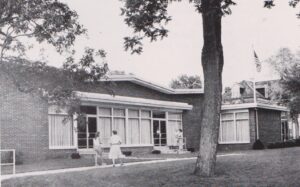
It was a provision in the will of Daniel Hirsch that allowed the library to construct a new, brick building on the corner of South Walnut Street and Maple Avenue, now the office of Dr. Norman L. Steward, DDS. The building was constructed on the site of the home of Dr. John B. Smith whose estate also provided funding for the library. The new library also contained books from the personal library of Smith, given by his daughter Mary Smith Kessler. Another bequest from Mrs. Samuel C. Evans was also beneficial to the new building.
“It seems to me that there is something distinctive about a cornerstone,” Robert Shilling, Chairman of the Library Commission, said when the cornerstone for the new building was laid. “It is not a part of the foundation buried away in the ground. It does not serve a particular structural purpose like a windowsill or the keystone of an arch, although it is firmly tied into the wall with mortar. It is down where it meets the eye, where even a child can touch it and perhaps trace the beautiful numerals with a small finger.”
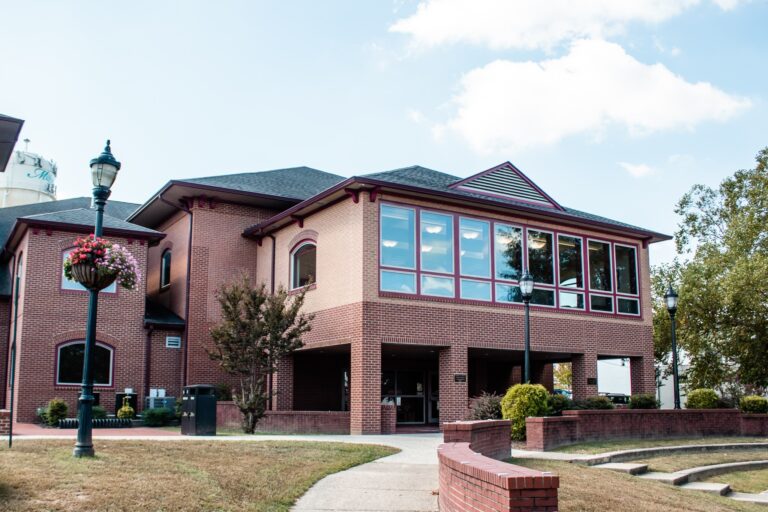
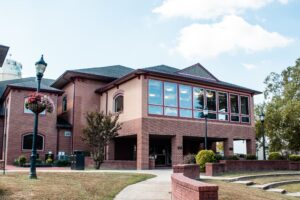
The new building was dedicated on January 17, 1960. The library remained at 214 South Walnut Street for 32 years until a new, state-of-the-art building was constructed at 11 Southeast Front Street where it stands today. In June 2026, the library will begin extensive renovations in celebration of their centennial anniversary of becoming the first free standing library in Milford. But the library’s history goes back as far as 1882 when a group of citizens saw the need for a library. Although that library disbanded in 1912, it is a testament to the will of the Milford community when a need is recognized.