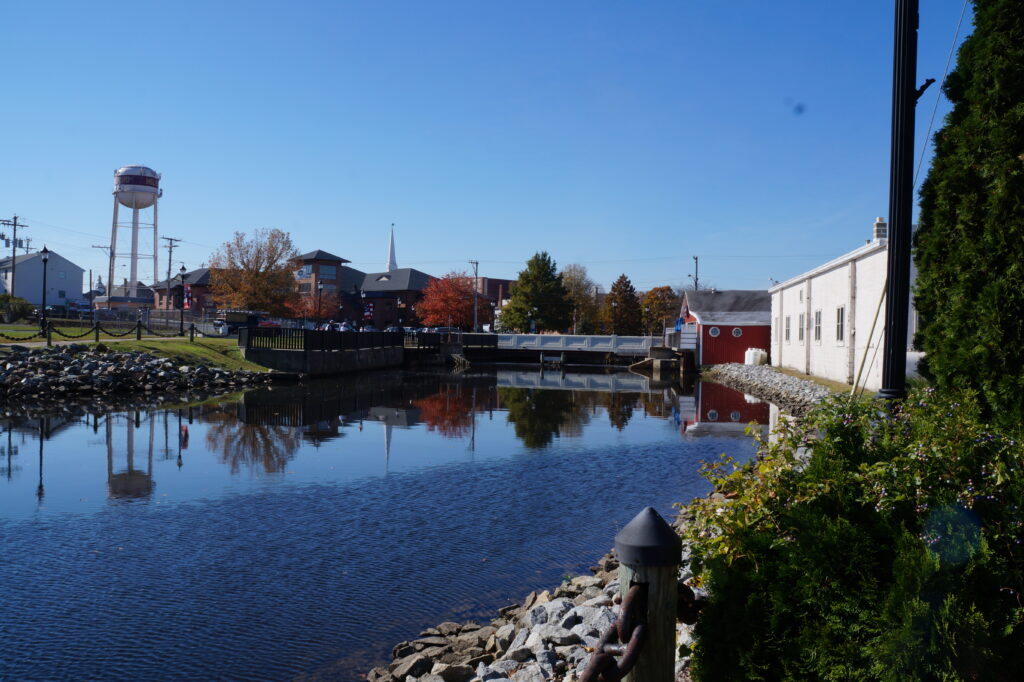





Griffith Lake is actually not a lake, but a man-made millpond created by Ezekial Riggs. The lake was created by damming the main branch of the Mispillion River for the sole purpose of water power to run a grist mill. All millponds in the area are man-made, so Griffith Lake is not a unique body of water in the area.
It is not known when the first mill was constructed, but an old deed map of the area drawn up on April 9, 1790 indicated there was a mill on the property at the time. It is not known if this was the first or second mill at that location. In Scharf’s History of Delaware Vol II, page 1186, a three-story frame building was the third mill on the site. The notation indicates that mill was constructed in 1858 for William Griffith whose wife, Sarah, inherited the property from her father, David Riggs, who inherited from his father, Ezekial Riggs.
After Sarah inherited the property, her son, Daniel T. Griffith gave the body of water the name “Griffith Pond,” a name that remained, even though the mill was known as Riggs Little Mill, along with the pond and five acres of land surrounding the pond were deeded to multiple owners over the years.
In 1890, Daniel T. Griffith and Mollie P. Griffith, his wife, deeded the land to James F. Anderson and Sarah G. Anderson, his wife. They deeded it in 1900 to Benjamin and Sallie Abbott. In 1904, the property was sold to Riley Melvin, Sheriff of Kent County at a sheriff sale in front of the National Hotel for $480, about $17,484 today. The sale occurred on January 23, 1904, and the buyer was James Anderson.
Anderson then sold the property to Charles and Annie Fitzgerald who kept it until 1916 when they sold it to Charles and Emma Cooke. However, Annie Fitzgerald must have had some hesitance when they stood before the notary. Barnet Gluckson, who served as the notary, added a statement to the transfer.
“Annie Fitzgerald who came before Notary Public and he swore that Annie L. Fitzgerald being at the same time privately examined by me, apart from her husband, acknowledged that she willingly, without compulsion, or threats or fear of her husband’s displeasure.”
This statement indicates that, although he may have had some concerns, Gluckson was satisfied after interviewing Annie alone that she had not been browbeaten or intimidated by her husband to be sold, and the property was deeded to the Cooke family.
The Cooke’s held on to the mill property until 1925 when they sold it to Charles C. Windsor. In August 1925, Peter Zodorsney bought the property from Windsor. In 1942, the property passed to Zodorsney’s son. By this time, the pond had all but vanished after a hurricane in 1935 which not only tore out the dam, but also the wooden bridge. The onrushing water reached Milford, partially flooding it.
During the storm, all cans and boxes were hurriedly conveyed to higher, safer levels at Draper Canning Factory in Milford as there were reports of at least six inches or more of water on the floor of the firehouse.
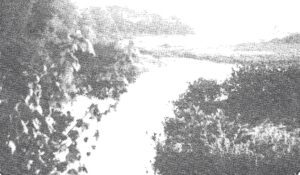
Over the next 19 years, the pond bottom reverted to a forest-like growth of dense, tall trees, scrub trees, brambles, honeysuckle and Cherokee roses. The Mispillion River, the original body of water in the area, meandered through the dense overgrowth.
In April 1954, William Lee Sparklin, the husband of Anna Zodorsney Sparklin, deeded the pond bottom and a plot of land to the State of Delaware for the purpose of restoring the pond and turning the plot of land into a park. Work began on clearing the pond bottom of the growth. Using axes and machetes, men worked at clearing the brush which was completed in just three months.
Construction began on a new dam on August 17, 1954, and it was completed on December 1, 1954. The concrete was allowed to season for a few months, and, in March 1955, the boards were put in place and the pond filled with water.
The Game and Fish Commission named the body of water Griffith Lake and today it is a primary fishing area. The lake is also a benefit to area farmers who use it to irrigate crops. None of the old mill remains today, but one of the old, original millstones, intact with its burr still deeply etched into it, was placed in the back of a house that was formerly the millers.
The last mill built for William Griffith in 1858 burned down in the early 1920s. The millers house still stands and was the home of the Zodorsney family for decades. According to an account written by Zodorsney-Sparklin in the Milford Historical Society newsletter in October 1980, the house also had an interesting history.
Zodorsney-Sparklin stated that Harrison Griffith, who was born on the property in 1890, the original home began as two cabins. One had a single room downstairs and one upstairs while the other had one room downstairs and two upstairs. The cabins were built around 1700, but may have been constructed earlier, judging from the huge chestnut beams and joists, all pegged together and the use of handmade iron nails. Griffith told Zodorsney-Sparklin that the cabins contained a boxed, pulpit-type stairway with nine-inch-high risers and plaster coming down the steps which indicated an early structure.
Griffith stated that the two cabins stood near the woods until around 1870 when William Griffith had the two cabins moved across the field about 800 feet, pushed them together, removed one stairway and formed a house for his miller, William Edington. Daniel and Mollie Griffith lived in the home and Harrison Griffith was born there. The same year Harrison was born, the family moved about 700 feet up the road and sold the miller’s house and the mill to James F. Anderson.
The Anderson’s built a long, shed-like structure across the back which became a kitchen when the Sparklin’s lived there. In 1925, Zodorsney-Sparklin’s father built a front and back porch which later provided space for a bathroom and utility room in 1949 once the home had running water and electricity. In 1970, the Sparklin’s added a bedroom wing on the east side of the home.
To keep the historic look, Zodorsney-Sparklin kept he gardens surrounding the home planted in wild flowers. The shrubs were also indigenous to the property and three, magnificent sycamore trees rounded out the gardens. Zodorsney-Sparklin was not sure who planted the sycamores, but the traditional “bride and groom” trees stand close to the back of the house. The third, apparently planted the same time, stands at the side, and, according to what Zodorsney-Sparklin was told, represented the child of the couple who planted the first two trees.
A new bridge to replace the one lost in 1935 was constructed in 1942, again connecting Kent and Sussex Counties.