

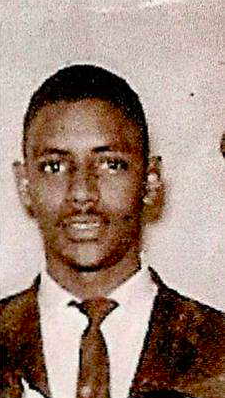


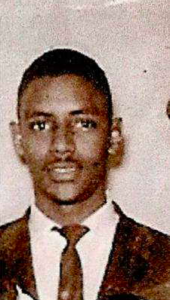
 Hayes Fountain made history in Milford when he became the first African American to serve on the Milford Police Department. The story of how he became a policeman is indicative of the times.
Born in April 22, 1938, the son of Hayes Edward Sr. and Grace Ann Harris, Fountain lived his entire life in Milford, except for a stint in the Navy. Fountain began working by picking peas at five cents an hour. In the Navy, he served on the battleship U.S.S. Missouri. In addition to becoming Milford’s first police officer, Fountain was also Kent County’s first black sheriff.
Fountain grew up poor in a house with no running water and no electricity. Hauling firewood and water between school and work were daily chores that he just “had to do.”
Fountain began working on the police force as a volunteer in 1959. In 1963, he finally began earning a salary of $60 a month with the police force after then Police Chief Phillip Wagner plead with council to begin giving Fountain a salary.
According to newspaper reports at the time, Hayes was earning money from a school bus business operated during the school year, a career he held for 50 years. During the summer months, he volunteered at his church. Fountain claimed at the time that his time in the US Navy during World War II prompted his desire to join the police force as he was a member of the shore patrol. Fountain also acted as deputy sheriff in Kent and Sussex Counties.
Fountain was also the president of the Houston Gun and Rod Club, a volunteer for the Boy Scouts and Girl Scouts, Milford Memorial Hospital and Carlisle Fire Company. He served as a security guard for the Bank of Delaware for over 20 years.
“He has turned in some good examples of police work in the past,” Wagner is quoted as saying. “We expect more good work from him in the future.”
According to Fountain, as a volunteer, he never knew when the police department was going to call him for assistance. Even as a volunteer, Fountain wore a uniform and carried a firearm. At the time, the Milford Police Department had 14 members with Fountain the only one working part-time.
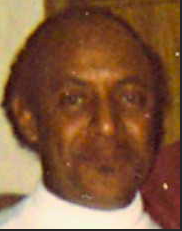 Fountain was president of the board of trustees at St. Paul’s Methodist Church, a trustee for William Henry High School and a member of the Saukium Temple of the Shrine.
In an interview in 1992, Fountain claimed his experiences with racism were “minor” and he used them as learning experiences.
“I grew up and saw the problems of a segregated society and that influenced me how to treat everyone I came in contact with,” Fountain stated in the interview. “I can honestly say I don’t hate a soul. I don’t see black and white. I see people, good people. I’ve had a few problems here and there, but I learned from them and grew. I never saw it as racial or anything. I do believe that all people are good, and that God made them that way.”
In the interview, Fountain talked about the changes in Milford even then. He remembered when Milford was mainly farms with a few buildings here and there with dirt roads that crisscrossed Kent and Sussex counties.
“Had plenty of open space back in those days, it was real nice,” Fountain is quoted as saying. “But there was lots to do, just regular chores would keep you busy all day. Nowdays, kids say there isn’t anything to do, they don’t know the half of it. Maybe if a lot of them and some chores to do to keep them busy it would keep them out of trouble.”
Fountain passed away on December 5, 2012, at the age of 92 and is buried in the Milford Community Cemetery.









Thanks for sharing this inspirational story about Officer Hayes Fountain. He was a real credit to humanity and provided excellent services to the citizens of Milford.
When white society allows racial predjudice to exist, we white people miss out on the talents of our Black neighbors.
I would like to be more like Mr. Fountain when I am older. My problem is I am already pushing age 83, so there is not much time.
Joseph Boyle