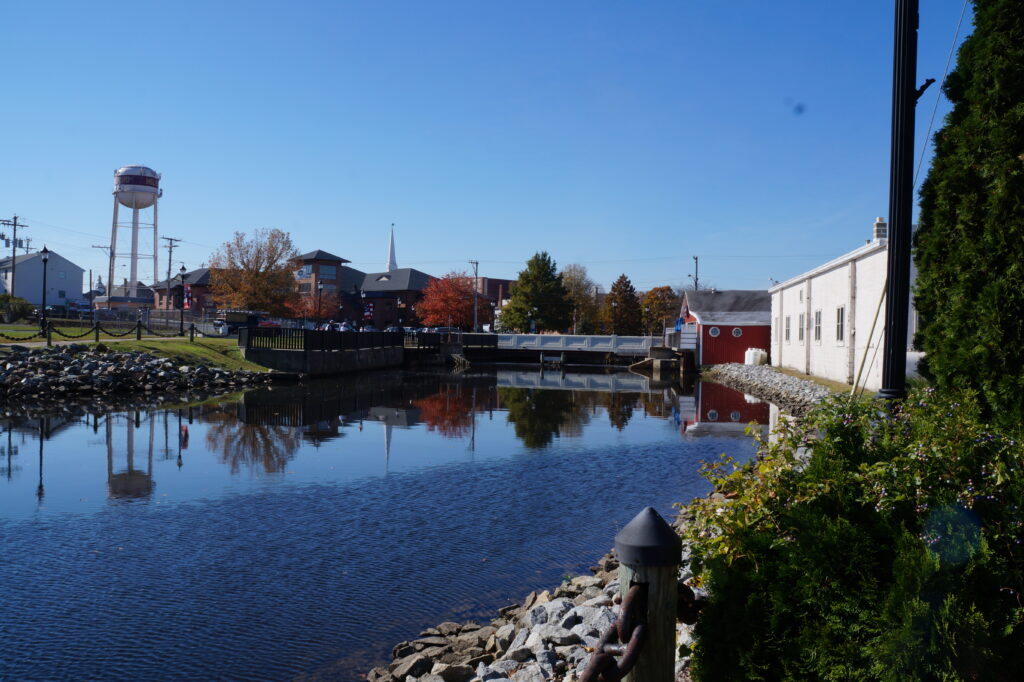
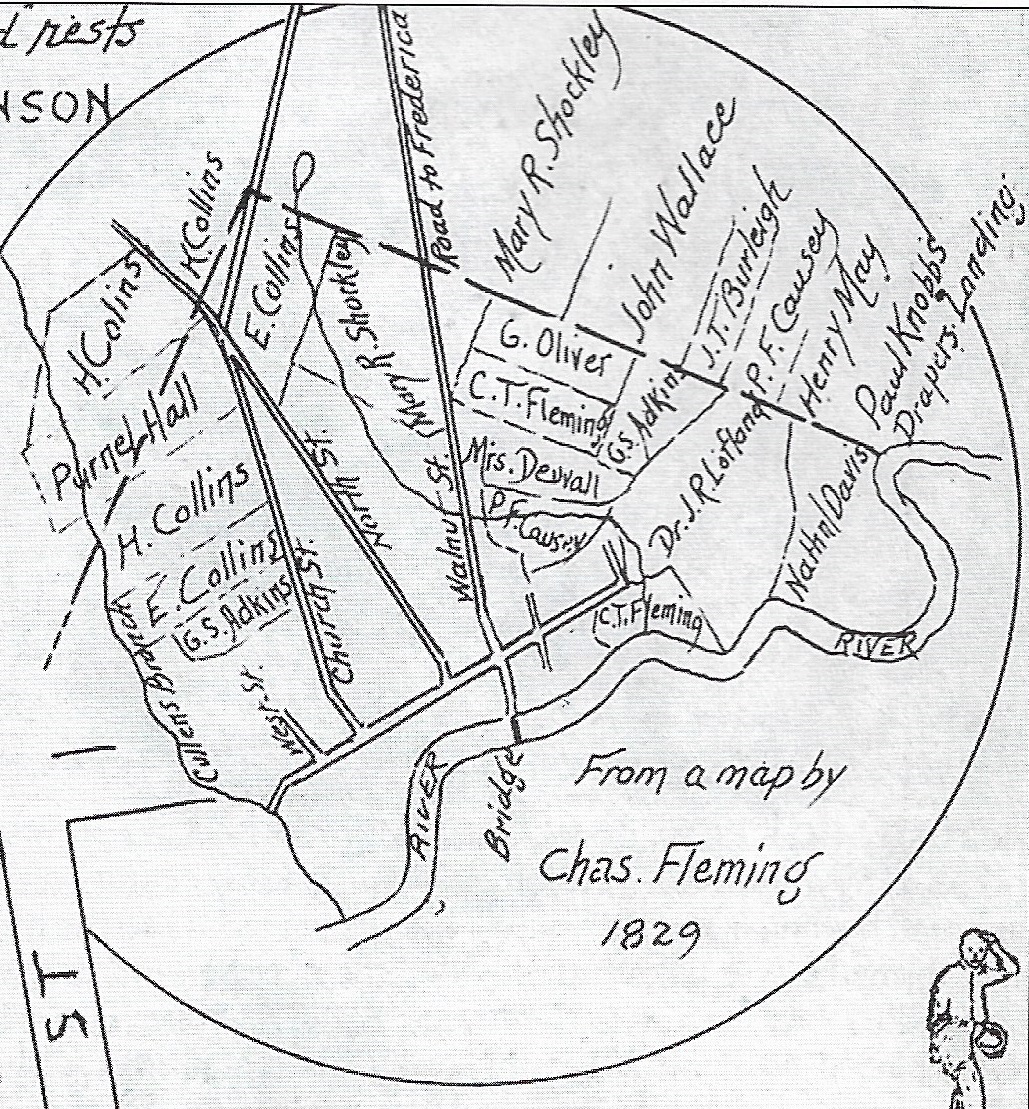

Although the town was first settled on the Kent side by Henry Bowman, Milford officially became the City of Milford on February 5, 1807, when it was incorporated. Although there are many towns in the United States named Milford, they all have one common origin and that is the existence of a mill and a ford where the town began. The “ford” was created when Rev. Sydenham Thorne constructed a dam which diverted the Mispillion River.
Much of the land where North Milford stands was a tract known as Saw Mill Range. It was warranted to Henry Bowman in 1680. There is a court record in 1681 in which Parrett, who is listed in the records as an “Indian Sacamore,” complained that Bowman and others had taken his land with no satisfaction. The court ordered those who secured land to pay Parrett “one match coat for 600 acres or under and if over 600 acres, two match coats.”
A match coat was a versatile outer garment used by indigenous peoples. Match coats were highly valuable and essential items in that era, particularly used as trade goods between Europeans and Native Americans. Match coats were also considered a status symbol as they could be decorated with beads, silk ribbon and brooches. Parrett likely received multiple match coats that he then used to trade with other tribes and European settlers.
“At the time the Indian receives the coat, he is to convey the land to the person he receives the coat of, and if any person refuses to pay the Indian for the land, execution is to be given for the same, the Sheriff to execute and pay the Indian,” the court records read. Bowman paid the required amount to Parrett and received a clear title.
The land then passed to the son of Henry Bowman, John, who sold it to Jacob Warrington. It was then sold to Warrington’s son-in-law, Joseph Oliver. In 1791, the General Assembly gave Oliver permission to build a drawbridge and to enact a toll for the bridge. Residents complained and the act was repealed the same year. The bridge was constructed near the present Walnut Street bridge, but no toll charged.
When Parson Thorne arrived in Milford, Oliver gave him two lots to construct Christ Episcopal Church. He purchased the Cullen plantation and offered to build a dam across the river at his own expense provided Oliver would lay out his farm in building lots. At the time, much of the industry in Milford was in Cullentown and New Wharf. At the time, the river was far more important for transport than road that were barely passable and the dam was constructed, redirecting the river away from Cullentown and New Wharf.
In 1787, the land was surveyed into building lots. The first was sold at the corner of Walnut and Water Street, which is now Park Avenue, to William Johnson. However, few of the lots were actually sold, but instead granted a 99-year lease in perpetuity subject that the yearly ground rent was paid.
The town grew rapidly and, in 1807, the decision was made to incorporate. This was the same year that Oliver passed away.
Prior to that, there was no record of a governing body. The year the town was incorporated, a Board of Commissioners was established with the first board composed of Dr. Joseph Sudler, John Wallace, Martin DeWaele and William Davis. There was no city charter when the town was incorporated, and the commission simply guided the town.
At the time, there was no mayor, but the commissioners elected a president. The first officially named president in the city was Curtis S. Watson in 1867, followed by General A.T.A. Torbert in 1868. In 1832, a city charger went into effect changing the name from the Town of Milford to the City of Milford and established a form of government that called for the election of the mayor and four councilmen as well as the appointment of a city manager.
The first mayors of Milford were Wilson M. Vinyard (1932-1936); Harry Pettyjohn (1936-1940); Edward C. Evans (1940-1948 and 1850-1856); C.V. Wilkerson (1948-1950); William R. Murphy (1856-1960); and Roy E. Pettyjohn (1960-1962).
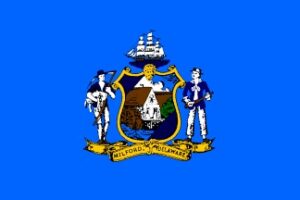
In 1937, John Mulholland, an Irish immigrant, who moved to Milford due to the abundance of birch trees in the area, designed the Milford seal which is used today. Mulholland, who owned the Mulholland Spoon Factory, which manufactured wooden ice cream spoons and later tongue depressors, presented the design and a flag to the city on September 27, 1937. The center of the seal shows a mill with representatives of agriculture and navigation on each side. The Mispillion oyster crowns the shield with a clipper ship representing early industries of the city. The seal is still in use today.