


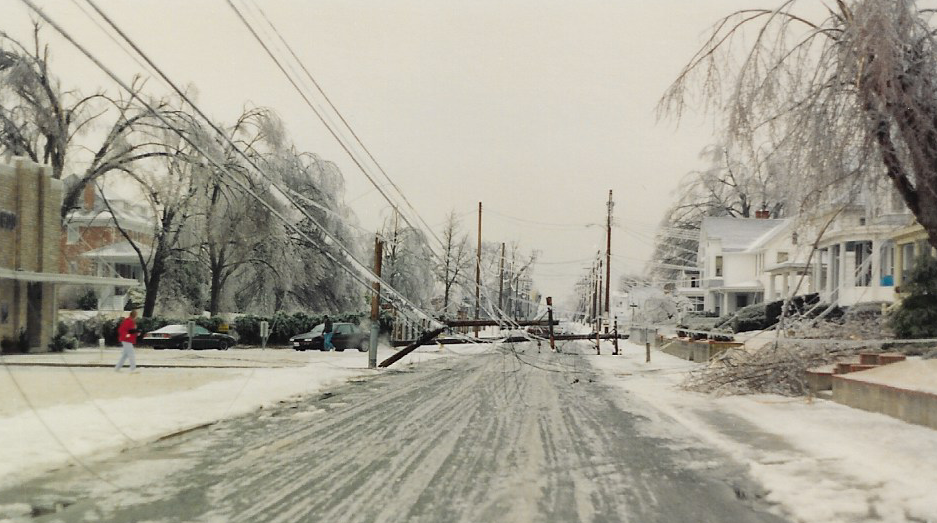


February 8 will mark the 32nd anniversary of the beginning of an ice storm in Milford that is still the topic of conversation. Mentioning the storm will bring stories of so many tree limbs snapping, it sounded like gunshots or how people managed without electricity for extended periods. The storm was epic in many ways.
On February 8, 1994, rain fell in the area despite the fact that the temperature hovered around 30 degrees. As the rain fell, a coating of ice developed on tree limbs, power lines and surfaces, slowly building up from a thin layer to a thick, heavy layer of frozen precipitation. Traffic accidents were reported throughout northern Sussex County and small electric outages began to be reported.
 The rain did not stop, however, but slowed to a light drizzle, adding even more layers of ice to the already bending trees and power lines. By Thursday, February 10, the power lines and trees could no longer take the weight of the ice. Branches hanging above power lines fell, pulling the lines and utility poles with them.
By Friday, February 11, telephone, radio and data systems are out of service for all utilities in the area, making it difficult for them to relay information to the public and almost all of Milford had been plunged into darkness as more than 10,000 electric customers lost power. Almost immediately, the storm was classified as a 100-year storm, something even the oldest Milford residents would say they had never witnessed. Although there had been a similar storm in 1973, it was not as extensive or as long-lasting. Emergency shelters were set

up in Milford schools and more than 200 people took advantage of the safety. Many of them lived in mobile homes that were destroyed by falling tree limbs.
At the time, the only way to report a power outage was to call the electric company. Delaware Electric used a manual switchboard system to transfer calls. Employees had to manually answer every call, some of which became repeat calls when limbs fell on lines that had just been repaired. As the calls came in, the employees hand wrote individual report tickets with “runners” delivering them to dispatch. On-call supervisors organized each ticket into piles in hopes of prioritizing the hardest hit areas, but constant damage made it impossible.
Others remained in their homes, using kerosene heaters, wood stoves or fireplaces to stay warm. People resorted to storing cold foods in coolers outside because there was no electricity to operate refrigerators or freezers. Even City Hall remained dark at the height of the storm, leading the late City Councilman Skip Pikus to create a storm center in the police station. Police officers, electric crews, dispatch and other staff worked 16-hour days, getting just 4-hours of rest throughout the storm.

“They worked radios, telephones and after their shifts, they came back and cooked for the crews and backed up whoever was on duty,” then-Chief Richard Carmean said. “I know some people might think they got a short answer when they called but, these people were on the front line, and they did a great job. What some don’t stop and think about that all of them have families, some without heat or power, but they kept doing their job in spite of their personal situation.”
By Saturday, February 12, heavy icing continued and all prior electric restoration efforts proved futile. The entire electrical system in the area approached collapse as falling lines endangered crews to the point they could not risk going out to make repairs. Electric switches are frozen in place by one to three inches of ice. By Saturday afternoon, however, the temperatures rose above freezing and the ice began to thaw, allowing crews to safely attempt to get electric power back on. By Friday, February 18, power had been restored to all but 300 Milford customers.

“I had to use a lighter to de-ice my car door lock so I could unlock it and drive to work,” James Stubbs commented on a post remembering the storm. “I drove from Milford to Greenwood and there were trees down everywhere and while driving, you could hear them cracking like they were about to fall right on top of you. The Milford Greenwood Road was horrible. I had to navigate through downed branches all over the road. I worked at Nanticoke Homes at the time. I think they only had about 15 employees show up.”
Sue Lindale commented that the tops of approximately 300 trees in her area lost the tops and that they had to burn debris wood in the driveway for almost six months after the storm.
“We lived in town and had an electric stove with oil heat,” Jane Kenwood said. “The problem with oil heat is that the furnace needs electric to light. The electric went out Thursday night, so we just wrapped up in

blankets and used kerosene lamps. The next day, we gathered some things and walked to my parent’s house which was a few blocks away with our two dogs. They had a gas stove and kerosene heaters. My aunt and grandmother lived near my parents, so they also joined us with their two dogs. There were six people and six dogs in that house, but we made the best of it. One night, we ate like kings because we had to use things out of the freezer. We had shrimp and steak and crab legs. We played cards and actually had a great time, but I was glad to get back to my own house!”
The City of Milford was not the only utility company facing problems during the storm. The Delaware Electric Co-op had almost 50,000 customers without power, some out for just a few hours but a large number out of power for almost two weeks. More than 400 utility poles were destroyed in the ice storm, all of which had to be replaced. Jim Smith, who was the public relations officer at the Co-op at the time, said the company had gone through ten years’ worth of line splices during the storm. Cable company crews also worked around the clock in an attempt to get everyone back online. At one point, Delmarva Power and Light reported almost 19,000 customers without electricity.

Delaware Electric Company was the hardest hit by the storm. They lost 500 power poles and nine substations, costing them as much as $3 million to replace. At that time, it took four hours to replace one pole. This meant line workers put in the equivalent of 50 normal work weeks to get power back to customers.
After the 1994 storm, steps were taken by all power companies in the area to remove any limbs that could result in outages during or after storms. In addition, electric companies use innovative technology to reduce outages during storms which allows them to redirect electricity in some cases. However, electric companies say a storm like the one in 1994 would still case extensive damage and outages.