

In “A History of Milford, Delaware,” compiled by the Milford Historical Society in 1962, two stories of African Americans in Milford in the late 1870s stand out. During this time, it is important to remember that everything was segregated, but these two stories demonstrate that their lives interchanged almost daily.
The book discusses funeral processions prior to the use of hearses. Before that time, coffins were carried through the town to the cemetery. One older member of the town told the editors that she recalls following the last walking procession, that of Kate Reville.
“The bearers wore tall hats swathed in crepe and the bier was equipped with legs in order that the bearers might halt and rest,” she recalled. “This particular procession halted three times between the Reville house, which stood on the corner of Southeast Front and Franklin Street and the Church of Christ graveyard.”
The book then continues that when speaking of funeral customs, it was important to recall an African American man, Billy Polk, who was a necessity for any funeral in the 1870s. Once a valet to General VanVorst, Polk had a very stately and decorous walk.
“Whenever there was a death among the gentry, Billy, dressed in a frock coat with white gloves and hat and bearing a silver tray, used to present a folded of paper in an envelope inviting the recipient to the funeral, naming the time and place,” the book reads. “After it was read, it was replaced on the tray, ready for Billy’s next call.”
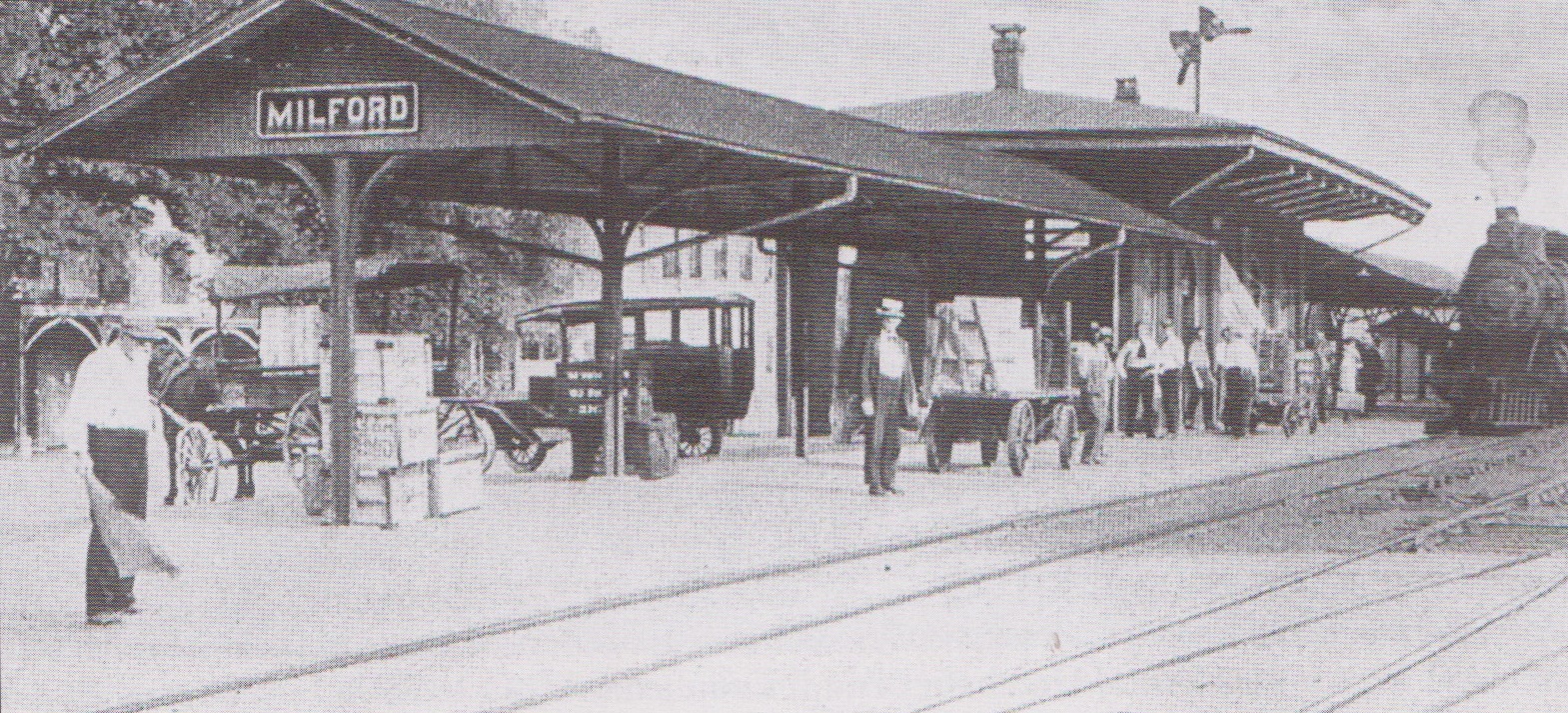
The arrival of the railroad is also discussed in the book as well as what existed at railway stations in various towns. According to the book, accommodations at the first stations were very poor or non-existent with nothing close enough to grab something to eat between stations.
“This was not the case at our station where Mary Shockley appeared every day for years at an early train time,” the book reads. “Immaculately clean, her head crowned with a white turban and carrying a tray from which she sold little cakes and persimmon beer she had made at home. These cakes were of three kinds, a sugar cake, a ginger cake and a plain cake cut into the shape of a horse. She was well known to passengers on the line and had many friends.”
Shockley is described in the book as a “light-skinned” African American woman.
These stories provide insight into how African American and white residents of Milford interacted, even though their lives were supposed to be completely separate.