


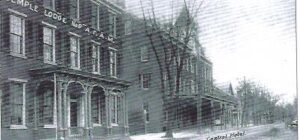
Currently owned by Dan Bond as an office and apartment building, the buildings at 10 and 12 Northwest Front Street look almost identical when viewed from the street. This was intentional as the homes were by brothers, Curtis and Bethuel Watson. Today, 10 NW Front Street, built by Curtis Watson, is known as the Watson Wells House. Both homes were built in 1855.
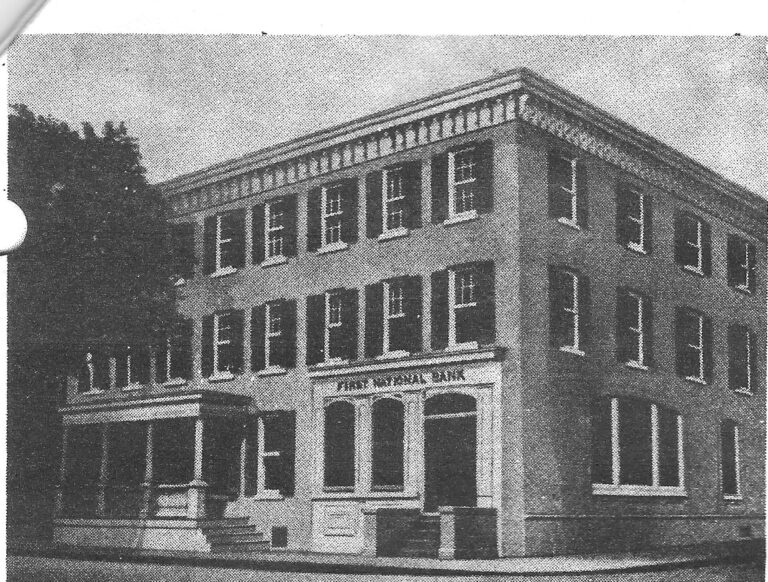
The building is an L-shaped, three-story, five-bay, center-hall brick building with gable roof. The entranceway is a portico with full entablature and Doric columns.
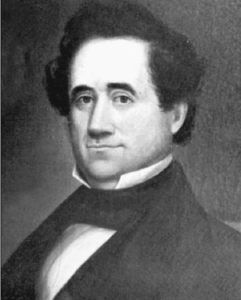
Curtis was the oldest child of Beniah and Elizabeth Watson. He obtained his education at the Milford Academy and lived on his family farm until he was 19. At the age of 21, he joined his father’s mercantile business, B. Watson and Son. When his father retired, Curtis took over the business bringing his brother, Bethuel, on as a partner and renaming the company C.S. Watson & Company. The two retired in 1856 after constructing their homes.
He married Sarah Davis in 1833, and the couple had seven sons. Thomas Davis was born in 1834 but died three years later. Thomas Henry was born in 1837 and died four years later. Beniah was born in 1841; Robert Young was born in 1842; Bethuel Emerson was born in 1846 but died at the age of three. John W. Watson was born in 1848 but died a year later and Curtis S. was born in 1850 and died a year later. Sarah died in 1851, and Curtis remarried Lydia White in 1853. The couple had no children. Curtis died in 1897.
The building at 12 Northwest Front Street, recognized by many as the Professional Building, was built by Bethuel. three-story, five-bay center hall brick building with a gable roof and box cornice. The entrance has a center porch supported by Doric columns and the home is on the historic registry. The porches on the two buildings are almost the only thing that differentiate them.
Bethuel died in 1857 during a typhoid epidemic along with his sister, Elizabeth, the wife of Manlove Carlisle. After the deaths of their spouses, Ruth Tharp Watson, the wife of Bethuel, married Manlove Carlisle. The couple moved into her home which Ruth inherited after his death.
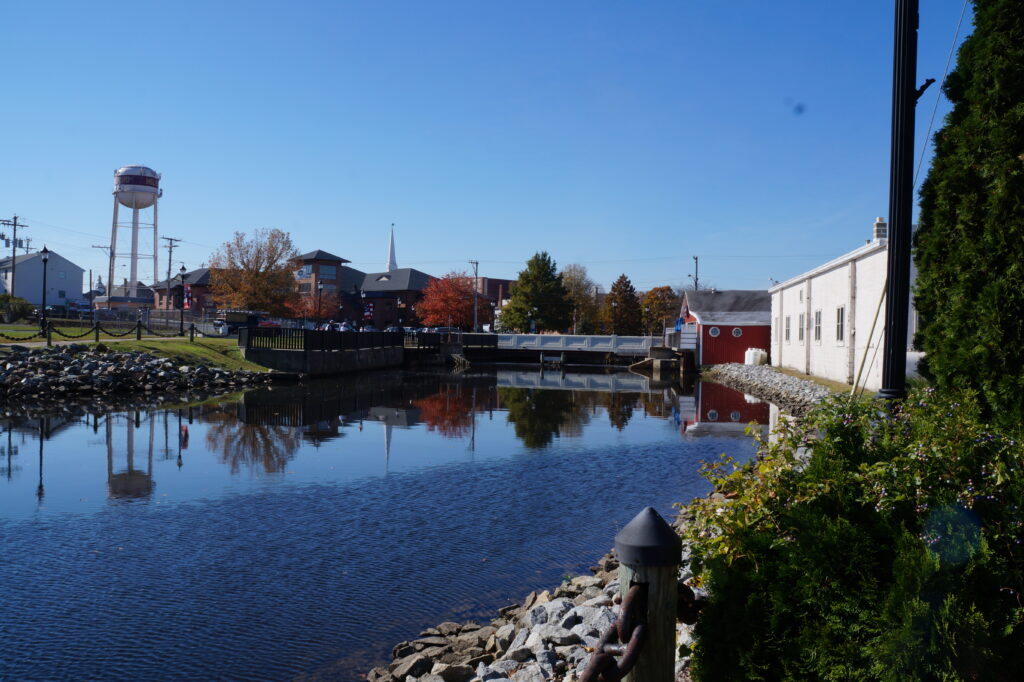
In 1891, a fire began in a shed behind the home of Ruth Carlisle. According to historian Dave Kenton, Fred Voelker, a valet for General Alfred T.A. Torbert fell into alcoholism after the general died in 1880. Voelker often slept in the stable and it is believed that either a cigar or lantern ignited straw in the shed, causing a fire that burned down a large part of the downtown. The fire led to the construction of the first water tower and the establishment of what is now Carlisle Fire Company.
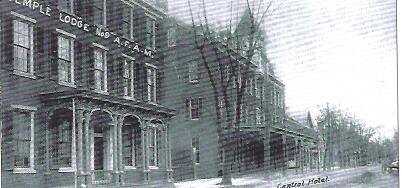
Ruth Carlisle died in 1907, and her home was purchased by the Tall Cedars of Lebanon. The organization held meetings on the second floor until they purchased the former Caulk building on the corner of Maple and Causey Avenue.
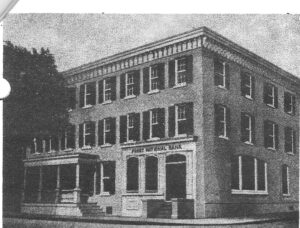
After his brother died, Curtis returned to the mercantile business, retiring again in 1882. He served on the board of directors of the First National Bank of Milford, acting as president on several occasions. For 15 years, he was a director in the Junction and Breakwater Railroad.
After his death, the home was inherited by his granddaughter, Sarah Curtis Watson, who had married Dr. James Stanton. Curtis’ son, who was Sarah’s father, Dr. Robert Watson, operated a medical practice in the home for many years and the home was recognized as the Watson-Stanton home. The first Milford hospital was located in the building before it was moved to the Windsor Hotel.
The building was later was purchased by Dr. Harold Halpern who ran an optometrist office from the building, the first to sell contact lenses in Milford. The 10 NW Front Street bulding was purchased by William Wells who, along with his wife, Lida, operated an insurance and real estate office from the location.
Today, the building houses Ericka Passwaters Permanent Makeup and LMT Bri Therapeutic Massage on the first floor with apartments on the upper floors. During renovation, a stunning carved ceiling was discovered in one of the rooms. It was returned to its beauty and is visible today.