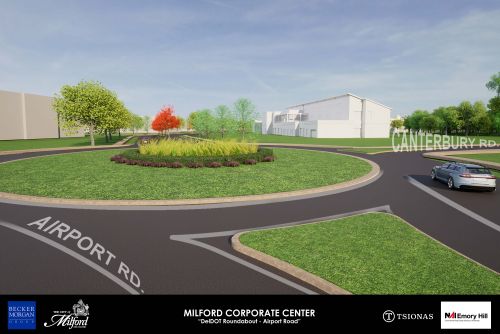


The City of Milford announced last week that Airport Road between Delaware Veteran’s Boulevard and Canterbury Road would be closed to all traffic for the construction of a roundabout starting October 27, 2025. The closure is expected to last until March 6, 2026. In addition, Canterbury Road at the intersection of Airport Road will be closed starting November 24 and will also not open until March 6, 2026.
“During this time, travelers in the area will be required to follow the posted detour plan,” the announcement from the city read. “Access to businesses and residences in the area will remain open. The city apologizes for the inconvenience and looks forward to improving traffic safety at this intersection.”
The roundabout was a road improvement required by DelDOT when the city purchased what was then the Fry Farm with plans to create a business park on the property. In all designs of the new industrial park, which broke ground in early 2025, a roundabout has been included. Not all residents are pleased with the plan, however.
“Airport Road doesn’t need a roundabout,” Marc Clery said. “Traffic moves smoothly. I use the route every day. Now, traffic on Canterbury Road will be backed up for miles to the Route 14 intersection.”
Kathy O’Neal felt that a traffic light or a policeman posted at the stop sign would have been more feasible. Lauren Ann Lillquist pointed out that most drivers did not know how to maneuver a four-way stop let alone a traffic circle. Not everyone was against the road improvement, however.
“I used to think roundabouts were stupid until we took several driving trips in Europe,” Peggy Schmidt posted. “Smoothest driving experiences ever, once we got used to it. Minimal braking, no waiting for the light to change, no waiting at a stop sign for a break in the traffic. It will take some time for us to adapt, but I look forward to that day.”
Stephen Corsiglia stated that it was a much-needed upgrade in that area and Kevin Yaniak posted that he loved roundabouts, thinking that they should be everywhere.
Some who were against the roundabout commented that New Jersey had done away with them. According to New Jersey officials, at one time, New Jersey had over 100 traffic circles with the first constructed in Pennsauken in 1925. As vehicles began traveling at faster speeds, the older traffic circles became dangerous, confused people from out of town and caused backups.
In the 1970s, New Jersey began phasing them out, putting in signaled intersections and overpasses. Recently, however, roundabouts are replacing some of those signaled intersections. A roundabout and a traffic circle are not the same as a roundabout is smaller, single- or double-lanes and designed for much slower speeds. The Federal Highway Administration reports that new roundabouts are safer, reducing serious crashes due to their design and the fact they force a driver to slow down. A traffic circle is designed for high-speed merging, leading to more accidents.
Another benefit to roundabouts is that that, although a roundabout is technically larger than a traffic circle, it requires less land than a circle or a signalized intersection. A signalized intersection requires turn lanes for queuing vehicles. Roundabouts are also designed to handle large volumes of traffic and requires vehicles to yield to circulating traffic.
The difference between a traffic circle and a roundabout may not be as apparent to the average driver. A roundabout requires vehicles to slow down or yield, but traffic does not stop so that more vehicle traffic can move through the intersection. The shape keeps motorists at 30 mph or lower and there is no need for lane changes. A traffic circle often has entry controlled by a signal or stop sign and circulating traffic is required to stop for entering traffic rather than the other way around. Vehicles enter at high speed and lane changes are permitted.
Roundabouts also save money as one signalized intersection costs approximately $5,000 per year to maintain. They are also better for the environment as vehicles do not have to idle and the center portion of the roundabout can create a more attractive look to an intersection.
There were also comments about whether large trucks would be able to use the roundabout, and research shows that large trucks, buses and other high-profile vehicles would have no issue. To accommodate those types of vehicles, engineers place what is known as a truck apron for the rear wheels of the vehicle to travel often in a different color to keep smaller vehicles from using it.
As for pedestrians, roundabouts are also safer as sidewalks provide a way to travel around the parameter of the roundabout and someone walking only has to cross one direction of traffic at a time. Crossing distances are also shorter and traffic is traveling much slower than traditional intersections. A European study found that a roundabout can reduce pedestrian accidents by 75 percent.