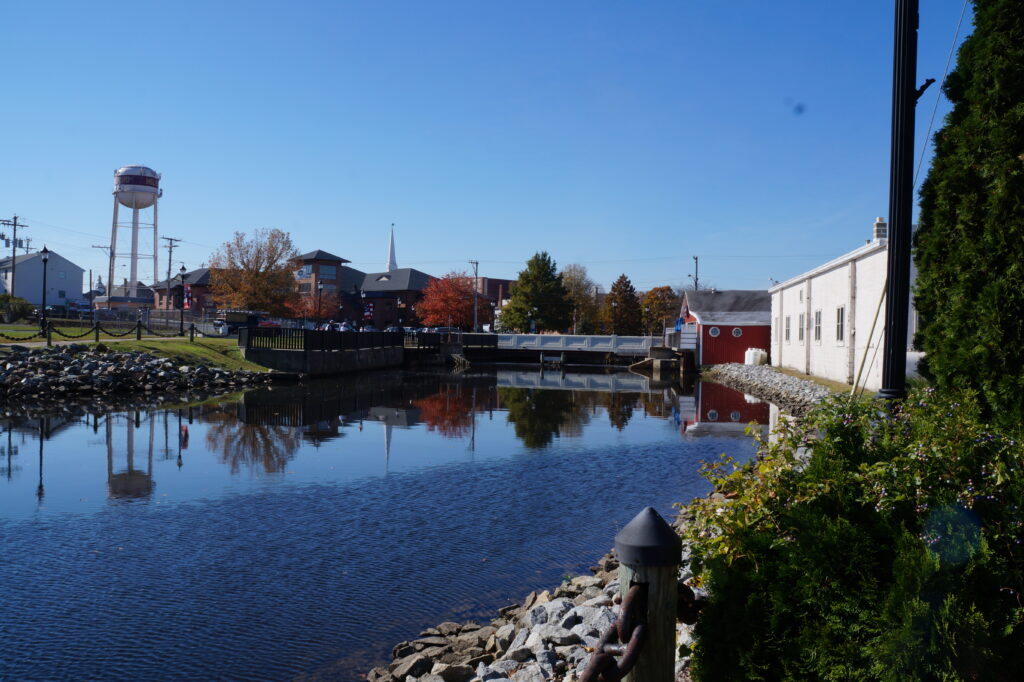






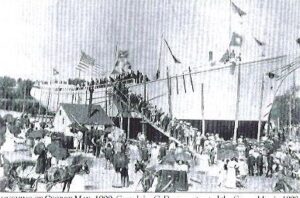
At one time, Milford was home to seven different shipyards between the years of 1782 and 1951, employing as many as three-quarters of the town’s workforce. A few of the vessels built in the town served their owners for many years and some, including the Augusta and Kismet still travel the waterways. However, two of the largest vessels constructed in Milford were not quite so lucky.
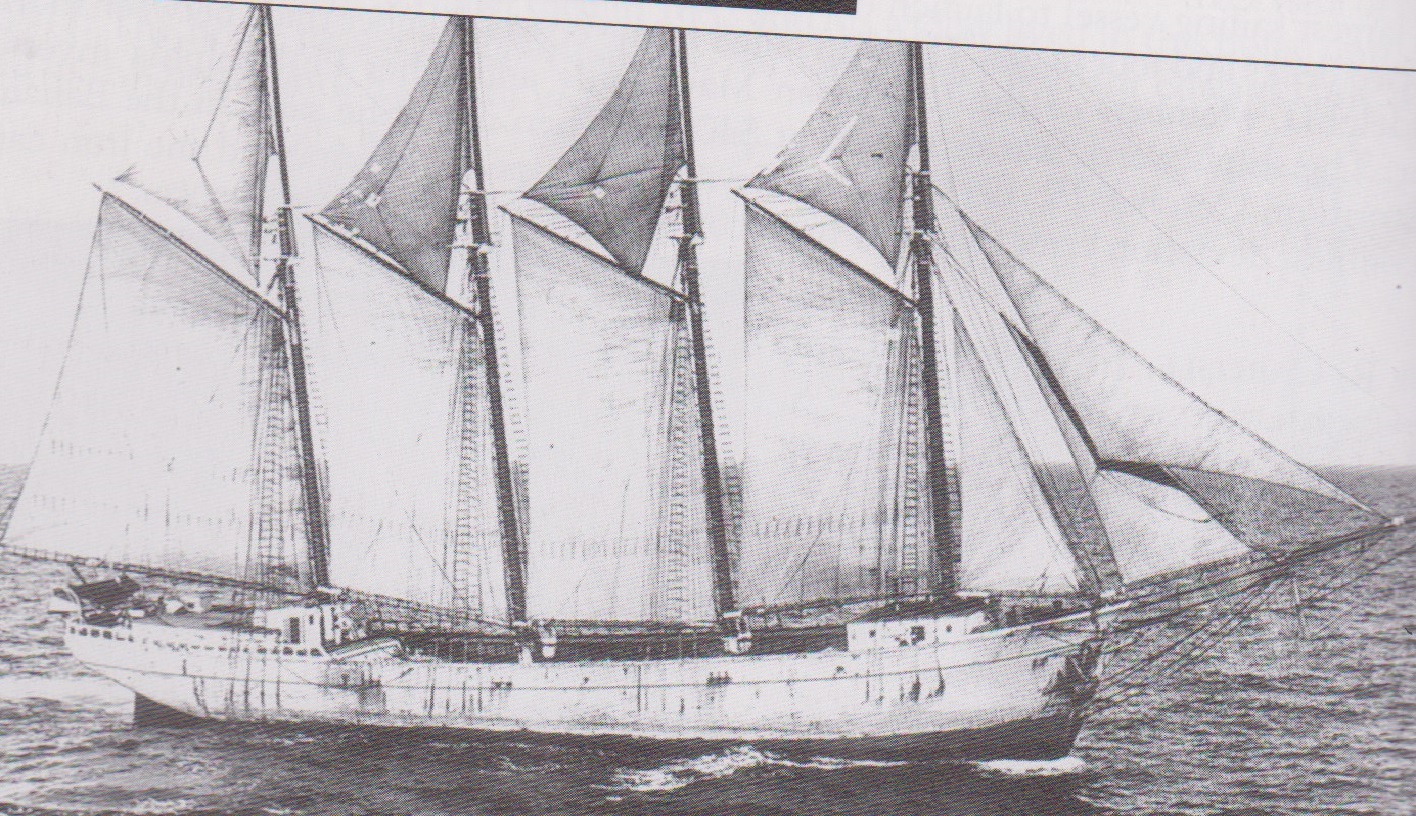
The largest ship built in Milford was the four-masted cargo schooner, the George May. The ship was constructed at the Vineyard Shipyard and launched in the early 20th century. The ship was 162 feet long with two decks and four masts. She operated in the coastal lumber trade between Florida and Philadelphia. Owned by the Jonathan May family, the ship was worth $40,000, the equivalent of $1.5 million today. It was contracted by Captain John C. Davis in 1899.
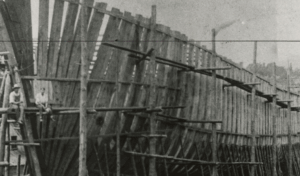
On October 25, 1911, the George May sank off the coast of the Bahamas during a storm. Reports are that all of the crew survived and it is believed that the iron pipe she was carrying interfered with a compass which caused the ship to deviate off course.
The Albert F. Paul, however, had a much more sinister fate. Built at the Abbott Shipyard in 1917, the Albert F. Paul weighed 735 tons, 174-feet long, also a four-masted schooner, and hauled coal, salt as well as lumber up and down the Atlantic coast. The Paul was the last large sailing ship to be launched on the Mispillion River from the Abbott Shipyard. In early 1942, she was sold to the Albert Shipping Company of Baltimore and her first voyage for them scheduled for February 23, 1942. The ship was heading to the Bahamas to deliver a cargo of coal, then to Grand Turks Island to pick up salt that would be delivered to Norfolk, Virginia. She was scheduled to arrive in Norfolk on March 11, 1942, but she never arrived.
No information was known about the fate of the Paul and her crew was listed as “missing in action” until after World War II ended. German records discovered after the war found a report that included the schooner on a list of vessels sunk by German submarines.
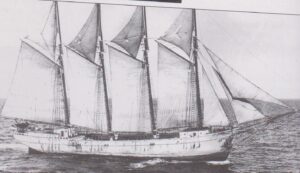
“On the morning of March 13, 1942, at approximately 160 miles north of Cape Hatteras, German submarine U-332 spotted the lone ship,” the report read. “The sub stalked the schooner for a couple of hours before firing off a torpedo that missed. A second, however, hit under the third mast, and the ship quickly sank, taking the entire complement of men.”
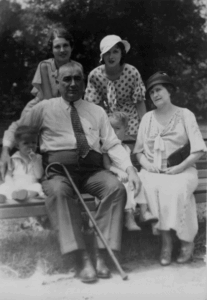
There were eight crew members aboard the Alfred F. Paul when she sank, all members of the Merchant Marine. The captain was William Mack Martino from Sharptown, Maryland. He was born October 6, 1877, the son of William J. and Martha Jane Wheatley Marino. He married Alice Olivia Caulk and they had five children – Ernest L. who was born in 1905 and died in 1906; Alice Irene, born in 1907; William Mack, born in 1911; Emma Grace, born in 1912 and George Allen born in 1913. Maryland papers list Martino as missing in action during the war.
Martino’s brother, John Luther Martino, was also a Merchant Marine and survived the sinking of the Alcoa Mariner in September 1942. However, he was lost at sea in the Caribbean in March 1951.

James Clarence Begley was only 22 years old when he died on the Paul. Born December 13, 1919, in Mechanicsville, Iowa, Begley was the son of Emmett and Ruth Begley of Kenosha, Wisconsin. He was an Ordinary Seaman, an entry level position on the deck of a ship. A report in a Kenosha paper reports that Begley was “missing in action” in the Atlantic Ocean. He transferred from the US Navy to the Merchant Marines that January. Begley’s father died when he was just a year old, leaving his mother to raise he and his three siblings alone. His mother worked the night shift at the Tri-Clover Company plant as a war worker.
Arnold “Arno” Wooster Brown was the ship’s cook. Born January 2, 1889, Brown was 53 when he went down with the ship. The son of Hiram and Alma Alley Brown of Springvale, Maine, Brown was the husband of Sara Brown of Baltimore, Maryland. His father was a sea captain, born in Maine and his mother was born in Grand Cayman. He had one sibling, Mary Elinor. Brown married Agnes E. Mons on August 18, 1913, but they later divorced. He married a second time to Sarah Ann and the couple had one child, Lester Arno Brown.
Also lost with the ship was Gideon Lindquist, an Able Seaman, who as 69 years old. An Able Seaman is a skilled and experienced member of the deck department, qualified for steering, maintenance and cargo operations. Lindquist was born in Pargas, Finland, emigrating to the United States in 1919. He arrived on the vessel Ilmari and became a US citizen in August 1920. The 1940 census had him living on South Street in New York as a lodger. He was listed as single on that census.
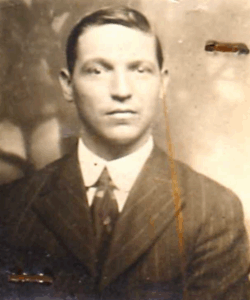
Douglas William Peek, the Boatswain, or senior deck crew member responsible for the maintenance and operation of the ship’s hull, deck equipment and the deck crew itself. Born March 19, 1914, Peek was only 28 when he died. He was the son of Thomas Franklin and Jennie Waldyn Peek of New Bern, North Carolina. Peek enlisted in the Merchant Marines and rose to the rank of Boatswain. Peek’s father served as a Corporal, Company G, 2 Regiment of the Georgia Infantry during the Spanish American War. Peek was not married but left behind his four siblings, Caroline, John Leonard, Doris E. And Thomas Edmund.
Another Able Seaman, Hugo Tokke, emigrated to the United States from Estonia in 1920. The son of Peeter and Kristine Margarethe Ihla Tokke, he became a United States citizen in April 1927. He also was not married but had six siblings – Anna Margarethe; Francesca; Berta; Elisabet; Emilie and Oskar.
Also lost on the ship were John Alexander Carlson, age 57, who was born July 10, 1884 in Pergas, Finland. He was the son of Carl and Alexandra Johanson. Carlson served as an Able Seaman. John Christopherson, also an Able Seaman from Annandale, New York, was the eighth casualty when the ship sank, but no information is available on his background.
The loss of the Albert F. Paul was especially troubling as it was unarmed, and it highlighted the brutality of unrestricted submarine warfare employed by the German Kriegsmarine during World War II when even non-military vessels were targeted. Because the incident was not discovered until after the war, it did not have an impact on German sentiment when it occurred.