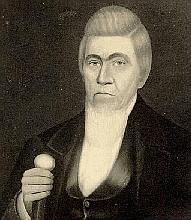

Milford has produced eight state governors. In this series, Milford Times will delve into the men and women who led our state who called Milford home. The seventh governor from Milford was William Burton who served as governor at the start of the Civil War.

Governor William Burton served as Delaware’s governor from 1859 to 1863, just as talks of secession by southern states began. A prominent physician, Burton entered politics as a Democrat, running against his friend, Peter Causey, who belonged to a faction of the Whig party known as the “Know Nothings.”
Burton was born on October 16, 1789, near Milford, the son of John Burton and Mary Vaughn West. Burton was the youngest child of the couple. His brother, Robert, was born in 1772, his sister Elizabeth Burton Hazzard was born in 1775. His sister Elizabeth Elma “Betsey” West Tingley Burton was born in 1776. His sister, Lydia was born in 1785 and his brother John in 1787. His father was a farmer who died when Burton was less than a year old. His mother remarried Robert Frame, a member of an old and honored Sussex County family who later became a very distinguished attorney in Delaware. They had three children, George, Robert and Elizabeth Paynter Frame Anderson.
After completing his early education in local schools, Burton began studying medicine with Dr. Sudler in Milford. He later entered the medical department of the University of Pennsylvania where he graduated with the class of 1810. His first practice was in Lewes, but he moved to Milford and opened a practice there. Burton married Eliza Sorden in 1815, but she died in 1829. He remarried Ann Catherine Hill in 1832 and they had one child, Rhoda, born in 1842. Burton also took in a young boy, Vincent Wooters.
The Burton family lived in Silver Hill Mansion, known now as Parson Thorne Mansion, moving there in 1858. There is evidence that he handled state business out of the plantation office that is currently being restored at the mansion.
During the early days of his political career, Burton was an “old line Whig,” but was converted to the Democratic party. His change in party affiliation was tied to the Whig support of abolition. His first foray into politics was election as sheriff of Kent County. He ran for governor in 1830 but was defeated. He was nominated for governor in 1858, and after his election assumed office in 1859.
War was on the horizon when Burton took office, coming to a head in 1860 with the election of Abraham Lincoln. Lincoln did not carry Delaware in the election. As mentioned, Burton was a southern sympathizer and ran on a platform of tolerance for the southern cause. Despite his southern sympathies, Burton believed that the union should be preserved by peace.

One little known fact is that Lincoln originally wanted to try his emancipation of slaves in Delaware, but the measure failed. According to an article in the News Journal, published in 1934, when Lincoln conceived of his plan to emancipate slaves through compensation to the owners, a measure he hoped would end the Civil War, he looked at Delaware as a trial ground for the idea since it was the smallest slave holding state.
In November 1861, Lincoln sent Congressman-elect George P. Fisher to outline his plan that had the federal government paying the state $900,000 at a rate of $90,000 per year for ten years. In today’s dollars, that would have been around $35.9 million total or around $3.4 million per year for ten years. Slaves would have been gradually emancipated and owners would be paid the value of the freed slaves from the appropriation. A bill was prepared for the emancipation, but it was decided to see how the legislature felt about the measure. The Senate pledged enough votes to pass it but the House did not which meant the bill was never introduced.
At the time, there was strong southern sentiment in Delaware, especially in Sussex County. There was significant pressure for Burton to allow Delaware to secede with surrounding states. Commissioners from Mississippi formally called upon Delaware legislators in 1861 and urged them to enact secession. However, the Delaware legislature overwhelmingly sympathized with the north and the request was not well received.
During this era, the governor did not have much executive authority. Beyond making political appointments, there was not much he could do other than exert his influence on the legislature. In fact, Delaware’s governor did not even have veto power when Burton was in office.
Burton corresponded with Governor Thomas Holiday Hicks of Maryland on the subject of secession. Hicks was an open supporter of Lincoln but wrote to Burton that he had grave doubts about the Union cause. He proposed to Burton that they form a Central Confederacy composed of border states that included Maryland and Delaware. He frankly asked Burton to use his influence with the legislature to create the Central Confederacy.
Burton’s reply left no question that he was not interested in such a proposition. He felt it was best to wait the result of the attempts to preserve the Union. However, he did call for a convention to consider secession, something the legislature declined.
On January 3, 1861, Henry Dickinson of Mississippi pleaded the cause of the Confederate States to the Delaware legislature. Immediately after Dickinson finished speaking, Dr. John Moore, a member of the House stepped forward and read a resolution he had prepared.

“Resolved, by the Senate and House of Representatives of the State of Delaware in General Assembly met, that having extended to the Honorable H. Dickinson, commissioner from the State of Mississippi, the courtesy due him as the representative of a sovereign state of the Confederacy, as well as to the state he represents, we deem it proper and due to ourselves and the people of Delaware to express our unqualified disapproval of the remedy for existing difficulties suggested by the resolution of the Legislature of Mississippi.
The ”disapproval of the remedy” referred to secession. An immediate vote was taken in the House and, by a unanimous vote of 21, the resolution passed. In the Senate, the story was different. They could not agree on motions to postpone the vote and adjourn. With more Democrats in the Senate than members of the People’s Party, it was feared the Senate would reject the resolution. Kent County Democrat Wilson L. Cannon sided with the opposition as did John Green. People’s Party senators Charles T. Polk, David W. Gemmill and John R. Tatum joined the two, passing the resolution with a vote of 5-3. Democrats Joseph A. McFerren, Speaker of the Senate John A. Martin and Alexander Johnson were the three dissenting votes.
Throughout his tenure as governor, Burton never did anything that could be construed as disloyal or obstructive to the federal government, despite his personal beliefs. He issued, at the request of the Secretary of War, a proclamation calling upon the men of Delaware to enlist in the armies of the Union.
Privately, Burton believed in the rights of the states, but publicly he was devoted to the Union. This was a common sentiment among Delawareans, who were pulled in different directions. Delaware affiliated with the north due to its progressive economic and social future, but respected traditional allegiance to the southern way of life.
Burton made it clear he wanted to see the Union remain intact. His reaction to the fall of Fort Sumter and Lincoln’s appeal for troops was to recommend the formation of a statewide volunteer militia. Many of those who joined entered the Union army, but it was suspected some were Confederate sympathizers. In May 1861, Burton took an important step in supporting the Union by appointing Henry duPont, a graduate of West Point, as commander of the Delaware militia. DuPont, a member of the prestigious duPont family had left his military career to work in the powder mills owned by his father, was an outspoken Unionist. His appointment calmed the fears of northern sympathizers in Delaware.
The Civil War took its toll on Burton. At the time, Delaware law did not allow governors to run for two consecutive terms. In his final message as governor, Burton was critical of the federal government’s interference in the 1862 election.
During the 1862 election, soldiers were sent to police polling places, an act that Burton claimed was unnecessary. He protested against what he felt was “unwarrantable and unconstitutional arrest of peaceful and loyal citizens.” In addition to the militia at the polls, voters were required to take a loyalty oath to the Union. Burton called for legislation that would make it illegal for any person to bear arms within one mile of a polling place in Delaware.
There were reports that troops disarmed volunteer militia companies and that Democratic voters were harassed assaulted, arrested and imprisoned.
Senator Gove Saulsbury introduced a resolution to refer the matter of military interference to a special committee and the resolution passed. When Burton’s successor, Governor William Cannon gave his inaugural address two weeks later, he justified the use of troops on the grounds of preserving law and order, ensuring the election was fair. In Cannon’s opinion, the government had to be above “liberty or even the life of any citizen.” In his view, during wartime, extreme measures had to be taken.

Three weeks later, “An Act to Prevent Illegal Arrests” passed which made it unlawful to arrest a white person without a warrant. It was also illegal to remove prisoners from the state without approval of the governor. The resolution went even farther, labeling Cannon a “governor unworthy of the respect and confidence of his fellow citizens.”
An investigation by the Delaware General Assembly concluded that Republicans had orchestrated a military invasion to manipulate the election while Republican sympathizers claimed it was Democrats who attempted to suppress the Union vote.
After his term ended, Burton returned to Milford and purchased The Towers. He lived in the home until his death on August 5, 1866 at the age of 77. He is buried in the Christ Episcopal Church cemetery in Milford. The Towers passed to his wife, Ann, and when she died in 1885, to the Burton’s only child.
Rhoda had married Alfred Wooten who became Attorney General of Delaware. After his death, Rhoda married Clinton Roudebusch of New York City and when he died, she returned to Milford, living in her father’s home, The Towers. She oversaw a major renovation project, taking four years to transform the home into the Victorian style structure that exist today. Rhoda spent $40,000 on the renovations in 1891, an amount that would equal $1.4 million today. It was Rhoda who named the home “The Towers.”
In 1911, an article in the News Journal reported that Wooters, who lived with Burton until the outbreak of the Civil War when Wooters joined the First Delaware Infantry, had passed away in Sonora, California. After the war, Wooten joined the gold rush, traveling to California. He returned to Milford once when his brother, Col. James I. Wooters passed away. At the time of his death, Wooters had amassed a substantial fortune which he had been “induced to leave to two people who were staying with him.”