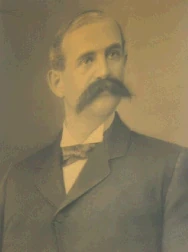

Milford has produced eight state governors. In this series, Milford Times will delve into the men and women who led our state who called Milford home. The sixth governor from Milford was William Tharp who followed his grandfather, William Tharp, into the office.

Governor William Tharp Watson was the son of Bethuel and Ruth Tharp Watson as well as the grandson of Governor William Tharp. He took the office of governor after the death of Governor Joshua Marvel.
Watson was born June 22, 1849, part of a family with many political ties. Beyond his grandfather, an uncle, Colonel C.S. Watson was a member of the senate in 1857 and 1871. His father, Bethuel, was a member of the Lower House. Bethuel, along with his sister, Elizabeth died in 1857 during a typhoid epidemic. Watson was only eight years old at the time. In 1861, his mother married a prominent shipbuilder, Manlove Carlisle, who was the widower of Elizabeth.
He was the second of five children. His sister, Mary Elizabeth Watson Harrington was born in 1847. His brother, Beniah, was born in 1851 and died in 1852. His sister, Annie Bell Watson Causey was born in 1854. His sister Minnilia Warfield Watson Heisler was born in 1858, seven months after the death of her father.
Educated in Chestertown, Maryland, Watson moved to Philadelphia in 1879, remaining there for about four years. He returned to Milford and was nominated by the Democrats for a seat in the House of Representatives in 1885. Because he had not been a resident of the state for three years immediately prior to his election and a resident of the county for at least one year, Watson refused to take the seat. He was nominated for the state senate and elected by a large majority in 1892. During that session, he was elected Speaker of the Senate.
Known as an avid reader, Watson’s library was extensive, and he was also an avid bicycle enthusiast. He was a member of Temple Lodge No 9, A.F.A.M. in Milford and was a Knight Templar. Before his election, he was a director with the First National Bank and the Delmarva railroad.
An article in the Delaware Gazette and State Journal on April 11, 1895, read that the Delaware House of Representatives met at 10:15 AM that morning “under the shadow of great sorrow.” Governor Joshua H. Marvil, who was sworn in only three months before on January 15, 1895, passed away on April 8, 1895. A joint resolution was read into the record.
“Resolved by the Senate and House of Representatives, that the members of the General Assembly have heard with deep sorrow of the death of his excellency, Joshua H. Marvil, late Governor of the State of Delaware,” the resolution read. “Resolved that they tender their sincere sympathy to the family and relatives of the deceased. Resolved that as a mark of respect, the State House be draped in mourning and the flag be displayed at half-mast until after the funeral. Resolved that as a further mark of respect the members of the General Assembly will attend the funeral in a body and no business will transmitted in the meantime.”

As Speaker of the Senate, Watson became governor as there was no lieutenant governor at the time. Even before the death of Marvil, the Delaware legislature had struggled to agree between three candidates to serve as United States senator. One of the candidates, Henry A. duPont, a railroad president and member of the prominent duPont family and the entire matter became embroiled in controversy on May 9, 1895, when Watson declared he had never given up his senate seat when he took the office of governor. In an effort to block duPont’s appointment, Watson returned to his senate seat and voted against duPont, casting his vote for Edward Ridgely. As a result, duPont received 15 votes, Ridgely 10, J.E. Addicks four and E.W. Tunnell one vote. This was one vote short of the majority duPont needed for the seat. A Republican senator declared duPont as the senator, believing that Watson’s vote should be disqualified.
On December 4, 1895, supporters of duPont filed a petition on his behalf and claimed he was elected as the senator. The duPont supporters argued that Watson illegally performed dual functions. On March 15, 1896, the Senate rejected duPont’s claim. duPont attempted to use a different argument with the Senate in January 1897, but the Committee on Privileges and Elections found no errors and cautioned the senate not to reverse its previous decision as there was no new evidence.
A November 1895 article in the Delaware Gazette and State Journal reported that Watson was “an able and conscientious chief executive, called into high office by the death of his predecessor who had been elected by the opposite political party.”
The article continued to support Watson’s role as governor.
“In the days of old, the people of Delaware were in the habit of electing opponents of the Democratic party to the chair of State, with almost unfailing regularity. Governor Tharp was a worthy executive, and his administration was dignified and honorable. If it be the ambition of Governor Watson to emulate his distinguished grandfather in this respect, he is following the course that will satisfy his desire,” the article reads. “Whatever grave responsibilities may devolve upon Governor Watson during the remainder of his term, there is little doubt he will deal with them in the same practical, judicious and common-sense spirit that has hitherto marked his official performances. He is not likely to disappoint the confidence of the people which he enjoys in the highest degree.”

Watson left the governor’s office in 1897 and retired from public service. He built Walnut Knoll, located at 600 North Walnut Street, in 1906. The home is on the National Registry of Historic Places and was once the home of Dr. Warner Portz. It is now the Tune and Fork Inn.
“Walnut Knoll is a two-story, five-bay, center hall building with a raised foundation to increase the massive appearance of the house,” according to the National Registry. “This effect is continued upward with the full front porch with wings on each side. The porch roof is supported by massive round Doric columns with contrasting square wood balusters. The porch roof has a slight pitch, while the wings have hip roofs with extended overhangs and plain soffit and drop.”
The registry continues that this area of Milford was developed late in Milford history. The 1885 Pictorial Atlas by Bailey shows the area with vacant land. The Lofland House, located at 417 North Walnut Street, was built to encourage development of the area, but most of that development was to the east rather than the north.
The registry states that the home is an “excellent example of a well-preserved, early-20th century estate. There is a brick carriage house and servant’s quarters including a brick laundry that still stand on the property. A frame stable at the rear of the property was also still standing in 1982 when the home was placed on the registry.
Watson died on April 14, 1917, and is buried at Odd Fellow’s Cemetery in Milford.