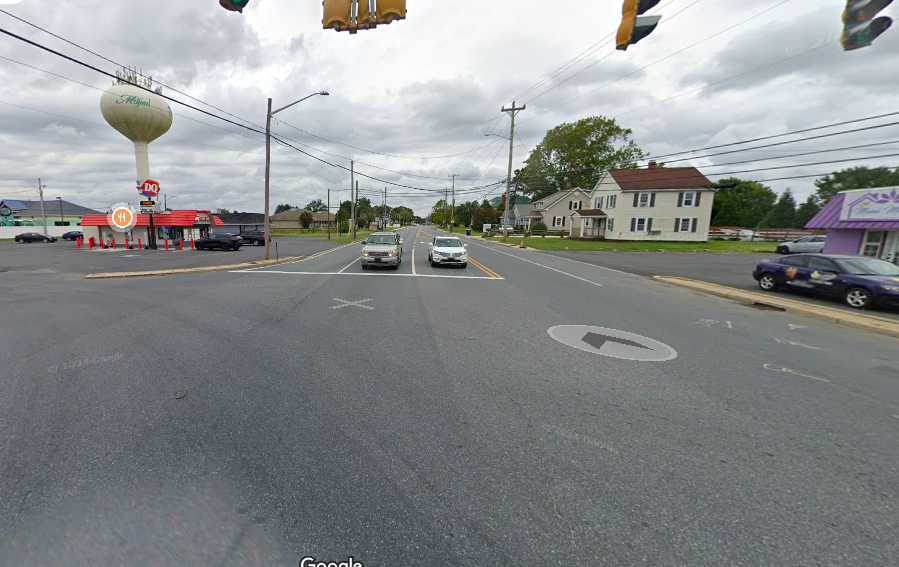


Late last week, parents of Milford Central Academy and Milford High School students who live in the northern part of town from Front Street to Dairy Queen will now be considered within walking distance of the schools. This change is due to a new crosswalk currently under construction on Rehoboth Boulevard, eliminating a “no-cross” rule that was put in place around 2008.
“Delaware regulations require a walk zone when safe access is available,” the notice from the district read. “To support student safety, a crossing guard will be present during arrival and dismissal each day. We ask that students use North Walnut or North Washington Street to access the crosswalk located at the Latino Market across from Federated Auto Parts.”
Prior to the installation of the crosswalk, students were not permitted to cross Rehoboth Boulevard, which meant the walk boundary for Milford Central Academy and Milford High School was limited to the east side of Rehoboth Boulevard and Northeast 10th Street. State law requires that students in grades Kindergarten through sixth grade live one mile or more in order to receive transportation while students in 7 through 12th grade must live two miles or more from the school to receive transportation.
During the period when students at Milford Central Academy and Milford High School students were provided busing despite living within the one- or two-mile distance, children attending Lulu M. Ross Elementary, Mispillion Elementary and Benjamin Banneker Elementary were required to walk up to one mile to get to school.
The reopening of Milford Middle School has led to changes in grade configurations as well as transportation. This year, Evelyn I. Morris Early Childhood Center and Banneker will serve Pre-Kindergarten, Kindergarten and 1st grade. Students will be required to walk up to one mile to Banneker. Ross and Mispillion will serve grades 2nd through 4th and will also have an up to one mile walk boundary. Milford Middle School will serve 5th and 6th grade. Students in 5th grade will have to walk up to one mile to school while 6th grade will walk up to two miles.
Milford Central Academy will serve 7th and 8th grades. Students will have to walk up to two miles to get to school. Milford High School serves 9th through 12th grades, and they will also have to walk up to two miles to get to school.
All walk boundaries are set by the State of Delaware and the district is required to abide by them. Walking distance is determined using the most direct route to school on public walkways or roadways. The presence of sidewalks is not taken into consideration by the state. Special needs students are provided transportation if they live within the walk boundary. In addition, students can be asked to walk up to a half mile to a bus stop, regardless of sidewalks.
Parents took to social media to express their concerns about the new walk boundary.
“Imagine walking to school in an absolute down pour at 7:00 AM being soaked down to your underwear before you even walk into school to start your day. Now imagine that was you having to walk into work after having that start to your day. I know I would be a hateful SOB after that for the rest of the day,” Anna Webb posted. “It truly doesn’t matter what you “used” to have to do decades ago. I have saw some insane things at the intersection by DQ and even more now that I live in S. Washington. A crossing guard truly isn’t saving anyone with a stop sign and a whistle, let’s be realistic.”
Others pointed out that this would be a 30-minute walk for their child while still others were concerned about sex offenders in the area. However, many of the comments supported allowing children to walk to school.
“These kids are soft because of these parents keeping them in a bubble. It not the same as when we were kids I agree,” Lowell Sutton posted. “But these kids have to live in this world after we are gone. You can’t shelter them from reality of the outside world and expect them to be prepared for it.”
One parent complained that students were not given lockers to put coats in at MCA or MHS, but a teacher at one of the schools stated that students could request a locker if they wanted to use one.
“Even rural Baltimore County has a walking zone,” Hannah Healy posted. “This is not your only option; you can also choose to take your child to school yourself.”
Because this is a state regulation, it is unlikely the district will be able to change it.Because this is a state regulation, it is unlikely the district will be able to change it. According to state regulations, a district can provide busing within the walk boundary, but all costs for transportation within that boundary must be paid fully by the district. Currently, the state covers approximately 70 percent of transportation costs and the district pays 30 percent. According to the National Center of Education Statistics, the cost to transport one student to school Is $1,152. It Is likely that if Milford overrode this change, they would be required to override all walk boundaries In the city, which could be as many as 1,000 new bus riders.
Using the figures provided by the National Center for Education Statistics, this would ad $1.1 million to the district budget. An Increase of that amount would likely mean a referendum to Increase taxes to cover those costs.