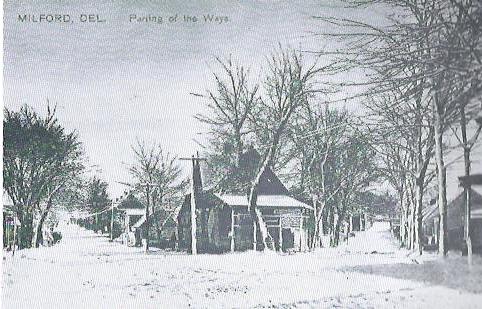


Have you ever wondered how the street you live on in Milford got its name? Milford Historical Society dug into this for a past newsletter and learned some interesting facts about how streets were named in the town.
“Many of the street names reflect custom and citizenry,” the undated article began. “On the Kent County side, the site of the original town, we find the usual names like North, West, East, but on the Sussex side we find more names of prominent families. In the outlying areas of more recent development, we find both picturesque and family names.”
An early map of Milford which is believed to have been created around 1820 when the town was entirely in Kent County. At that time, the town ended a little west of West Street and a little east of East Street, which was then known as East Lane. In deeds of the late 1700s, Front Street was known as First Street but changed by the early 1800s. This explains why the town streets with numbers begin with Second and not First.
Church Street, which is one of the longest streets in town, has been known as several different names over the years. On the 1820 map, the portion of Church Street from Northwest Third Street heading north was known as High Street. At what was then First Street, Church Street was known as Ralston’s Alley and was about half the size it is today. It became known as Church Street from Front Street heading north by 1859 with an extension heading south to the railroad tracks known as Railroad Avenue. By 1943, the entire street was now known as Church Street.
Maple Avenue has gone through the most name changes over the years. The street, which runs from South Walnut Street, crosses Causey Avenue and intersects with Northeast Front Street, was known as Depot Street from 1859 through 1891, but the street did not stretch to South Walnut Street. Instead, it ended at Causey Avenue. In 1897, the street was known as Lake Street but became Depot again to Railroad Avenue.
It was not until 1904 when the street ran from Railroad Avenue to South Walnut Street and it was then known as Hall Street, changing again to Peabody Avenue by 1919 with Lake and Depot Street no longer appearing on maps. Maple Avenue replaced the section then known as Hall Street. By 1930, the entire street was renamed Maple Avenue. One of the reasons the street may have been changed from Hall Street was that after the construction of St. John’s Catholic Church, the street in front of it was named Hall Place. In order to avoid confusion, the name of Maple Avenue may have been changed.
From the late 1800s to the 1930s, Park Avenue was known as Water Street. One interesting street name change was Washington Street, and that change occurred about the same time Park Avenue was changed. Prior to the construction of the Washington Street bridge, the road ended at Southwest Front Street with only a dirt road leading to the electric light plant and the river. Across the river, a street ran from Walnut Street and Park Avenue northward known as Pear Street. When the bridge was built, the two streets were joined and renamed North and South Washington Street.
On the Sussex side of town, maps from 1859 to 1910 showed Georgetown Road for what is now South Walnut Street. The street north of the river was simply named Walnut Street, named for the trees that lined the street. At one time, Walnut Street was not the center of town with businesses lined along Front Street instead.
Kings Highway was originally known as Eugenia Street but was likely changed in recognition of what was formerly known as The Kings Highway. Lakeview Avenue was originally known as Lake Avenue and the name changed around the early 1940s.
Family names also abound in street names throughout Milford. Causey Avenue was named for the Causey family who lived in what is now known as Causey Mansion. Peter Causey was a wealthy merchant who served as Delaware’s governor from 1855 to 1859. In addition, Polk Avenue, Foster Street and Williams Street were all named for members of the Causey family. Williams was the maiden name of Causey’s wife, Maria, and they named one of their sons William. William married Anna Polk. Causey’s middle name was Foster which may have been his mother’s maiden name.
The Sussex side of town became known as “South Milford” and three streets stand out as being named for prominent Milfordians. Marshall Street was named for Dr. William Marshall who also owned a mill on Marshall’s Pond. Trusten P. McColley, a Methodist minister and businessman, built Egglinton Hall on land near what is now McColley Street. Carlisle Lane was named for the Carlisle family as it ran to the shipyard on the river operated by them.
McCoy street was named for the family whose home sat on the corner of South Walnut and McCoy Street where the church now stands while Elizabeth Street was named for Elizabeth VanKirk McColley, the siter of Harry Van Kirk who operated a men’s clothing store in town.
Wilbur Street got its name from Wilbur Simpson, Sr., who operated a men’s clothing store, Interestingly, Simpson’s Lane, which became Seabury Avenue, was named for another Simpson family who owned a large farm in the area near what was known as Simpson’s Woods. The woods were a popular hunting area and where many went to gather evergreens along with mistletoe at the holidays.
Gilchrest Avenue was also named for the family that lived in a house at the corner of S. Washington Street and East Clarke Avenue. As development grew in Milford, many streets were named for family members or businesses nearby. These include Brady Drive, Denny Row, Nailor Street, Pierce Street, Rogers Drive, Salevan Place, Wilkerson Terrace, Betty Street, Caulk Road, Claude Street, Dot Street, Evans Street, Grier Lane, Lemuel Street, Hall Place, Marvel Road, Reed Street, Richard Street and more.
One of the oldest streets in Milford is actually an alley. In 1820, Shockley’s Alley ran between the building that used to be the Banking House in on Front Street to the river. Other alleys in the town include Cedar Alley which runs parallel to Southeast Front Street between Washington and Franklin as well as Pearl Alley which runs from Southeast Front Street to Southeast Second Street behind the Presbyterian Church. Cherry Alley runs between Sussex Avenue and Kings Highway while Plum Alley runs behind the west side of South Walnut Street from Jefferson Avenue to Clarke Street next to Milford Wellness Village.
Barker Alley runs from South Washington Street to South Walnut Street and is named for the Barker family who lived in the brick home that housed the original Lofland Funeral Home, then People’s Place that sits next to the alley. The street with the most interesting name is Buzzard Alley, named for the turkey buzzards that used to gather in a large field along the alley.