



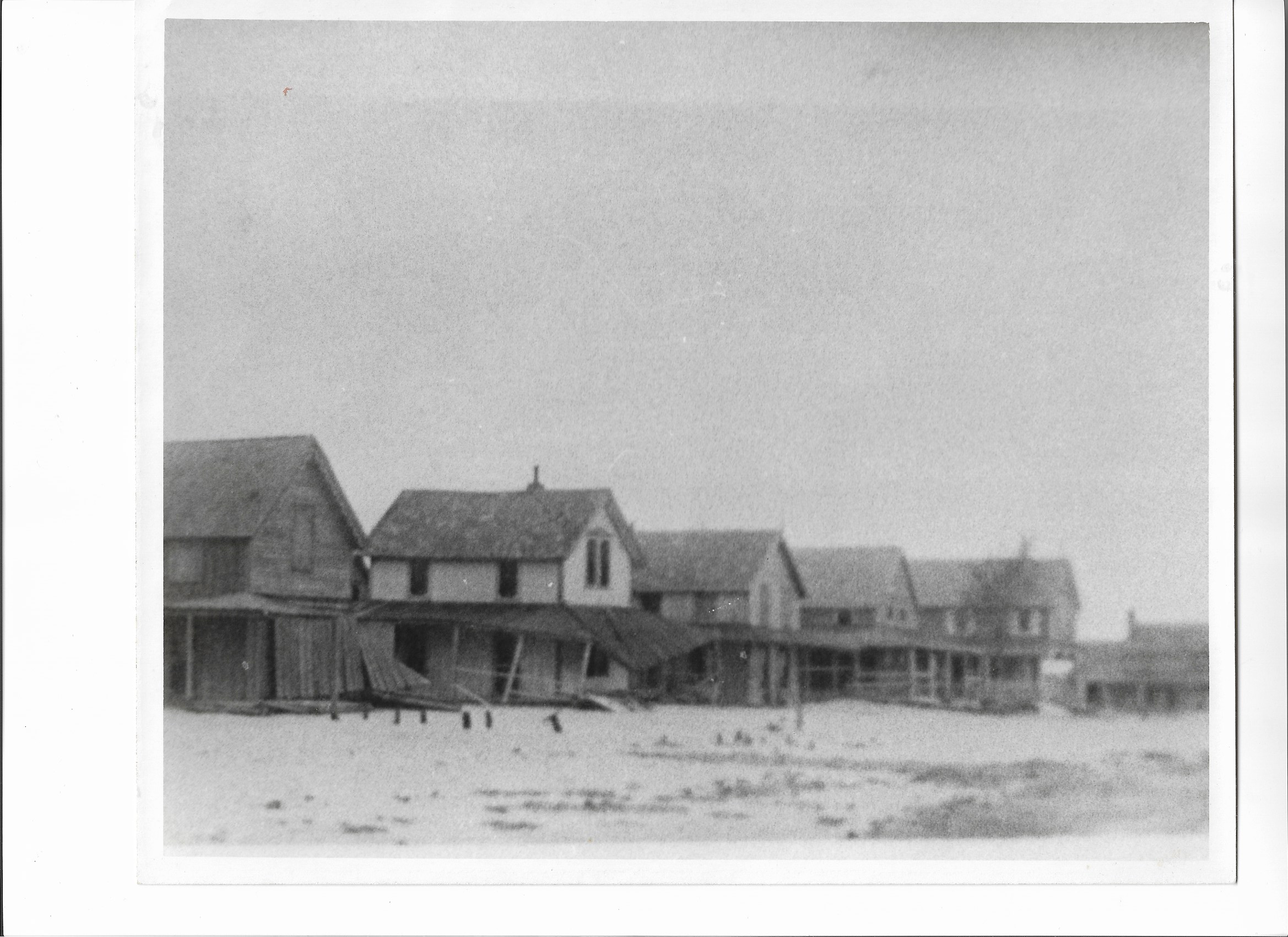

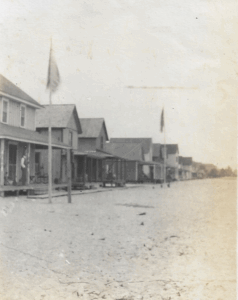
The history of Bowers Beach reveals many names that are found in the history of Milford. The land was one of the earliest settlements along the Delaware Bay, known as Whitwell’s Delight in the 1600s and settled by Francis Whitwell who owned other tracts of land in the area. Whitwell’s Delight was located under a warrant dated 1675, granted by Sir Edmond Andros who was the Governor of the Province of New York.
“Beginning on the west side of Dover River at a point called Mulberry Point, by the bay side, down the bay to the Murder Creek meadow, up the meadow and inland to the head of a small branch, down branch to Mill Creek, down Mill Creek up to Dover River, down Dover River to Delaware Bay, down the bay beginning, containing eight hundred and thirty-four acres of woodland and five hundred and forty acres of meadow,” the warrant reads.
In 1865, Whitwell assigned the property to William Frampton who obtained a warrant of re-survey. In 1686, the land was now called Dover Peere and included 1,374 acres.
Frampton was a wealthy merchant, trading in tobacco, pork, corn and other commodities. In 1686, Frampton requested the removal of goods from a “cave” as he was planning to build a wharf. It is believed that Frampton wanted to build the wharf as it was directly across the stream from what was then Towne Point, where court was held at the time.
Although the petition was granted, Frampton never constructed the wharf as he moved to Philadelphia and died soon after. His daughter, Elizabeth Frampton and Charles Pickering, were the administrators of his estate. They sold the property in early 1686 to William Bassett.
By 1750, John Booth, the oldest son of Joseph Booth, who, along with Sydenham Thorne laid out the town of Milford, owned Whitwell’s Delight/Dover Peere. That year, in August, Booth sold it to Benjamin Chew, a prominent attorney in Kent County. Chew moved to Philadelphia in 1754 to establish a law practice. Prior to Booth owning the land, 420 acres were sold to Nathaniel Hunn who left it to his children when he died. His children, Caleb and Nathaniel Hunn and their sister Mary Hunn Sipple, sold 300 acres of “fast land” and 120 acres of “marsh land” to John Bowers.
At the time, the area was known as Mulberrie Point or Whitwell’s Delight. After Bowers purchased the land, it became known as Bowers’ Beach. The land remained in possession of the Bowers family until 1847 when ownership transferred to Joshua Adams who had married Elizabeth Bowers, the youngest daughter of John Bowers II.
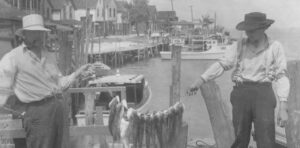
In the early years. Kent County inland residents visited Bowers Beach, traveling in wagons and carts, often draw by oxen. The entire family would travel to the beach, a trip which sometimes took three or four days. Families would lay in a supply of oysters for the fall and later return to gather more for the winter which they preserved in salt water and a covering of salt hay.
In 1844, there was a hotel and tavern in Bowers that was very popular with those in Northern Kent County, especially on what was known as “Big Thursday.” The event stemmed from a law enacted by the legislature that prohibited oyster harvest from May 15 to August 15. Because August 15 fell around the second Thursday of the month, many people rushed to Bowers Beach on that Thursday to obtain their supply of oysters and be home on Saturday. This led to large celebrations being held the second Thursday of August each year.
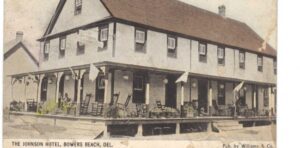
One news report in the Delaware Gazette and State Journal in August 1898 described how raucus Big Thursday could get. During the late 1800s, there was a south entrance where black beachgoers would gather to celebrate.
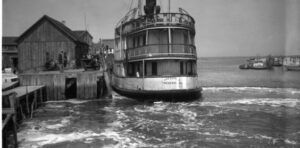
“Big Thursday (two days ago) at Bowers’ Beach was a memorable occasion. It attracted about 5,000 people and was enlivened by at least a dozen fights,” the report read. “Jacob Wilson of Milford, who was attached by an unknown man, had his face and breast slashed by a razor. After he had bled profusely, he was attended by a Philadelphia physician and sent home. A Philadelphia named Kelley was also severely cut. He was put aboard the steamer Githens which conveyed him to Philadelphia.”
The report continued with more incidents of violence.
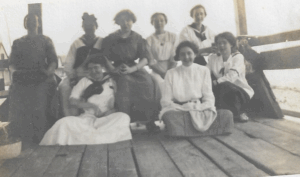
“Alexander Anderson, colored, was the victim of a drunken mob. When he attempted to obtain a drink, the crowd knocked him down, kicked him and hurled beer glasses at him, after which they tossed him through a window, breaking two of his ribs,” the report continued. “John Pyne of Dover narrowly escaped drowning. Throughout the day, few women had courage to leave the hotel steps.
Although Bowers Beach is one town, it is split by the Murderkill River into two sections, leading many to refer to the two sections and North Bowers and South Bowers. Each section of the town has a fire department however, each with its own history.
The South Bowers Volunteer Association was founded in 1927 with financial support from T.C. Beswick, MD. The first fire apparatus was a well-used Model T pumper purchased by Beswick and donated to the company. The pumper was housed in a garage owned by Clayton Kirby. In 1930, the organization was accepted into the Kent County Volunteer Fireman’s Association and the name changed to South Bowers Volunteer Fire Company Inc.
The second piece of apparatus was purchased in 1931 and used as the chief’s car. The first fire chief was William Purnell Powell. In 1931, $275 was raised to purchase land for a fire house at the north end of the beach. It was constructed with blocks pressed from mud that hardened with age, but the building flooded, burnt down and was damaged many times over they years. Eventually, cement blocks were used to reinforce the building, but renovations were constantly necessary.
A fire driven by gale winds and snow destroyed 20 cottages in South Bowers and four in North Bowers. Between 1943 and 1944, the company raised enough funds to purchase a small parcel of land on the Murderkill River which gave them a safe place to draft water and store a rescue boat. That land is still owned by the fire company.
In 1970, the company purchased a large plot of land at the corner of Scotts Corner and Thompsonville Road from Clinton Adams where they constructed a new fire house which was supposed to be a substation. As the company outgrew the original station, the decision was made to sell the building, and it still exists today as a home with the substation becoming the official fire station in 1972.
Bowers Fire Company, located in North Bowers, was incorporated in 1938 but there is very little information on why the company started. There is no bridge connecting the two sides of Bowers at the point. This requires first responders to travel by land around the river to the closest bridge, a trip that can take 20 minutes or more.