




In an effort to clear up several myths related to shared use paths, Delaware Department of Transportation provided details on how these paths are designated and what lands they use to create the paths.
“The Delaware Department of Transportation worked with the City of Milford to develop a bicycle plan that the town adopted in 2021,” Kathryn Beasley, Deputy Director of Community Relations, said. “Any future bicycle projects would be prioritized by the City of Milford and the MPO.”
According to Beasley, every shared-use path is different and requires different land uses. When the lanes are installed, the state attempts to use existing rights-of-way in order to avoid purchasing easements. If there is not enough right-of-way available, the state works with the property owner to purchase an easement on their property. An easement allows the property owner to retain fee simple ownership of the land but allows DelDOT certain rights to use a specific portion of the property as described in the easement.
“Bicycle lanes are five-feet wide and if there is already five-feet of shoulder, additional rights-of-way are not necessary. Therefore, there would be no need to purchase additional easements,” Beasley said. “Again, each project is different, and it would depend on the existing right-of-way, scope of design and the type of improvements being made. The easement for say a utility project would differ greatly from a roadway widening project.”
Beasley explained that the state can also use a temporary trespass agreement or a construction easement, but no matter what, they would consult with the property owner. Beasley also stated that new large developments going through the subdivision process with DelDOT are normally required to build bicycle or pedestrian facilities along their frontages.
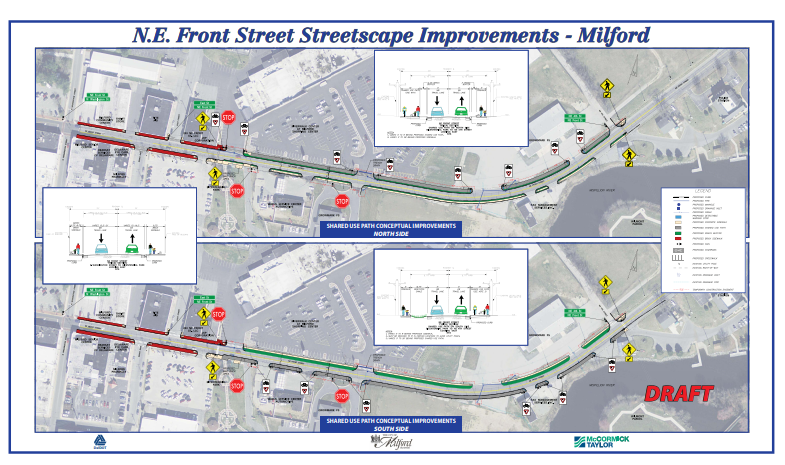
“We are currently working with the City of Milford on two bicycle projects which are not bicycle lanes but off-road shared-use projects,” Beasley said. “These are on Northwest Front Street and Route 113.”
Although DelDOT does occasionally use eminent domain to obtain land for projects, they are required to pay the appraised value for the property. When DelDOT exercises the power of eminent domain, they must notify property owners at least six months prior to the action and attempts to negotiate with the property owner during that time. DelDOT obtains an independent appraisal and provides a written offer to the property owner. Property owners have the right to obtain and pay for their own appraisal and submit it for review.
If there is no agreement reached between the parties, DelDOT files legal proceedings to exercise eminent domain which the property owner has a right to challenge. A property owner can challenge the amount offered, the necessity of taking the land and the justification for public use. Just recently, landowners at Route 1 and 16 were awarded $5 million by a jury for land obtained by eminent domain. DelDOT offered $1.48 million for the four-acre parcel and $144,700 for an easement. The property owners obtained their own appraisal, and a jury determined that appraisal was more accurate.
Delaware began creating more bicycle paths under Governor Jack Markell, an avid bicycling enthusiast. The state created a plan to improve safety for cyclists with physical separations to avoid pedestrian and cyclist injuries and deaths. In 2010, Delaware adopted the Complete Streets policy to create a transportation system that is accessible and safe for everyone. The bicycle paths being added in Milford and other municipalities are due to a state initiative to create safer methods for pedestrians and bicyclists to travel.
“Bike paths encourage physical activity, which is crucial for individual health and reducing healthcare costs,” the Delaware Bike Council reports on their website. “Bike paths attract tourism and boost local businesses. Studies indicate that properties near bike paths tend to have higher values. Bike paths reduce traffic congestion and air pollution, which can improve overall community well-being.”
Another benefit to pedestrian and bicycle paths is that they provide an alternative to motorized transportation which reduces carbon emissions. There is also increased public demand for traffic calming measures, which bicycle paths provide, lower speed limits and more shared-use paths.
The City of Milford Bicycle Master Plan can be found by visiting here.