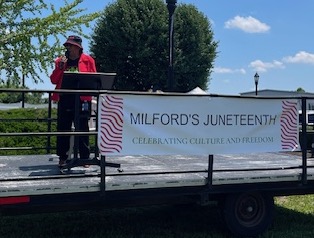


Juneteenth, a federal holiday that commemorates the day that signaled the end of legalized slavery in the United States, was celebrated in Bicentennial Park on June 19, 60 years after Union Major General Gordon Granger arrived in Galveston, Texas, to announce that all enslaved people in Texas were free. The date was two years after the signing of the Emancipation Proclamation that only ended slavery in Confederate States. After an opening blessing by Gwen Fountain, Beauty Marsh performed a song.
“This is our third year celebrating Juneteenth in Milford and we’re glad you guys are in attendance today,” Darron Johnson-Wilson, Master of Ceremonies, said. “There are several celebrations taking place today, so we thank you for being in Milford and supporting us as we continue to grow and show unity for all races in our community.”
Brandon Ferro sang a few gospel songs to commemorate the occasion before Dr. Reba Hollingsworth took the stage to provide some history of Juneteenth.
“Juneteenth is a holiday, not just for black people, but for all citizens of the United States,” Hollingsworth said. “Juneteenth is one of the oldest holidays commemorating the end of slaver in the United States. Although the Emancipation Proclamation was issued on January 1, 1863, it did not immediately free all the enslaved people in the United States. Texas, for instance, was considered a safe haven for slavery long after the proclamation.”
Hollingsworth continued, explaining that it was not until Granger arrived in Texas that the news that slavery had ended. What Granger announced was General Order Number 3 which stated that all slaves are free.

“This involves an absolute equality of personal rights and rights of property between former masters and slaves, and the connection heretofore existing between the, becomes that between employer and hired labor,” the order read. “The Freedmen are advised to remain at their present homes, and work for wages. They are informed that they will not be allowed to collect at military posts; and that they will not be supported in idleness either there or elsewhere. They are informed they will not be allowed to collect at military posts; and that they will not be supported in idleness either there or elsewhere.”
The enslaved people had no idea they had been granted freedom two years before, Hollingsworth said. Lincoln hated the monstrous injustice of slavery, thought it was an abomination. However, his real plan was that black people would leave America as the Hebrew children left Europe.
“Abraham Lincoln, like many white people of the time, used the “N” word all the time, in public and in private,” Hollingsworth said. “He conceived a plan to liberate slaves through compensation of slave owners by the United States Government.”
Hollingsworth stated that Lincoln offered to pay $900,000 at $90 over 10 years, but her information was slightly incorrect. In fact, Lincoln proposed paying $300 per slave. Delaware representative George P. Fisher countered with $500 per slave which would have totaled $900,000. The state would then pay the slave-owners value of the slaves, but the measure did not pass the Senate and it was also unsuccessful at the federal level. Johnson-Wilson commended Hollingsworth for her knowledge, pointing out that she was 98 years old.

“The Bible teaches us that our people are lost because of lack of knowledge. The year is 2025 so it is not because it is not there, it’s just because we have to know how to access it. There are a lot of traps and tropes out there,’ Dr. David Carter, former Milford High School and current Georgetown Middle School principal, said. “Education is one of those things you crawl and scratch because they didn’t want African Americans to know, because when you learn to read, you read to learn.”
Carter continued, stating that it was important to push children into education because so many African Americans fought for the ability to get a quality education.
“A lot of times we hear about Plessy vs. Ferguson where it said education could be separate but equal,” Carter said. “But it really wasn’t that. The beauty of it was that our kids were being taught by people who looked like them, that people cared about them, that people could talk to them about physical contracts that aren’t written down, like don’t go down that road, don’t say that, don’t look like that, because that can get you jammed up.”
It was Brown vs. Board of Education, Carter stated, that changed the landscape of schools because it said separate but equal was not happening. Black children did not have the same kind of schoolhouses, they did not have access to the same books or other educational benefits as white children. What they did have is educators that looked like them, which led to the dark side of the legislation.
 “What they don’t tell you is that 90 percent of the principals of color were fired because of desegregation. They don’t tell you that many high school black teachers in the southern states were fired,” Carter said. “So, fast forward to 2025, and one of the common things you hear is that there aren’t a lot of people in education that look like the students.”
Carter explained that those who were fired passed along that message to their sons, daughters, grandsons and granddaughters, discouraging them from entering education because of what happened to them.
“It was for that very reason I stayed in education,” Carter said. “I would see students when I first became a teacher and a coach and ask them about what their next steps were beyond high school. When I started out, I was a middle school teacher, then a high school football coach, so that gave me access to students that just didn’t know what they didn’t know.”
Growing up with nothing, Carter learned firsthand how difficult life could be for students like him.
“Things like breaking up the household when you sign up to be in low-income housing. Understanding Cash Advance Plus and things like that are a setup because they may loan you $500, but there is no point in time when you will have $2,000 to pay them back,” Carter said. “It is about understanding that we have to get away from the crab in the pot mentality to lift each other up, help each other out. It’s important for you to tell your youth the importance of education because no one can take that high school diploma from you. No one can take that college diploma from you. No one can take the skills and trades you learn away from you.”
 Desiree Hazzard, Miss Milford for America Strong, reminded those in attendance that it was hot outside, but her ancestors were not standing listen to speeches during the weather, but picking cotton. Her platform was mental health as there was a strong stigma in acknowledging mental health among African American cultures.
“Our ancestors were resilient when they arrived at this unknown land, but they had to adapt to the harsh reality of slavery,” Hazzard said. “On June 19, they were told slavery had been abolished but our ancestors suffered long lasting effects from slavery, such as institutionalized subjugation, post traumatic slave syndrome and a legacy of enduring prejudice.”
Brandy Walker, Mrs. Magnolia and a runner up for Mrs. Delaware, also spoke about mental health.
“Juneteenth is a celebration of freedom, but for me, it’s only a celebration of legacy, of the strength that runs through our bloodlines of ancestors who endured the unthinkable so that we could stand here today, gathered in joy, pride and empowerment,” Walker said. “Our freedom isn’t just personal, it is emotional and spiritual, too and our community deserves to thrive, not just survive.”
 Dennis Spence read poetry that emphasized the resilience of his ancestors while other speakers continued the theme of pride, empowerment and freedom. Entertainers performed musical numbers related to the event as well. After the speeches, DJ Dave played dance music, encouraging all in attendance to get up and dance to celebrate this momentous anniversary.
The first Juneteenth celebration was the following year with prayer meetings and the singing of spirituals. Celebrants wore new clothes as a way of celebrating their freedom