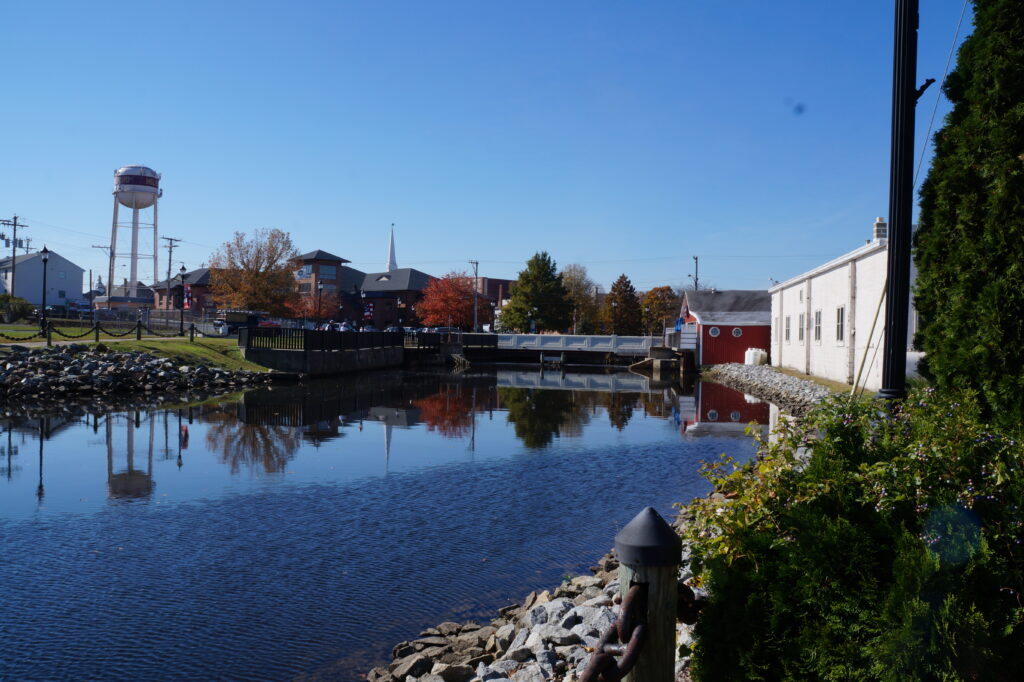







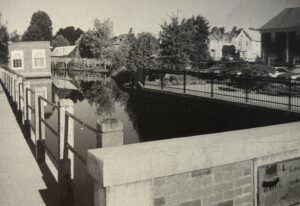
The construction of the Walnut Street bridge which connected north Milford with south Milford create an unexpected issue – a rivalry between the northern and southern side of the town.
North Milford was established first when the town was laid out by Joseph Oliver in 1787. When Milford was young, there was not much in south Milford other than the Causey Mansion as the Causey’s and their heirs owned large areas of land surrounding the mansion that was used for farming.
As the shipbuilding industry grew, however, more homes were constructed, especially along the river to allow easy access for employees to get to the shipyards. The railroad, with a station established in south Milford, accelerated the growth of the southern section of town. For much of the 1800s, there were two separate communities in Milford, each with their own local government.
What this created was a rivalry, especially among young people, who lived on either side of the river. When the town was incorporated in 1887, three council seats were given to north Milford and three to south Milford, acknowledging that there needed to be representation of both sides of the river.
“There had been a time when a South Milford boy who dared to cross the bridge into North Milford got a rough reception which was eagerly returned when the situation happened to be reversed,” A History of Milford Delaware compiled by the Milford Historical Society reads. “Boys had been known to walk down the creek bank and swim over rather than cross the bridge on Walnut Street.”
The rivalry was fueled by separate school systems and could not simply be attributed to childish prejudice. As late as 1910, there was a great rivalry between the firefighters.
When the schools were consolidated and a. new school building constructed in North Milford in 1904-05, the school in south Milford was abandoned and the rivalry began to fade.
Even after the city combined into one Milford there were discussions that reflected the rivalry. On March 28, 1941, newspapers report that after a year’s delay and long argument, decisions had been made regarding street names in town. The problem was that north and south Milford had duplicate street names which were causing confusion. The solution was to use geographic location to name streets.
Front Street became Northeast or Northwest in Kent County and Southeast or Southwest in Sussex County. The same was true of Walnut Street as well as numbered streets. At the railroad tracks, Causey Avenue was changed to Lakeview Avenue; Railroad Avenue became Church Street; Peabody Avenue became Maple Avenue; Eugenia Avenue became King’s Highway and Water Street became Park Avenue.
What is even more interesting is that newspaper accounts when the streets were renamed specifically states there is a “north” and “south” Milford, long after the city was combined into one. This indicates that even 54 years later, there was still somewhat of a rivalry in Milford.