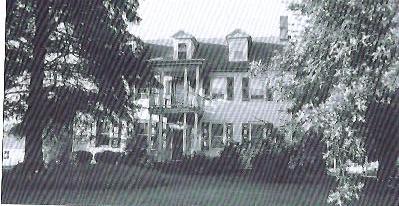

 Egglinton Hall, which is listed on the National Registry of Historic Places, was the subject of a variance public hearing at th Milford Board of Adjustments meeting on March 12. The owners of the property, David and Brenda Carr, were requesting three variances.
“The applicant is proposing to subdivide the property that currently contains two single family detached dwellings on one property into two lots, each containing a single-family detached dwelling,” City Planner Rob Pierce said. “In order to subdivide the property, the owner has to obtain three variances. The applicant is seeking to reduce the minimum lot area from 8,000 square feet to 5,746 square feet. The applicant is seeking a variance to reduce the lot width from 80 feet to 58.68 feet. The applicant is seeking to reduce the southern side yard setback on proposed lot one from 8 to 7.6 feet.”
Brenda Carr provided details on the reason for the request to the board.
“We have 25 years of renovating Egglinton Hall and making improvements, we’re relocating” Carr said. “When we purchased the property, it had been sitting empty and was in a deteriorating state, home and yard. Improvements and updates have been made with the house and property. The home has been updated to the modern family with beautiful landscaping now.”
Carr continued.
“One of the improvements was building a guest house on the property which is used by our daughter. We find ourselves wanting to downsize and our decision to sell Egglinton Hall did not come lightly,” Carr said. “We’ve always strived to honor Egglinton Hall as an historic home and we feel that dividing the property to give the smaller house a smaller lot gives the historic house a bigger lot. It is a big home, and it needs a bigger space. It has an entertaining area; it has a pool and a garden area. So, this gives room for the house to not feel crowded. We have strived to keep the integrity of the property, and we feel it honors the house. It also gives an aesthetic value that enhances that road and that home.”
Chairman Brendan Warfel clarified that the main reason for the request was to keep the guest house separate from the main house and Carr confirmed that was true as well as creating a bigger lot for the historic home. Board member Ron Rizzo asked if the Carr’s daughter was still living in the home.
“She will be in the house for a little while, she is also selling,” Carr said. “We are all relocating.”
City Solicitor Greg Morris asked if what Pierce stated to the board was true to the best of Carr’s knowledge and she confirmed it was. She also stated that surrounding properties were significantly less than 8,000 square feet, so that would put the smaller lot more in line with neighboring properties. Carr’s said their main purpose was to respect Egglinton Hall and its value to the city as well as the state.
Egglinton hall was originally built in 1790 by Henry Egglinton as a one-room home. It was purchased by a prominent Milford citizen, Reverend Trusten P. McColley who constructed the home that stands today.
“It just surprised me, the city comments on this separation for a lot of two homes on properties already built,” Julie Morris who gave an address on Cedar Beach Road said during the public hearing. “This staff was very positive and pushing forward the developer over on Walnut Street with a separation of properties where homes weren’t even built yet and the neighboring lot was much closer than this one. So, it just really surprises me that this is a homeowner, not a developer, and you guys are not supporting this kind of separation of properties. It just surprises me.”
Pierce read an email into the record from Martha Pileggi whose address is on Southeast Second Street. Pileggi was unable to attend the hearing.
“I would like to oppose the zoning variances for proposed parcels 205 Fisher Avenue and 213 Fisher Avenue,” Pileggi wrote. “Variance one reduces the lot size by 24 percent and variance two reduces the lot width by 26 percent. These are not small amounts. The variances requested are self-created and they disregard city zoning laws and neighborhood conditions. By creating a variance, other landowners will be encouraged to ignore lot size, and the city would be creating neighborhood crowding and discord.”
Pileggi claimed that the residents of the property had created other hardships in the neighborhood.
“These residents have been creating hardships and harassment for other neighbors for some time now,” Pileggi said. “Loud parties, burning of toxic materials, drug use, using the front lawn as a dirt bike track and drag racing up and down the street day and night is an ongoing problem. They have also built a wooden fence that reaches to the street so that there is no room to safely walk on that side of Fisher Avenue, another code infraction. Their total disregard for neighbors and the citizens of the city is appalling. Why should we let them benefit from their bad behavior and disregard of the neighborhood and city.”
Pileggi asked the board to deny the variances.
“These people are clearly not entitled to a variance,” Pileggi said. “There are too many citizens that respect the city’s code, law and zoning and want this city to retain proper laws and regulations.”
Despite Morris and Pileggi’s statements, the Board of Adjustments approved the three variances unanimously.