







 Seventy-two years ago today, eleven African American students walked through the doors of Milford High School, beginning a difficult chapter in Milford’s history that would ultimately become part of the community’s path toward educational equality.
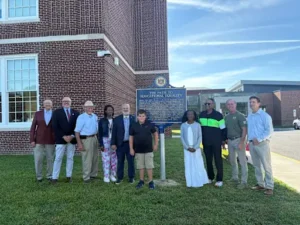
On September 8, the Milford School District gathered at Milford Middle School, the former Milford High School, to rededicate the Delaware Public Archives historical marker recognizing the Milford Eleven and the events surrounding the integration of Milford schools.
The timing of today’s rededication is significant. September 8 marks the anniversary of the students’ arrival at Milford High School in 1954, as well as 21 years since the original “Path to Educational Equality” historical marker was presented by the Delaware Public Archives in 2005.
The original marker was temporarily removed during the construction phase of the Milford Middle School reconstruction. With the school reopening in 2025, the marker has now been returned to the building where this history took place.
“Having this marker back in this building is important,” said Superintendent Travis Moorman. “Our students walk these same halls every day, and they should know the history of the place they call school. That history includes moments we can be proud of, as well as moments that were difficult for our community. We have a responsibility to make sure our students understand all of it.”
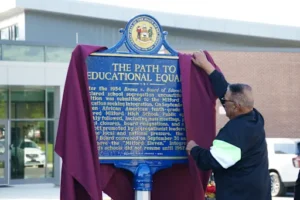 On May 17, 1954, the U.S. Supreme Court ruled in the case of Brown v. Board of Education, declaring racially segregated public schools unconstitutional. In August 1954, a petition was submitted to the Milford Board of Education requesting integration. A plan for gradual desegregation was adopted, and on September 8, eleven African American 10th grade students were admitted to the district’s High School at this location.
On September 17, approximately 1500 persons met to discuss the situation. Many signed a petition opposing the action. This was the first overt public resistance to integration since the Brown ruling. The school was closed the following Monday so that a public meeting could be held. A large crowd gathered to express their opposition, and the closure of the schools was extended. Failing to receive the support of the State Board of Education, members of the Milford Board resigned.
On September 26, several thousand people attended rallies organized by segregationist Bryant Bowles advocating a boycott of the schools. Less than one-third of the students attended when the schools reopened. The boycott spread, and several Sussex County schools were closed as a result.
 With the national media focused on events in Delaware, two of the members of the Milford Board resumed their positions and appointed replacements for the others. The Board reconvened on September 30 and decided to remove the eleven students “in the interest of the welfare of the children and the community as a whole.” Eight years would pass before integration of Milford’s schools was resumed.
The Milford Eleven were Kenneth Baynard, Leo Blue, Orlando Camp, Charles Fleming Jr., Eugene Harris, Irene Pettyjohn, Lillian Simmons, Madalene Staten, Annie Ruth Thompson, Edna Turner Sharp and Ronald Vann. All were awarded diplomas at the Class of 2012 commencement ceremony, 58 years after they were originally enrolled.
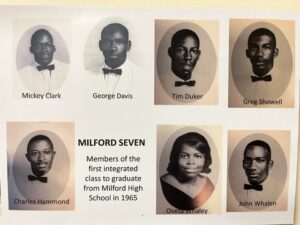 Today’s rededication also recognizes the Milford Seven — Mickey Clark, George Davis, Tim Duker, Greg Showell, Charles Hammond, Oveta Whaley and John Whalen — who were part of Milford’s continued path toward educational equality.
The rededication included student voices, with Milford Middle School students Cayden Burch and Chris Viccama sharing essays and reflections on Milford’s history. Viccama also presented on Milford’s path to educational equality.
The Milford High School Chamber Choir performed The Star-Spangled Banner and Lift Every Voice and Sing. Superintendent Moorman and Delaware Secretary of Education Cindy Marten also offered remarks.