



This is a guest article written by Milford Advocacy for the Homeless and published as a blog on their website. We are using it with permission.
 On July 17, 2026, Martha Gery, Founder and President of Milford Advocacy for the Homeless, Inc. (MAH), participated in a panel discussion during Homelessness in Delaware: Housing Amidst Uncertainty.
The statewide event brought together leaders, service providers, housing professionals, advocates, and community partners to discuss supportive housing, shelter and transitional housing capacity, vulnerable populations, and the role of state and local leadership in responding to homelessness.
Martha was invited to bring Milford’s perspective to the conversation and share what MAH has learned through five years of walking alongside individuals and families experiencing homelessness and housing instability.
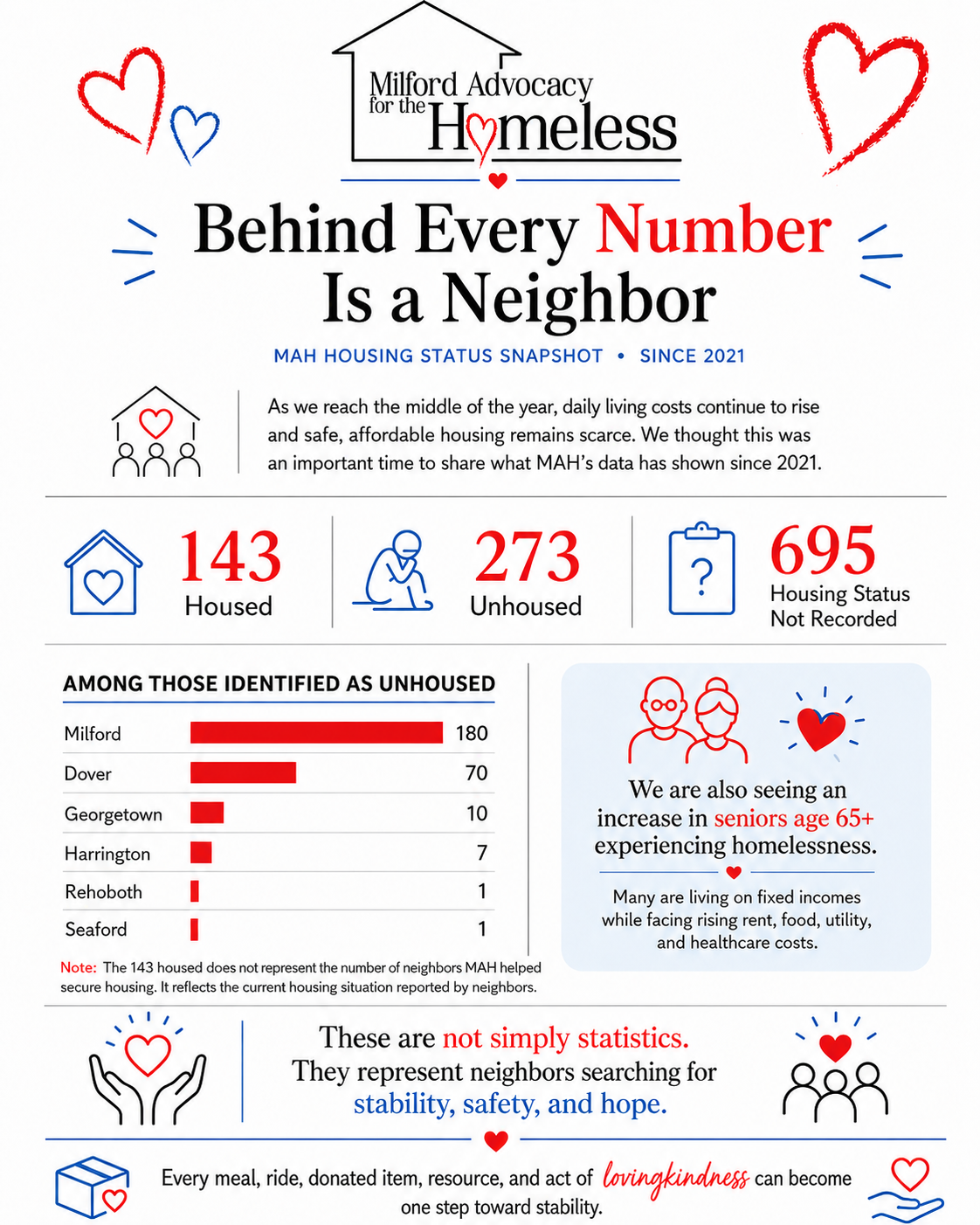
Based on self-reported information provided by the individuals MAH has served, our most recent point-in-time snapshot identified 273 unhoused neighbors in Milford.
This number should not be interpreted as a complete count of every person experiencing homelessness in our community. It represents the people who connected with MAH and voluntarily shared information about their housing situation at a particular point in time.
A Point-in-Time count is designed to provide a snapshot of homelessness during a specific period. It is useful for identifying trends and comparing changes over time, but it may not capture every person who is without safe and stable housing. The point in time that this data is represents is July 1, 2026.
In Milford, many people experiencing homelessness are largely invisible.
They may be:
- Working while sleeping in their vehicles
- Moving between the homes of friends and relatives
- Staying temporarily in motels when they can afford a room
- Sleeping in tents or other locations away from public view
- Living in overcrowded or unsafe conditions because no other housing is available
Because Milford does not have an emergency homeless shelter, many of our neighbors create temporary survival arrangements that are difficult to identify through traditional counts.
MAH’s five years of local data also show a troubling year-over-year increase in the number of adults aged 65 and older experiencing homelessness or housing instability.
Some are living on fixed incomes that have not kept pace with rising rents, utilities, food, transportation, and medical expenses. Others are facing eviction, the loss of a spouse, a health crisis, or the sudden end of an informal housing arrangement.
Delaware’s 2025 statewide Point-in-Time Count reported that adults aged 65 and older represented 6.6 percent of the people counted. The same statewide count identified 1,585 people experiencing homelessness, a 16 percent increase from the previous year.
For older adults with limited income, recovering from a housing crisis can be especially difficult. Even when they could afford a modest monthly rent, they may not have enough money for an application fee, security deposit, first month’s rent, utility deposit, moving expenses, or other costs required to secure a home.
The stories shared with MAH consistently point to two primary causes of homelessness in our community:
Delaware faces a shortage of nearly 20,000 rental homes affordable to households earning no more than 50 percent of the area median income. State housing research has also projected the need for thousands of additional rental and homeownership units to meet Delaware’s growing demand.
When affordable units are unavailable, even people who are working, receiving Social Security, or earning another form of steady income may have nowhere they can reasonably afford to live.
A vehicle becomes a bedroom.
A friend’s couch becomes temporary housing.
A motel becomes an emergency shelter until the money runs out.
These arrangements may keep someone out of sight, but they do not provide the stability, safety, or dignity of a permanent home.
The 273 individuals reflected in MAH’s local data are not simply statistics.
They are neighbors searching for stability, safety, and hope. They are seniors choosing between rent and medication. They are employees who report to work each day after sleeping in a vehicle. They are parents trying to keep their children safe while moving between temporary places to stay. They are individuals navigating illness, disability, job loss, grief, and unexpected financial emergencies.
Each number represents a person with a name, a history, strengths, challenges, and hopes for the future.
At MAH, we believe meaningful change begins by listening to people, understanding the barriers they face, and treating every person with dignity and respect.
Participating in this statewide panel allowed MAH to make sure Milford’s experiences were included in the larger conversation about homelessness in Delaware.
It also reinforced the need for communities, nonprofit organizations, housing providers, businesses, government agencies, and residents to work together.
Delaware needs additional affordable and supportive housing. Milford needs emergency and transitional options for people who have nowhere safe to stay. Our seniors need housing assistance that recognizes the realities of living on a fixed income. Working individuals and families need pathways to housing that are attainable based on the wages they earn.
Most importantly, our neighbors need to know they have not been forgotten.
MAH will continue collecting local data, sharing what we are learning, strengthening partnerships, and walking alongside people as they work toward safety and stability.
Homelessness may be complex, but every meaningful solution begins with the same commitment:
See the person. Listen to their story. Protect their dignity. Work together to create a path forward.