


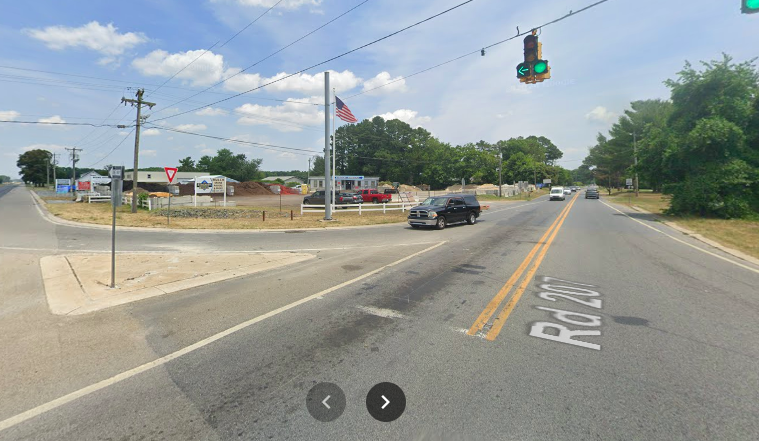


In October 2023, Delaware Department of Transportation (DelDOT) completed a Traffic Impact Study (TIS) review for a proposed Wawa that would be located at the corner of Johnson Road and Dupont Highway in Lincoln. As of now, only the TIS has been issued and no preliminary plans have been submitted or approved by Sussex County Council. According to Sussex County property records, the land where the proposed Wawa will go is in the name of JKJ Properties, owned by Jim Weller.
“This TIS impacts a proposed 5,585 square-foot convenience store and gas station with 16 vehicle fueling positions on the northeast corner of Johnson Road and US Route 113,” the memo reads. “The property is currently zoned as C-1 General Commercial, and the developer does not plan to rezone the land. Construction for the project is anticipated to be completed in 2024.”
DelDOT recommended that, if Sussex County should approve the project, it requires the developer to make certain upgrades to the intersection. This would include constructing an unsignalized entrance into the proposed Wawa on Johnson Road at least 545 feet from the current intersection. They would also have to add turn lanes on Johnson Road and Route 113 for safety. This could require complete reconfiguration of the intersection at developer expense. In addition, the developer would be required to enter a traffic signal agreement with DelDOT along with cross-access easements.
In addition, the developer would be required to include a 15-foot-wide easement along 113 and Johnson Road where they would be required to add a shared-use path. The shared use path must connect both Johnson Road and Route 113. ADA compliant curbs are required along with a minimum five-foot wide bicycle lane. Utility covers are not to be placed in any of the bike lanes and bicycle parking provided close to the building.
In early 2024, Wawa applied for Transportation Infrastructure Investment Fund (TIIF) funding in the amount of $1.795 million. This fund was created in 2019 by lawmakers to support projects that created a significant number of direct, permanent, quality, full-time jobs. According to a social media post by Representative Bryan Shupe posted on social media about TIIF funding.
“In 2024, I sat in a room with DelDOT then-Secretary Nicole Majeski, then-Secretary Deputy Secretary Shante Hastings, lawmakers and the owners of the Wawa land,” Shupe posted. “We discussed whether Wawa’s proposed Lincoln store could qualify for TIIF funding. The answer was simple. No. This project did not meet the standards for TIIF. That was the decision at the time.”

Shupe continued, stating that a few months after that denial, the TIIF Council changed the rules, and the project denied TIIF funding in 2024 would now receive $1.795 million. The same week, it was revealed that TIIF funding would be given to Royal Farms in the amount of $1.8 million for a new store they plan to build in Milton. In an unprecedented move, DelDOT refuted Shupe’s statement that TIIF funds were designed for high paying jobs in a social media post.
“In 2019, Rep. Shupe voted yes on SB 61 with HA creating the TIIF Council,” the post reads. “Unfortunately, Mr. 302 Bryan Shupe did not offer an explanation in his video over the weekend about the TIIF program and its purpose while declaring he is “holding DelDOT accountable” and calling out “reckless spending” when he, in fact, supported the creation of this economic development initiative. These claims require a response to hold him accountable as well.”
According to DelDOT, TIIF is not an extension of DelDOT but an economic development program overseen by a nine-member independent council that evaluates proposals in a public forum and makes recommendations. Since the inception of the program, 28 businesses have been awarded more than $50 million which has supported the creation of over 12,000 jobs in Delaware. Grants have been awarded to healthcare and wellness organizations, business parks, manufacturing and distribution companies, biopharmaceuticals and more.
Most of the businesses who have received TIIF funding employ large numbers of staff, including Bayhealth Sussex Campus, CMT Harrington, Milford Corporate Center, Frito Lay, and First State Logistics Park. Bayhealth Sussex alone employes over 5,000 and the Milford Corporate Center is slated to bring over 1,300 jobs. According to statements by DelDOT, the Royal Farms in Milton and the Wawa project in Lincoln will employ around two dozen mostly part-time employees at each location.
Shupe responded, stating that the TIIF was written so that only businesses who were bringing substantial, full-time positions to the area qualified. A reading of the final bill approved by the General Assembly states that in order for a business to qualify, they must “meet certain employment standards.” The application for funding requires anyone who seeks TIIF funding to “provide a detailed description of how the project will create a significant number of direct, permanent, quality, full-time jobs.”
In addition, the TIIF Employment Standards Guidelines, although it does not include how many jobs are considered substantial, does have specific requirements. Part-time employees may not be aggregated into full-time employees. Employee compensation must exceed $35,000 per year annually and the company must offer health benefits. The employee compensation must also be based on full-time hours of at least 35 per week.
“While the Council acknowledges that all new and expanding businesses in the state in some measure add to the economic prosperity of the state, the following development types are generally considered to be excluded from consideration for TIIF based on the adopted jobs definitions,” a section of the guidelines entitled “Generally Excluded Development Types,” reads. “Projects which do not attract or retain employment opportunities; restaurants, for-profit retail; convenience stores; gas stations; hospitality; residential; mixed-use projects that incorporate one or more of these categories.”
The regulations go on to say that the Council can award funding to Generally Excluded Development Types (GEDT) if they demonstrate by extensive narrative how their particular jobs creation differs from other similar GEDTs such as upward mobility, turnover rates, etc. They must also demonstrate by extensive narrative and supporting documentation of qualitative and quantitative arguments how the GEDT will create or stimulate secondary jobs growth in the region of the project; and provide a comprehensive environmental justice analysis (using industry standard screening and mapping tools) of the impacts the proposed GEDT will have on the surrounding area.
“The transportation improvements under consideration for GEDTs will be limited to improvements with direct public benefit such as increasing intersection levels of service and/or safety improvements,” the regulation continues. “Site entrances including auxiliary lanes and frontage improvements for the purpose of enabling entrance into and egress out of the GEDT including pedestrian facilities along the frontages, which are required by DelDOT’s Development Coordination Manual or by local regulations for access to municipality-maintained streets are considered developer-funded investments in the economic development project and are not TIIF eligible”
Based on the description of what cannot be covered by TIIF funding, the Wawa project should have been disqualified as DelDOT’s own TIS stated that adding the Wawa would degrade the safety of the intersection without adding turn lanes and an entrance on Johnson Road. All other intersection changes were related to pedestrian and bicycle traffic which TIIF funding cannot be used to install.
The TIIF funding awarded to Wawa was for widening and restriping eastbound Fitzgerald Road and westbound Johnson Road to provide dedicated left, through and right turn lanes with associated traffic signal modification and pedestrian crossings. It would also cover the engineering, design, construction, inspection, utility relocation and contingency for upgrades to an intersection required by DelDOT of the developer in a TIS. The award states that there would be only 34 new jobs added in a three-year period. The public endorser, which is required for any TIIF funding was Senator David Wilson.
It is unclear when Wawa will submit plans to Sussex County for approval of the new store in Lincoln or when they will begin construction if the plan is approved.




The TIIF guidelines specifically exclude both retail and gas stations from eligibility – Wawa and Royal Farms are both retail and gas station. The guidelines also specify qualifying projects should be able to demonstrate the hiring of significant numbers of full-time employees with benefits – neither of these projects meet that requirement.
Are you really justifying $3.4M in public funds to hire 2 dozen part-time workers?
Who do I call to get an explanation and find out what compelling evidence was provided to rationalize this insanity. Or is this an “I scratch your back, you scratch mine” under the table agreement?