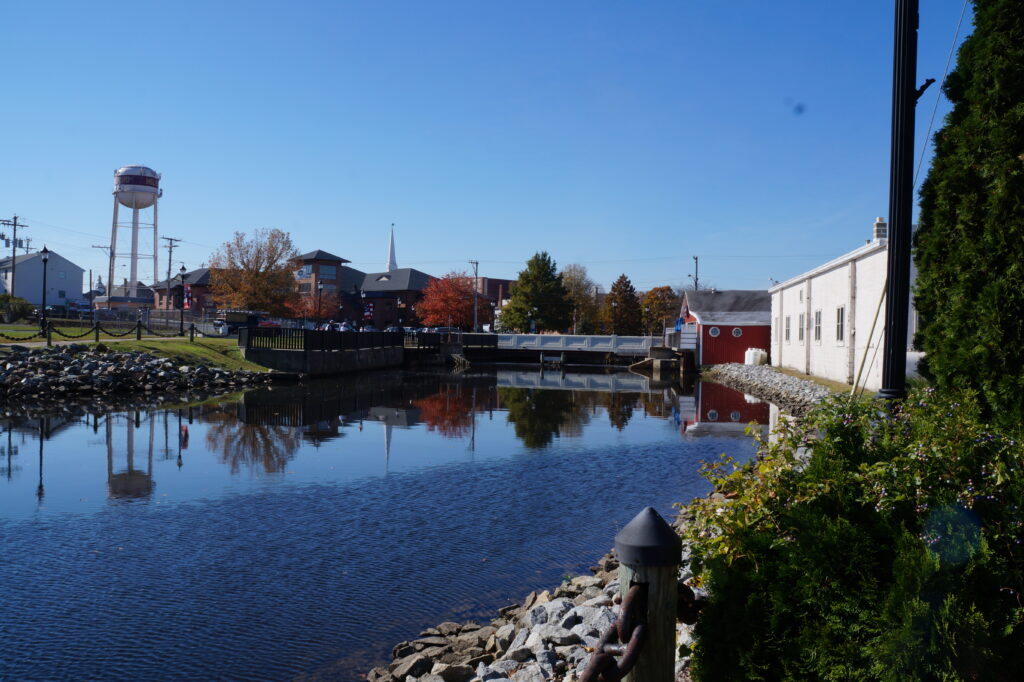


As we continue our series of the small towns that surround Milford, we move our attention to Ellendale, a little town with a lot of history. Ellendale was initially a swamp with a forest containing tributaries that connected the Delaware Bay to the Chesapeake Bay. Early Europeans created a thriving fur trading industry where the town now stands, and it was a popular hunting ground for the Nanticoke until they were driven out by the Lenape.
In the late 1700s, the land was known as Bennett’s Pleasure and, as Europeans arrived, farming and timbering made the swamp smaller. However, the “Nanticoke Swamp” as it was known then, was a place where criminals often hid from the law. In fact, this is mentioned in a 1759 murder deposition. One of the reasons this was a popular place to hide from the law is that Maryland and Delaware were in a boundary dispute over the area.
In 1780, The Black Camp Insurrection took place near Ellendale. This was a brief loyalist uprising opposing the move toward independence from Britain. Most of the insurrectionists were poor farmers who were frustrated with the state they were in due to the war. Bartholomew Barnum and William Dutton were the two main leaders.
Because residents of northern Sussex County were removed from the centers of rebellion in larger cities, they really had no objection to being ruled by the British. During the war, markets were shut down and products were sometimes seized by both the American and British armies. In 1780, a drought destroyed most of the summer wheat and many of the farmers in what is now Ellendale were unable to pay their taxes. This was not the trigger for the insurrection, however.
On July 15, a group of men came together to discuss the hardships they were facing. It was known at this point the British had captured Charleston and many of the farmers believed the British were about to secure all the southern colonies from Maryland to Georgia. They came up with a plan to secure Sussex County for the British, hoping it would earn them favor with the Crown. With Barnum in the lead, Dutton became a captain, William Ratcliffe was a first lieutenant, Job Townsend a second lieutenant and Sengo Potter the company clerk. Similar groups formed in Cedar Creek Hundred as well.
The groups set up in the western portion of Cedar Creek Hundred and organized into militia companies. The largest camp was in Black Swamp which is where Ellendale sits today. In August, they went public as 100 men were sent across the countryside, seizing arms and ammunition from those who seemed sympathetic to the revolution. As they traveled, they gained momentum with eventually 400 to 500 people joining the militia.

Unfortunately, the group was very disorganized and never notified the British. State leaders became aware of their actions and General John Dagworthy was sent from Kent County to disperse them. His militia spent three days chasing them between camps until they were disbanded. About 200 were detained and brought before a military tribunal. Heavy fines were imposed, although some consideration was given regarding poverty. William Deputy, Solomon Veach and John Workman were only fined one pound each. Some were ordered to serve in the Continental Army while 37 were indicted for treason and sentenced to death. On November 4, 1780, all were pardoned, so no death penalties were carried out. However, many were stigmatized by their neighbors for months and encouraged to move away.
In the late 1790s, two villages existed in the area that is now known as Ellendale. Fleatown, which eventually became Federalsburg, was to the north and New Market to the east. A branch of the old King’s Highway connected the two villages while also providing a way to get to Milford and Milton.
The community was first surveyed in 1867 by Dr. John Prettyman who had visions similar to Abel Small, the founder of Lincoln. He named the town after his wife and, once the town was established, it eventually absorbed Federalsburg and New Market.
“Ellendale is a newly laid-out and prosperous village in Cedar Creek Hundred on the Junction and Breakwater Railroad,” the “Delaware State Directory” read in 1874. “It contains several stores, a steam lumber mill and a population of about 150. Distance directly from Georgetown 8 miles and south from Milford 8 miles.”
The steam mill was erected by B.E. Jester & Brother in 1870. In 1872, Henry D. Macklin opened a brick manufacturing company in Ellendale, producing about 50,000 bricks each year. A second sawmill and gristmill were erected in the town in 1881 by Henry Start. In 1886, a basket factory was added, creating 2,000 baskets a day. Between these businesses, there were about 22 people employed.
Canning and refrigeration came to Ellendale in 1886 when Jester & Reed established a canning factory in the town, shipping canned goods to Philadelphia during growing season. By 1891, there were two churches, two stores, a school, a post office, and an evaporator along with the other businesses. The town population had also grown to about 100 people.
Peaches were one of the major crops grow in Ellendale at this time. Some of the more prominent farmers were Mark Davis, Joseph Davis, George Draper, William Phillips, William Prettyman, Frederick Wiswell and others.
Railroads came after the Civil War and many emancipated African Americans settled in the area. In 1898, the Queen Anne’s Railroad was constructed from Queenstown on the Chesapeake Bay through Greenwood, then Ellendale before ending in Milton and Lewes. The railroad brought amenities to Ellendale, including a pump house, watch box, water tower, two stations and a hotel with jitney service to Milton.

“An important postal station on the D.M. & V. R.R. in the southern part of Cedar Creek Hundred, no better section can be found in the state for farmers desiring homes with lower prices, as land sells at the low price of from $10 to $20 per acre,” a description of Ellendale reads in a Nutter Associates advertisement. “Its railroad facilities for marketing are the best. Among the industries located here are a steam saw and planning mill an basket factory, and a cannery and fruit evaporator. It has a daily stage line to Milton with a fare of 50 cents. Telegraph and express offices.”
The town incorporated in 1905 after being surveyed into 13 streets, five alleys and approximately 500 individual lots. The town was centered on the north-south railroad tracks and an east-west main street. However, only about one-quarter of the lots were ever developed.
Many of the farmers in the area were sharecroppers and, during the 1920s, seasonal agricultural workers, both black and white, traveled north from Florida following harvests. In addition to these migrant workers, African Americans and teens worked the local farms seasonally.
Dupont Highway was completed in 1918, intended to be a superhighway. The dream of Coleman DuPont, he envisioned a center roadway for high-speed motorized traffic, electric trolley tracks and separate lanes for heavier vehicles. The highway did not become such a large endeavor, but it did shift residences and businesses from the center of Ellendale. and the Ellendale Volunteer Fire Company established in 1920.

The fire company was established by the town council and the first piece of equipment was a Ford Model T fire truck purchased in 1921. In 1923, they purchased a lot on Main Street and constructed a fire house. Today, they run about 400 fire alarms and 1500 ambulance alarms each year.
The Ellendale State Forest was established in 1927 soon after the establishment of the State Forestry Commission. The first tract was a three-acre plot north of Hudson Pond with the second known as the Appenzellar Tract, between Staytonville Road and the Ellendale Crossroad. The land was given to the state by T. Coleman DuPont. Eventually, the state purchased a 40-acre tract from Harry W. Jester in 1931 to erect a campsite. The Civilian Conservation Corp assisted with the building of the campground.