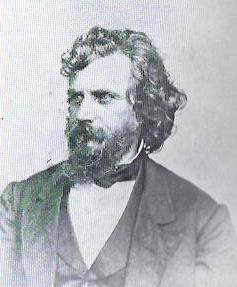


Although Milford has only been home to eight governors, it has been home to countless other political figures who served the state. George Purnell Fisher is one of those relatively unknown figures who served in many political capacities at the state level.
Fisher was born the son of General Thomas and Nancy Owens Fisher on October 13, 1817, in Milford. His father was once high sheriff of Kent County, and his mother was the third wife of his father. Fisher had three siblings – Sarah Burton; Henry Purnell Fisher; and a brother also named George Purnell Fisher who died at the age of nine months. He attended public schools in Delaware before attending Mount St. Mary’s College in Emmitsburg, Maryland, briefly. In July 1838, Fisher graduated from Dickinson College in Carlisle, Pennsylvania.
While attending Dickinson College, he was a member of the Belles Lettres Society.
After graduation, he read law with John M. Clayton who was then a Chief Justice of the Delaware Supreme Court. Fisher was admitted to the Delaware bar in 1841, joining Clayton’s law firm in Dover where he also tutored the Clayton children. He then clerked for the Delaware Senate in 1843 before becoming a member of the Delaware House of Representatives in 1844.
Reports are that Fisher tended to impress those in authority, not just due to his talent but because he was over six feet tall and had a military bearing. In 1840, Fisher married Elizabeth Ann “Eliza” McColley, the daughter of Rev. Truston Polk and Hester McColley. The couple had ten children. Truston Fenwick Fisher was born in 1840 and died at the age of five. Frances Virginia Fisher was born in 1842 and died three years later. Sallie Fisher was born in 1851 and died a year later. Sallie Angelina “Lena” Fisher was born in 1853 and died at the age of 11. Truston P. Fisher was born in 1859 and died the same year as did Hetty Fisher.
The children surviving to adulthood were Frances Virginia Fisher born in 1845; Nancy Owens “Annie” Fisher Cahoon, born in 1847; Charles George Fisher, born in 1849; George Purnell Fisher Jr., born in 1856.
In 1846, Fisher was appointed Delaware’s Secretary of State by Governor Joseph Maull and served in that capacity from 1846 to 1847. While serving as Secretary of State, Fisher was the Aide-de-camp to Major General Nathaniel Young, Commander of the Delaware Militia, serving in that capacity in 1846.
From 1849 to 1850, Fisher was the confidential clerk to the United States Secretary of State John M. Clayton and assisted in the negotiation of the Clayton-Bulwer Treaty with Great Britain. This treaty calmed Anglo-American tensions in central America caused by the idea of a trans-Nicaragua canal. President Taylor also sent Fisher to South America to settle claims of the United States against Brazil as a commissioner between 1850 and 1852.
When President Zachary Taylor died suddenly in 1850, Fisher became the temporary private secretary of President Millard Fillmore until Fillmore’s son took over the position. After his service in Washington, Fisher was appointed by then-Governor Peter F. Causey to a five-year term as the Delaware Attorney General from 1855 to 1860.
With the Civil War looming, Fisher was unexpectedly elected as a Unionist from Delaware’s At-Large congressional district to the United States House of Representatives, elected during the pivotal election of 1860. While serving, Fisher helped organize the military effort in his state, named a colonel in the 1st Delaware Cavalry.
While serving in Washington, Fisher caught the attention of President Abraham Lincoln. He enlisted Fisher and a fellow Dickinson graduate, Nathaniel Smithers, to propose his gradual and compensated plan to free slaves in Delaware in 1862. The plan was to free ten percent of slaves by compensating owners, but both houses of the Delaware legislature were too cautious to commit to abolition.
He ran for Congress in 1862 but was not re-elected and, on March 10, 1863, Fisher was appointed by Lincoln to the Supreme Court of the District of Columbia to a new Associate Justice seat. Fisher was confirmed by the United States Senate on March 11, 1863, and began his commission the same day.
While serving as a Supreme Court Justice, Fisher presided over the trial of John Surratt, who was accused of being a conspirator in the assassination of Lincoln. The trial ended in a hung jury with Surratt going free, but Fisher won widespread praise for his conduct of a difficult trial.
Fisher resigned from the federal bench in 1870 when another United States President, Ulysses S. Grant, appointed him as the United States Attorney for the District of Columbia until 1875. When he left that position, he stated he had no intention of “again entering public life,” but was appointed by President Benjamin Harrison to serve as the first auditor for the United States Department of the Treasury, a position he held from 1889 to 1893.
When he retired from that position, Fisher “returned to the home of his childhood, lived quietly in his extensive library, and devoted the last years of his life to reading and literary pursuits.”
Fisher died on February 10, 1889, after a short illness in Washington, DC. He was initially interred at Oak Hill Cemetery in the nation’s capital but was re-interred in Christ Episcopal Church Cemetery in Dover.
His daughter Nancy, known as “Annie,” married Benjamin Benson Cahoon, a prominent attorney from Missouri in 1891. She died in 1915 at the age of 67 and is buried in the family plot in Dover. His son, Charles George Fisher, married Philippa Lloyd in 1869 and died in 1912 at the age of 63. He is buried in the Milford Community Cemetery in Milford. His son, George Purnell Fisher, Jr., married Julia W. Farnsworth in 1886 and died in 1931 at the age of 75. He is buried in Lake County, Illinois. Frances Virginia Fisher died in 1909 at the age of 63 and there is no record she married. She is also buried in the family plot at Christ Church.