

Presented at a City Council meeting recently, City Planner Rob Pierce provided Milford Planning and Zoning with details on growth trends in Milford at a recent meeting. The presentation was in preparation for Comprehensive Plan updates that are scheduled for next year. Growth could impact the plan.
“This is kind of important with the upcoming updates to the comp plan,” Pierce said. “I think we just need to get a baseline for where we are at.”
Pierce pointed out that the city entered into an agreement with the University of Delaware Institute for Public Administration to assist with the plan. He began the presentation explaining that the last Comprehensive Plan was adopted in 2018. The plan drives land use decisions within the city and includes three additional master plans – Southeast Master Plan, Downtown Master Plan and the Bicycle Master Plan, all of which are available to view on the city website.
“One of the big things in the comp plan is our future land use maps and what zones could be annexed,” Pierce said. “It differentiates proposed future land use versus the things we already have in town. One of the unique things is that a lot of municipalities have targeted annexation area while we have what we call the urban growth boundary.”
The Comprehensive Plan is the “big picture” of how leadership wanted to see the town grow. The main master plan incorporates smaller plans, including the Bicycle Master Plan which identifies areas where we want to see mainly bicycle improvement, bike infrastructure improvements.

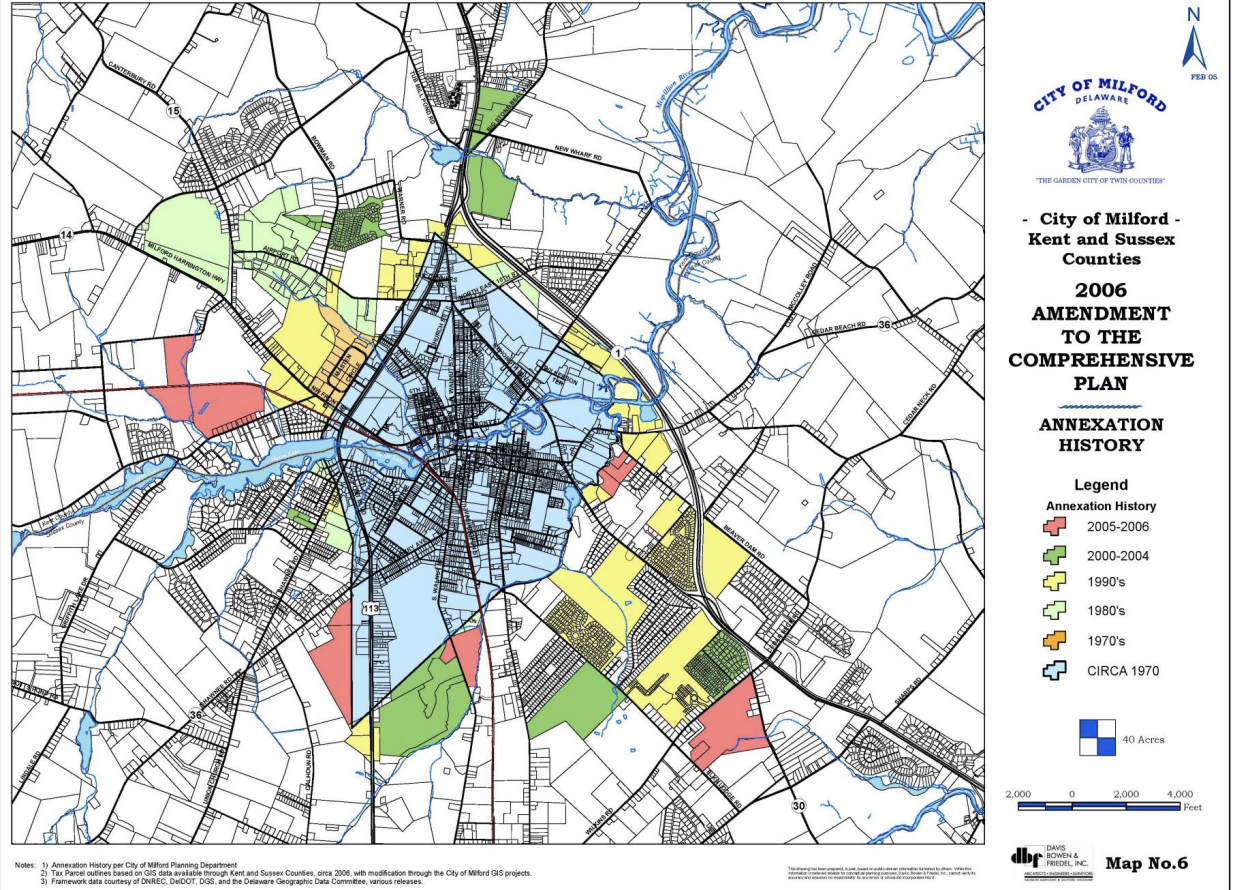
“This shows you kind of how the town has grown over the years,” Pierce stated, showing a map of annexations created in 2006. “They started in the center area around 1970 but then it shows by decades how the town grew. One thing I found kind of interesting is that intersection of Canterbury Road and Route 14, where the new Milford Corporate Center is going, we actually annexed that in the 1980s. So, it has taken 40 years for something to get built on it.”
The Comprehensive Plan Future Land Map showed that there had not been much change in the boundaries of the city from one created in 2008. Pierce explained that unless there are specific requests from landowners, there was no need for the city to seek annexation of other lands.
“At the time we developed our 2018 Comprehensive Plan, about 45 percent of the acreage within the city was either vacant or agricultural and we annexed a lot of property in the early 2000s. Some of that got recorded for subdivisions that never broke ground,” Pierce said. “As of 2025, we’ve got about 30 percent of land that is either vacant or agricultural, so as you can see, a lot of the land that is available is already annexed into town.”

Another point Pierce made was that some of the developments being constructed now were approved more than 15 years ago. Currently, the city has just over 3,400 dwellings approved to be constructed with almost 500 more proposed. Looking back a few years, Pierce stated that the city had over 5,000 units approved. The city issued 131 construction permits in 2025, down from 235 issued in 2024. Assuming a rate of 200 new residential units each year, Pierce stated it would take 17 years to build out approved projects, 20 years to build out approved and proposed projects and 36 yeas to develop all vacant land within city limits.
Of the active residential developments, Pierce pointed out that only three were approved last year and one this year. In 2024 Knight’s Crossing, Red Cedar Farms and Westwood were approved. Riverwalk Villas was the only one approved in 2025. Hearthstone Manor was approved in 2002; Watergate in 2007; Cypress Hall in 2009; Simpson Crossing in 2007; Milford Ponds in 2006 and Mispillion Landing in 2008. It was seven years before another development was approved and that was Winward Grove which was then called Wickersham. Another seven years passed before Hickory Glen was approved in 2020.
“I will say that these projects that were approved years ago, some of the developers did come back and ask to modify the plan,” Pierce said. “Some gave up townhouses for single family homes while others removed single family homes for townhouses.”
Over the last ten years, the city has annexed 66 acres of land with over 49 of that a request from Baltimore Air Coil and almost seven acres for the city electric substation. This amounts about one percent municipal boundary growth over the last ten years.
“Essentially, we have annexed ten acres of land in ten years,” Pierce said. “A lot of this has been smaller lots that have been absorbed into adjacent properties.”
One of the things Pierce mentioned was the school district and the impact of growth on them.
“There is publicly available information that the state puts out every year that has the enrollment and unit counts for the school districts,” Pierce said. “If you look at the information that is available online, Milford School District has actually reduced the number of students over the past two years, I think by 81 students. I think this is important information for folks to hear.”