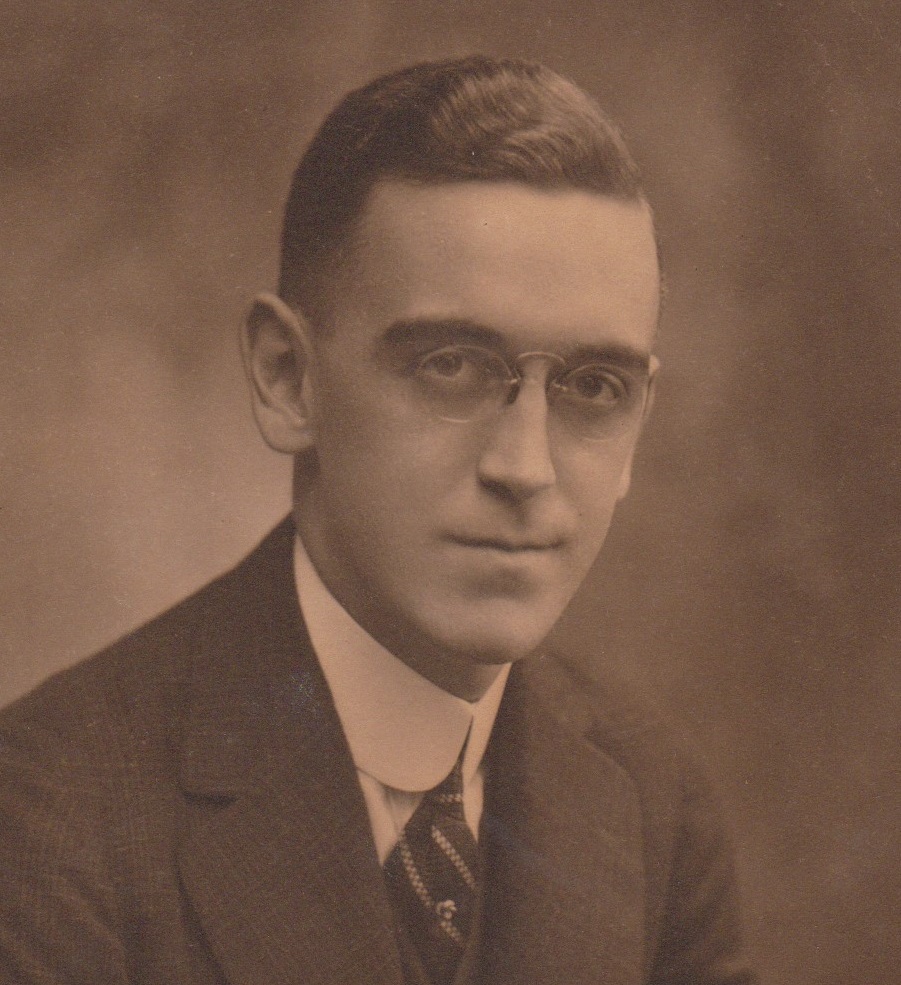


Paris Townsend Carlisle IV, the son of Dr. and Mrs. P.T. Carlisle Jr., was born in Frederica September 14, 1893. The family moved to Milford in May 1903, living in a stately home on what is now Causey Avenue.
The Carlisle family was very prominent in the area. John Carlisle, Paris’ great-grandfather, was a farmer and local Methodist preacher. He and his wife, Margaret had four children, John Jr., Paris Townsend, Samuel G. and Sarah. Paris I, his grandfather, married Rachel Luff in 1833, the daughter of Nathaniel and Sarah Powell Luff.
Paris I was born in Bridgeville but grew up on a farm near Frederica. According to reports, Paris I was considered a legal expert and prepared many legal documents for friends in Frederica. He began a mercantile business and was so successful, he retired at the age of 40. He was the third husband of Rachel who was previously married to Dr. George Barrett and then Jacob Boone. The couple had one son, Paris T. Jr.
Paris II married Jane “Jennie” Agnes Smith in 1858. She was the daughter of John and Phebe Beswick Smith. He was born in Frederica and entered Delaware College at the age of 16, graduating with an AB degree in 1853. He became a member of the firm of Carlisle & Son, general merchants, dealing in lumber and building materials. The company closed at the start of the Civil War, but reopened in 1872 with Paris II partnering with James Moxon, a ward of his. The business was sold in 1875, and Paris II returned to managing his eight farms. He ran for senate in 1874 but was not successful.

Paris II and Jennie had six children, Linda Carlisle, who married Rev. Edward Hubbard; Dr. Paris T. III; Rachel; Mary Blanche; John G.; and Lester Luff, who married Helen Smithers. Paris III married Anna M. Vaules, the daughter of William and Sara Minors Vaules. After attending school locally, Paris III entered the Conference Academy and then read for medicine under Dr. Hall. He entered the University of Pennsylvania in 1884, graduating with honors in 1887. He opened a practice in Frederica before moving to Milford.
Paris III and Anna had two children, Paris T. IV and Elizabeth Vaules. Paris III was a highly regarded physician and surgeon, eventually appointed to the Board of Trustees of the Delaware State Hospital. In 1896, he was elected a delegate from Kent County to the State Constitutional Convention and, in 1906, served as president of Milford Town Council, a position now known as mayor.
Paris IV graduated from Milford High School in 1911, then entered the University of Pennsylvania. Carlisle excelled at the university, graduating at the top of his class.
After graduation, Paris IV returned to Milford, taking a position in the Chemical and Physical Department of the L.D. Caulk Company. He was instrumental in forming what was then known as the Milford Fire Company and devoted much of his time to making the company one of the best in southern Delaware.
As a member of the company, Paris IV served as secretary and a member of the board of directors. According to news reports, Paris IV was a “practical man,” active in efforts to equip the firemen.
When World War I broke out, Paris IV, like many at the time, believed that America’s place was with their allies. He enlisted in Wilmington in June 1917.
After training camp in Fort Myer, Virginia, Paris IV was commissioned First Lieutenant and assigned to Co. I, 19th Infantry Regiment Camp Lee in Petersburg, Virginia. On December 15, 1917, Paris IV was commissioned Lieutenant Adjutant and sailed for France on May 14, 1918. His regiment was immediately sent into battle.
Paris IV died October 6, 1918, killed in action near Nantillois, France in the Meuse-Argonne Offensive. He was just 25 years old. This offensive was the largest operation of the American Expeditionary Forces, beginning September 26 and ending November 11, 1918. Paris IV was one of 26,000 Americans who died in the battle.

Paris IV was buried in the Meuse-Argonne American Cemetery which is now a memorial. The cemetery is in Lorraine, France and his grave is in Section A, Row 6, Grave 7. One of his closest friends, Dr. Frank Grier, visited his grave in his later years.
His death was a severe shock to the citizens of Milford with newspapers announcing his death as soon as they heard the news.
“Dr. P.T. Carlisle, deeply regret to inform you that First Lieutenant Paris T. Carlisle, Infantry, is officially reported as killed in action October 6,” the telegram that notified his family read. It was signed “Harris, the Adjutant General.
Letters to the Carlisle family described an outstanding young man. A letter from one of his commanding officers commended Paris IV for his service.
“Paris came to my company “Co 1” when he was assigned to Camp Lee and until a few days before his death, I have been in constant touch with him,” Captain Rowland F. Jenkins wrote. “Today he stands out amongst my acquaintances both in civil life and in the army as one of the best examples of what a MAN should be and what a man could be, that I have ever known. At a time when my brother officers and the men of our regiment were making the greatest sacrifice a man can make, he was taken away from us, and more strong men shed tears for him than it was possible to believe.”
The letter continued.

“Never in my constant association with him did I ever see anything that I could not admire about him,” Jenkins wrote. “I assure you that the boys of Company “I,” to whom he had endeared himself, always felt as though the Lieutenant belonged to us. I am sending by parcel post a few effects of his that I thought you might care to keep. He carried very little baggage with him and so it is not at all a large parcel. Knowing that you will be gratified to know that your son died a soldier doing his duty, I am respectfully yours.”
Another letter received by the family was written to Paris IV before his death.
“You may not appreciate the feeling, but a certain restraint kept me from telling you some of the things I am writing you,” Sergeant D. G. Cameron wrote. “I want you to know that my few months of association with you because you were broad enough to make it more or less of an association was a very great help to me. That your character, clean morals and ideals unconsciously raised my standard in these things. That the consideration you gave me was in itself remarkable. My army life has been short but my association with me much longer, and in view of both experiences, I consider myself fortunate to have known and worked with you and for you. Here’s to the future, Lt. Carlisle, and the men who work with you and may they appreciate the privilege.”
His death devastated the fire company that Paris IV helped form. On December 16,1918, the company voted to officially change the name of the fire department to Carlisle Fire Company in honor of Paris IV, a name that remains today.