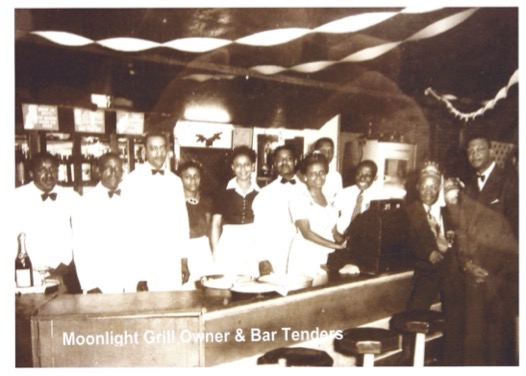


The Moonlight Grill, which stood where Milford Headstart stands today, 518 North Church Street, was not only one of the few places African Americans could go out and enjoy live music, it was also a popular stop for national artists in the 1940s and 1950s.
Local jazz pianist Lawrence James “Scotty” Scott got his start the Moonlight Grill. In an interview published just before the establishment closed in 1992, Scott explained that he got his start with a band called Aces of Rhythm. He remembered hearing Duke Ellington, Dizzy Gillespie, Count Basie, Jimmy Lunceford, Ray Charles, Jimmy McGriff, Earl “Fatha” Hines and Lionel Hampton when he was at Moonlight Grill.
The Moonlight Grill was owned by Franklin P. Fountain as well as a package store that stood in front of it. At the time, African Americans barely made enough money to live and some would bootleg to earn money. The Milford Theater occasionally held $1,000 lucky drawings for residents. It was one of these drawings that gave the Fountain’s the money to construct the Moonlight Grill.
Established in a predominantly black neighborhood, the Moonlight Grill marked a pivotal moment for African American’s. During the 1940s, everything was segregated which meant African American musicians would stop in Milford while “barnstorming,” a practice of traveling by bus and making one-night stops in jazz clubs. In an interview, Franklin recalled the bands sometimes had no piano player, so a local one filled in.
Hotels and motels at the time did not allow blacks, so the musicians often slept on the bus. However, in Milford, which was often an unscheduled stop, musicians enjoyed playing at the Moonlight Grill because families took them in for the night.

“The Moonlight Grill was one of the most popular spots on the East Coast,” Hayes Fountain, brother of Franklin, said in the 1992 interview. “There wasn’t anywhere for blacks to go at that time. The bands all played at black places, because if they went to white places, they wouldn’t let them stay in the hotels.”
With so many national artists stopping at the Moonlight Grill, patrons from Philadelphia, Baltimore and areas of Virginia would visit. When a big name was announced, tickets sold out immediately. Information about a big name spread by word of mouth and, even though the town was segregated, whites could buy tickets to see performances.
Georgie Hicks, who lived just one block from the Moonlight Grill recalled in an interview in the late 1980s that people would get dressed up to go hear the music and that she remembered banquets held there.
As the United States began to integrate, big names stopped coming to the Moonlight Grill. By the late 1950s and early 1960s, African American bands were accepted into white establishments. This led to the attraction of the Moonlight Grill fading. In the late 1980s, the clientele declined and it fell into disrepair. The City purchased the property in 1992 for $80,000.
In 1990, Scott returned to Milford to play at the Banking House Inn. He learned to play piano at the age of five. After high school, he took to the road to play music. He hooked up with road shows and carnivals. He also played casino shows, but although the road was difficult, he played with big names at times, including Dina Washington and Billie “Lady Day” Holliday. In Pep’s Bar in Philadelphia, he played with Jackie Davis. He also played with Earl Gardner and Dizzy Gillespie.
He returned to Wilmington where he started playing with Aces of Rhythm and the Pancho Villa Quartet. They were popular at Rosedale Beach, a once popular resort on Indian River. At a concert at the Moonlight Grill, however, he met his wife, Connie, who wanted him to get a regular job. He took a job in a factory, almost losing his hand in machinery which led him to return to music. Scotty passed away from cancer at the age of 74 in 1997.