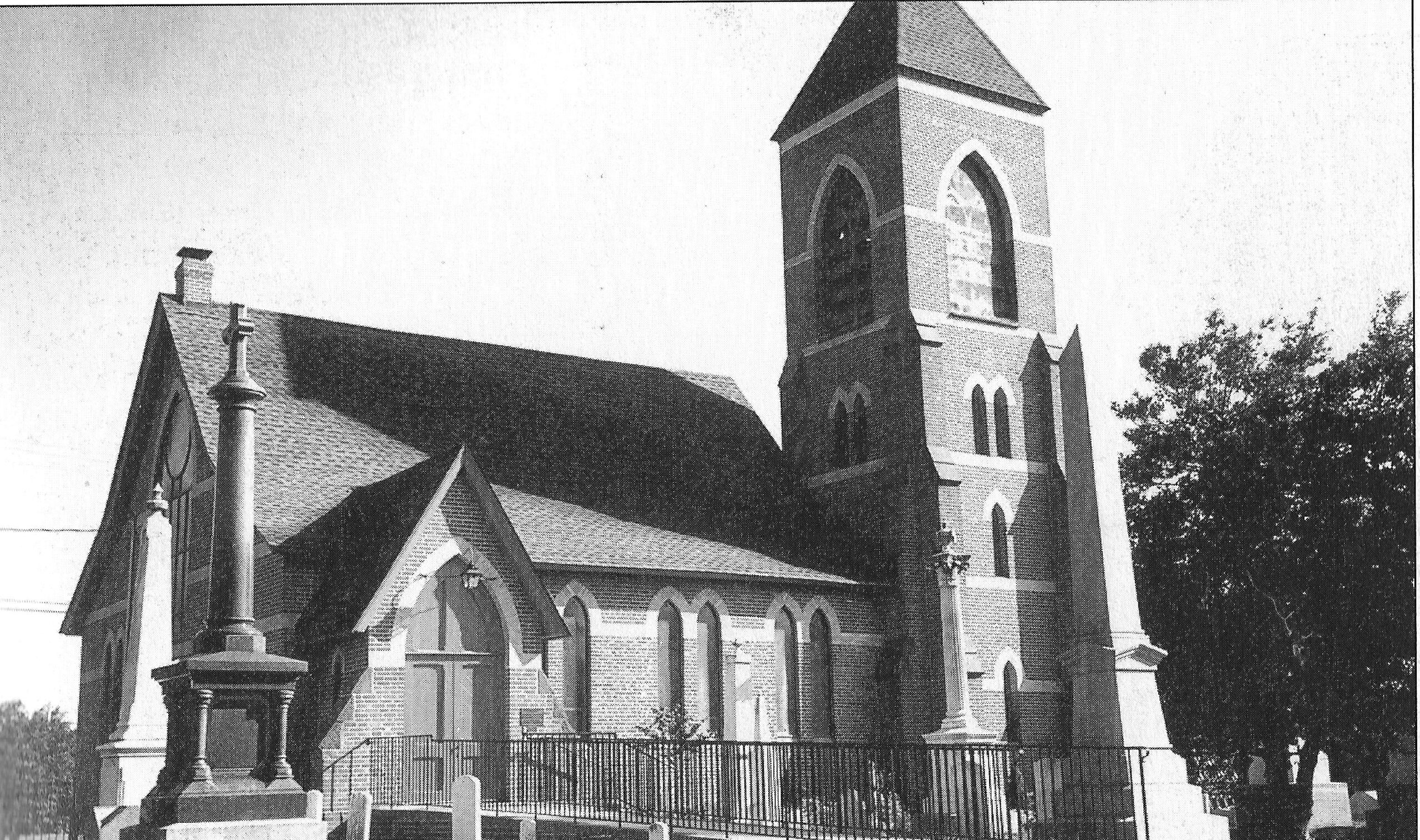


Christ Episcopal Church was founded in 1704 by the Society for the Propagation of gospel of the Church of England. Since many of those who settled in the area were from England, it was natural that the earliest churches would be similar to what they were used to at home.
Originally, the church was known as Christ Church, Mispillion with the first service held in a location about three miles west of what is now Milford. It is not known exactly where the original church stood, but the first building of record was recorded as a small wooden chapel 36 feet by 30 feet.
It is believed this was the second church built in the area now known as Church Hill and it is mentioned in the missionary reports of Christ Church. At the time, it was known as Savannah Church due to a swam nearby and to differentiate it from the Three Runs Presbyterian meeting house that was about two miles away.
During the early years of the church, the rector served Dover, Mispillion and Duck Creek parishes. The first rector on record was Rev. Thomas Crawford who served between 1704 and 1709. In 1745, Rev. Arthur Usher took over the position, followed by Rev. Hugh Neil and, in 1757, Rev. Charles Inglis. Inglis left Milford to become rector of Trinity Church in New York and eventually became bishop of Nova Scotia.
Rev. Samuel Magaw took the seat after Inglis. After Magaw, one of the most important rectors to serve Christ Church when it comes to Milford history was Reverend Sydenham Thorne, who arrived between 1773 and 1775. Parson Thorne has long been considered one of the founders of Milford and was responsible for the construction of the present church.
After arriving in town, Parson Thorne married a wealth widow, Betty Crapper, and purchased a home built by John Cullen. He completely renovated the building, creating what he called Silver Hill Mansion, but is now more commonly known as Parson Thorne Mansion. The back portion of the mansion is likely the oldest structure in Milford.
The land that Christ Church is situated on was donated by Milford’s co-founder, Joseph Oliver and the foundation was laid in 1791. There was some opposition to the location of the new church, but Oliver and Thorne prevailed. Parson Thorne paid for the bricks used to build the new church. He also furnished the lumber necessary for construction from his own land.
The Revolutionary War was problematic for the Episcopal Churches in the colonies as in their ordination vows, every clergyman had to take an oath of loyalty to the King of England. After the Revolution, many ministers returned to England, and this led to Christ Church closing its doors from 1793 to 1833. Parson Thorne died in 1740, never seeing the completion of the church he began. Originally, the church was two stories with galleries on the north, west and south. The common table was in the east portion of the chapel. The pulpit was surmounted, common in this era, by a sounding board.
Rev. William Price became rector after the death of Parson Thorne and served until 1800. He was followed by Rev. Henry R. Judah and then Rev. Joseph Spencer, who was also master of the Milford Academy. In 1823, Rev. Daniel Higbee served, ending his rectory in 1839.
In 1833, Rev. Corry Chambers arrived in Milford and many claim he was as dedicated and energetic as Parson Thorne. He gathered members who had scattered, made extensive repairs to the church and, when a fire destroyed a portion of the roof, Chambers started aa subscription paper whose pledges paid for the repairs. The church building was consecrated on January 26, 1836, by H.U. Onderdonk, acting as assistant bishop of the Episcopal Chruch in Delaware. A church school was soon organized and a resident priest named. The building was renovated and enlarged as well.
Christ Church as continued as an important part of the community, dedicated to spiritual and moral growth. In 1840, Rev Joh Reynolds took over for Chambers and in 1844, the Rev. John Linn McKim took over the position.
McKim was a “rare scholar” according to an account in “A History of Milford, Delaware and the Vicinity” by George P. Hynson.
“A man of unusual ability, he was much loved and respected,” Hynson wrote of McKim.
In 1863, his son, Rev. John Leighton McKim succeeded him, and, during his charge, the church was enlarged, adding a chancel, sacristy, porch and tower. He resigned in 1880 to become rector of St. Mary’s Hall in Burlington.
The following year, Rev. Charles E. Milnor became rector and was succeeded soon after by Rev, Lewis H. Jackson. In 1886, Rev. J.C. Kerr arrived to take over the rectory but resigned to become a chaplain in the Army. Rev. J. Holwell Geare served for about 18 months until Rev. J. Leighton McKim returned in 1894.
The cemetery that stands on the church grounds is home to many well-known Milfordians. Parson Thorne is buried there with an epitaph that reads “By the elegance and affability of his manners, by the diffusive benevolence of his heart and especially by the real and ability he displayed as a preacher of the gospel, he endeared himself to his parishioners, to his friends and to all who came within the spere of his acquaintance. He was born on the 29th day of October in the yar of 747 and departed this life on the 18th day of February 1793, aged 46 years.”
First interred in his family graveyard, the body of Joseph Oliver is now interred at Christ Church. His epitaph reads “Joseph Oliver, who departed this life February 28th at twenty minutes to seven in the morning in the year of our Lord 1807, aged about 90 years.”
Other Milfordians important to Milford history buried in the cemetery include Governors William Burton, Peter Causey and William Tharp.
Christ Church is located at 200 Church Street, Milford.