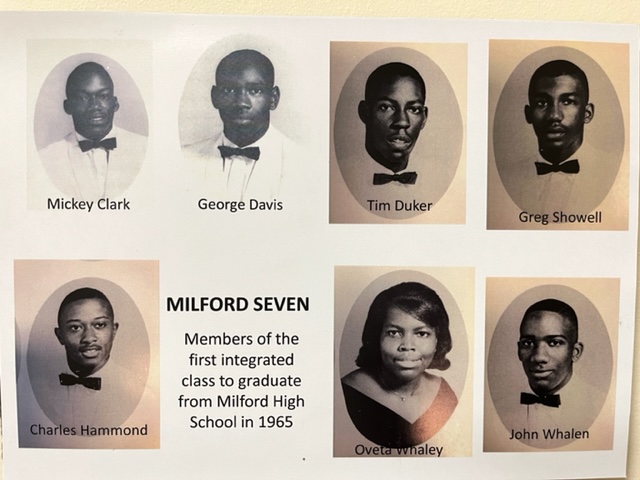


The story of the Milford Eleven is well known, not only in Milford but across the country as the protests that blocked the first African American students from attending Milford School District made national news. It would be almost a decade before Milford schools were successfully integrated, thanks to the Milford Seven.
In 1962, Milford School District quietly enrolled about a dozen African American students in Milford High School and seven of those went on to graduate in 1965. These trailblazing students are now known as the Milford Seven, a name given to them by one of those who integrated the district.
John Whalen, Timothy Duker, Josephus Clark, Gregory Showell, Charles Hammond, who came up with the name Milford Seven, and Oveta Whaley Gray, the only female, began attending Milford High School that year. George Davis joined the six later in the year.
“If we had not attended Milford, we would have had to go to either William Henry Comprehensive High School in Dover or William C. Jason High School in Georgetown,” Hammond said. “We knew we would have better opportunities if we went to Milford.” Duker said that the students themselves made the decision to attend Milford and that they were not pressured by parents nor were they approached by the school district to attend.
All seven of the students began attending school together in first grade in what is now Benjamin Banneker Elementary School. The young men all lived in the same geographic area and Duker says he recalls the five of them sitting down together and deciding that they would attend Milford High School. Although all of the Milford Seven indicated that they were mostly accepted by other students, there were some who were not as accepting.
“We were often in a classroom alone,” Clark said. “The only black person in the room. We all had lunch together, though. A few days after school started, I was headed to lunch and a guy at a locker called out the “N” word. I got to lunch and mentioned it to the rest of them. One of the guys asked me to describe him, which I did. Every one of the other guys said ‘oh, yeah, he called me that, too.”
For the most part, the group was accepted, they said. One reason was that all of the young men not only played sports but excelled at them. Davis was the first black selected from Milford High School to play in the Blue-Gold Football Classic at the University of Delaware. Duker integrated the basketball team while Clark, who was known as Mickey, substituted at quarterback. Hammond, who was known as Butch, Whalen, Showell and Clark were members of Milford High School’s first championship mile relay team while Hammond became the school’s first black band member, playing drums.
“I wanted to go to William Henry because I wanted to play drums there,” Hammond said. “But, we were a team. When they all said they wanted to go to Milford, I said ‘well, I guess I am going to Milford.’ I really think our success was because we had very strong upbringings.” Showell said that the seven students were very mature for their age and they wanted to take control of their own destiny.
Their experience at Milford was not always pleasant, but they worked hard to avoid any animosity that came their way. Once, during an assembly, Clark said that a group of students began calling out racial slurs at the group. Despite their desire to avoid fights and confrontation, a few of the seven walked over to address the offenders. Clark said that he “just knew I was about to get suspended and then I had to go home and face my mother.” Just as the black students reached those who were calling them names, Clark said, a group of white students came up behind them, led by John Burris, and called Clark down.
“He said ‘Mickey, they aren’t worth it, they’re just ignorant,’ and I will never forget that,” Clark said. “He and the other students stood up for us and we just went back to our seats. Overall, we bonded with the white students.” As the only female, Gray said that her experience was slightly different than that of the young men.
All of the young men lived in town and could either walk or ride their bicycles to school. Gray lived in the country and had to ride the bus, the only African American on the bus.
“In town, it seemed like people had more progressive values,” Gray said. “Out in the country, they didn’t share those values. That bus ride was very difficult with name calling and things like that. I kept my head down and sat near the driver where I was safest. Once I arrived at school, it was much better, but the bus ride was terrible.” Like her male counterparts, Gray wanted to attend Milford due to the better-quality education she would receive.
Gray said that she always knew she wanted to be a nurse and that many nursing schools would not accept a diploma from a black school. She does not recall a conversation with the young men about attending Milford. She also said she wanted to create a path for the children coming up behind her. Duker said that all of them felt the need to avoid confrontation and fights because they didn’t want to give white students the impression that they were violent or less intelligent.
Classmates of the Milford Seven say that integration in 1962 was actually very smooth. Former Senator Gary Simpson, who graduated with the group, said that he recalls it being “no big deal” to him.
“I had worked summer jobs with African-Americans and considered them my friends,” Senator Simpson said. “While I had not known any of the seven students prior to seeing them in school, I don’t think I reacted any differently to them as anyone else coming new to the school. I had the privilege of growing up in a non-racist home, and, in fact, my father’s best friend was African-American. Like most teenagers, I was probably thinking more about my own life than about how others felt. Thinking back, I can imagine now what it must have been like for the seven students coming for the first time into an all-white school. I should have gone out of my way to make them feel comfortable and accepted. I could kick myself for not doing so.”
Gwen Guerke, who also graduated with the seven, said that she had no knowledge that black students would be attending with her when she started school that year. She attended what is now known as the former Milford Middle School during most of her education, spending only two years at Lulu Ross.
“We went to school and there were black students,” Guerke said. “We had no warning, but it really didn’t mater that much.” Hammond said that you learned which white students, like Guerke, really didn’t mind them being there and which students had issues attending with blacks.
David Sockrider also attended school with the seven and remembers it much like Senator Simpson and Guerke. He said that he recalls that they were there when school started and it seemed fine.
“I played basketball and track, but I wasn’t really good,” Sockrider said. “These guys were good. I remember making friends and you were just part of the group. I do remember that we played no other teams with blacks.”
Despite being accepted due to their athletic ability, outside of the school, the young men met with prejudice, mostly from adults. Duker recalls being the only black on the baseball team and that he used a black mitt. He recalls a referee telling him at a game in Georgetown that he could not use his glove because it would conceal the ball. A teammate lent him a brown glove so that he could play. Hammond recalled traveling to Chincoteague, Virginia, with the band for a parade. A fireman pointed to him when he stepped off the bus and asked the band director whether Hammond had been given his own bus.
“Truth be told, those seven students were of such high academic standards and athletic abilities, they seemed to blend in to the student body very comfortably,” Senator Simpson said. “I have been able to keep up with four of these students and they have gone on to achieve great success as adults. I hope they consider me a friend.”
All of the Milford Seven went on to have distinguished careers. Showell, Hammond and Duker went on to attend Delaware State University, joined the same fraternity and graduated together. Gray was the first African American to graduate from Milford Nursing School. All seven of the students went on to successful professional careers as teachers, military officers and ministers.
“These guys are very humble,” Guerke said. “But they achieved so much. All of them went on to have very distinguished careers. They are all not only very nice people but extremely successful as well.”