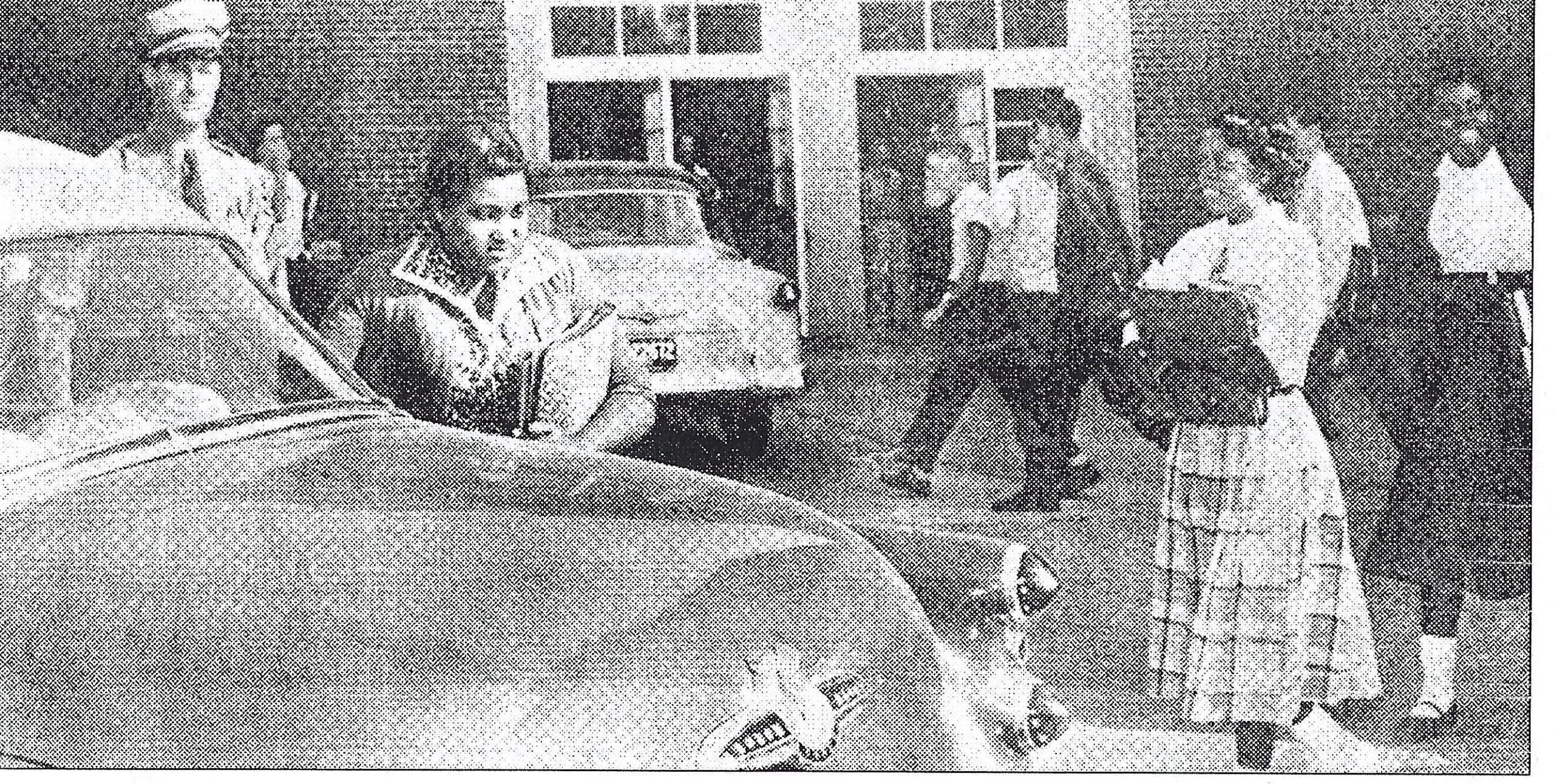


The landmark case Brown v Board of Education was decided by the United States Supreme Court, a decision that stated segregated schools were unconstitutional. What many do not know is that Brown v Board of Education was not just one case before the Supreme Court. It was actually five, and one of those was Gebhart v Benton. This was a case involving Shirley Bulah, an eight-year-old girl who was required to ride a bus two hours from home to a black school rather than attend an all-white school.
Delaware had already begun the path of desegregation even before the landmark decision. Claymont, Arden and Hockessin began enrolling black students in white schools as early as 1952. After the decision, other districts in Delaware began to look at the issue as well. Then, in September 1954, Milford took the steps to integrate.
Orlando Camp writes in his book The Milford Eleven, that at the Augus 9 school board meeting, minutes reflect that a committee would be composed to make plans and submit recommendations for integration in compliance with the Supreme Court decision. Members of the board were W.D. Kimmel, who served as president; Ida Phillips, Harry Mayhew and Willaim Sipple. The district superintendent who served as secretary was Dr. Ramon Cobbs.
Before the committee could convene, however, black families began to wonder if their high school aged children could attend Milford High School that fall. There was a first through eighth grade school in Milford, Benjamin Banneker, but black high school students were required to take a 40-mile round trip to black high schools in Dover or Georgetown. Some of the families turned to Reverend Randolph Fisher, a Methodist minister and the local representative of the NAACP. With the Brown v Board of Education decision, Fisher advised the parents to enroll their children in Milford High School. In Camp’s book, Dr. William Kimmel, who was the son of the board president at the time is quoted.
“It was a night in August when there was a knock at the door and a black attorney and another black man, I don’t remember their names, came to visit Dad right out of the blue. They had an injunction to integrate the Milford schools,” Dr. Kimmel is quoted as saying. “I stayed on the back porch and listened to them in our dining room. My dad told them this was going to blow the town apart. They eventually came to a deal to admit the kids to the tenth grade. They had just graduated from Banneker and had to go to either Jason in Georgetown or Henry in Dover. It all started that night in Dad’s dining room at 430 S. Walnut.”

Local papers published a press release from the school district that the school term would start September 8, 1954, and that “white pupils in grades one through twelve will report [as usual] to the Lakeview Avenue School. Colored pupils in grades one through nine will report to the Benjamin Banneker School.” There was no mention of integration and Camp points out that advance notice may have helped avoid some of what came next.
Camp recalls several students were driven to school by Melvin Staten, father of one of his classmates, Madalene Staten, while Charlie Fleming and Kenneth Baynard rode the segregated bus, driven by Amos Bell, who was also a janitor at Banneker. The students were sent to classrooms separately, which they later said made them feel isolated. Teachers introduced themselves in a way that made it clear they were unsure how to handle the situation. Camp also recalls that when they received their first assignment, the reason for the Supreme Court decision became obvious as “separate but equal” was not an actual fact.
“We were given Algebra II homework assignments when we hadn’t even had Algebra I at Banneker. We knew we had a long way to catch up,” he wrote. “Looking back, the district seemed insensitive to our academic placement. It’s hard to know if it was intentional or simply a case of innocent oversight.”
Other than struggling to catch up academically, Camp wrote that the first days were so peaceful that the high school principal commented in a faculty meeting that he was pleased things were going so well. One white child remarked that he didn’t “think much about the negro kids’ one way or another” while another remarked “it seemed like they belonged in the school after a couple days. Nobody minded them. One was a darned good football player – the kids really whooped it up for him when a scored a touchdown in a training game.” Richard Johnson who was in ninth grade at the time also commented that the kids didn’t pay any attention to the fact black students were in their classes.
The students began to assimilate into normal high school activities. Edna Turner was told in gym class she was to join the field hockey team although she had never played before. Baynard joined the band, playing saxophone, piano and drums. There was tension and often the black students were alone and ignored. They began to understand that the white children were taught to fear them, so they simply kept their heads down and learned.
It was a school dance that became the catalyst for what was to happen next. The fear that white and black children may dance together was not something parents were willing to ignore. Just before the dance, a white girl claimed Leon Blue, one of the eleven students, had asked her to go to the movies.

“This is my honest statement. About a week ago, Leon Blue spoke to me at my home. The next day in school, he asked me to go to the movies,” Betty Jean Tingle, a 10th grader at Milford High School was quoted as saying in the Morning News on September 28, 1954. “On Friday, I was called down to Dr. Cobb’s office and asked if this was true. Leon Blue was also asked. He denied it. On a Saturday night, him and some other boys tried to get my attention. On Monday afternoon, I was sitting the porch, and some colored people told me to get in the house and stay there. Then I became frightened. This is the honest to God’s truth. Dr. Cobbs come to him and made him admit it. Also, several others talked to him and he admitted it.”
There were other rumors swirling around town that a black student had flashed a knife during a quarrel in the boys’ restroom, and a black girl used vile language when speaking to a teacher. By the end of the second week, the rumors had grown and expanded. There were conflicting reports of what was true and what was not. Camp’s mother told him he was not to go to the dance, and he replied he had no intention of doing so.
On Friday, September 17, a large meeting of white people gathered at the American Legion Hall. It was reported that 1,500 people were there and about 900 of them signed a petition expressing dissatisfaction that black students were in the high school. At the time, the Milford Chronicle reported that they were very suspicious of the meeting as it appeared a large percentage were not from Milford.
Russell B. Bradley, who worked for Brown P. Thawley, a local tractor dealer and prominent citizen of Milford, presented the petition to the school board on Monday, September 20. At the time, Bradley was the president of the Lincoln School Parent-Teacher Association, and he told Camp he didn’t want to present it, but was pressured to do so. A decision was made by the school board and Mayor Edward C. Evans to close schools for one day to hold a public meeting.
At that meeting, hundreds of residents attended and the majority were overwhelmingly in favor of segregation. The board advised the black parents to keep their children home for a week so they could work out details. They then reached out to Governor J. Caleb Boggs and the State Board of Education to determine if the Milford board had the authority to admit black students and would they be legally liable if they now unenrolled the students.

The night of September 20, the Milford School Board announced that integration would continue but the black students would remain out of school for one week as a cooling off period. Angry calls and threats poured into the district office leading the board to close schools indefinitely. That afternoon, Harry Mayhew resigned from the board, an act that led many to feel he sided with the segregationists. A meeting with the State Attorney General H. Albert Young and Governor Boggs revealed that the district had not violated any laws by admitting black students and that they would violate the law if the students were now unenrolled.
Milford School District Board of Education made the decision to keep the students enrolled but sought the State Board of Education’s support. If they did not get the support, the entire board would resign. The state board agreed the eleven students should remain enrolled but did not approve or disapprove the Milford plan for integration. This left the board feeling abandoned. On Thursday, the state board criticized Milford for not presenting an integration plan prior to implementation. The fact is, Milford had submitted an integration plan September 10, after the start of the school year. Milford’s attorney, Howard Lynch released a statement.
“Since the state board has not seen fit to approve or disapprove their [Milford Board of Education] action, they do not wish to continue in their position,” Lynch said. “They feel that they are too close to the situation to accept the responsibility of opening the Milford School Monday with negroes in attending without the full backing of the state board.”
Milford School District planned to open Monday, September 27 with the eleven black children enrolled. The decision was to prove cataclysmic. Although there are conflicting reports about how he arrived in Milford, that weekend Bryant Bowles, the self-proclaimed founder of the National Association for the Advancement of White People (NAAWP), arrived in Delaware. One report is that he was contacted by Brown P. Thawley and asked to come to Milford.

Camp writes in his book that Bowles hired airplanes equipped with loudspeakers, inviting everyone to a meeting at the Harrington Airport. There are reports that up to 5,000 people turned out for the meeting with almost every speaker suggesting parents boycott the school. Newspaper accounts of the crowds that gathered demonstrate how adamant the opposition was to integration of schools.
“If we keep our children home from school, maybe somebody’ll do something about this situation,” William Macklin, who identified himself as the mayor of Cedar Neck, was quoted as saying in The News Journal on September 27, 1954. “Anyone who joins forces with the other race is a traitor to his own race.”
When asked by Bowles if anyone would like to be the director of the Delaware chapter of the NAAWP, three stepped up. Mildred Sharp of Lynch Heights claimed to be a servant of God and that she believed God had called on her to serve at the meeting. Rev. Manaen Warrington of Selbyville also felt called.
“We should be a separate people,” the News Journal quoted him as saying. “The Lord set me today.” The News Journal issued a disclaimer that Warrington was not listed on the Peninsula Annual Confernce rolls of the Methodist Church.

Charles West of Millsboro also stepped up.
“If God intended us to be one race, He would have made us all white,” West said. “If the Supreme Court is going to make us all equal, it should also free the Indians from their reservations.”
Bowles collected $5 from everyone who wanted to join his organization, claiming that $2 would go toward his publication and the other $3 would remain with the chapter which would have an office in Milford. Reports were that Everett B. Warrington and a man named “Abbott” from Lincoln had reached out to the Kent-Sussex Fairgrounds for the rally, but the board of the fair wanted to take no liability. The airport at the time was privately owned by Daniel R. Link and his sons, Vaughan and Atlee Link.
Prior to the Bowles rally, Governor Boggs had requested that citizens cooperate in the opening of Milford’s schools on Monday. The State Board of Education asked for clarification as they believed Milford had violated policy by not providing the state board with an integration plan before enrolling the students, but were advised by the state attorney general that, since the students were enrolled, Milford would violate the law by unenrolling them. It was also unprecedented that an entire school board resigned at once, with no protocol for appointing a new board.
Tensions in Milford continued with crosses burned on the lawns across from Banneker. Classes resumed on Tuesday, September 28 with only 456 of 1,562 students showing up for class. Milford Police Chief Samuel Powell placed additional officers at the high school along with Delaware State Police. Of the 182 attending Milford High School, ten of those were the black students.
Eugene Gordon, who was described as a black man representing a paper called The National Guardian began asking parents why they had not sent their children to school, according to The Morning News on September 28, 1954. He spoke out, stating that he knew the “good people of Milford were hard workers,” but he wanted to know “who was behind all of this.”

“The negroes have their own schools, and the white people have their own schools,” Dorothy Bennett, who then lived on Charles Street, was quoted as saying in The Morning News. “If negroes need any help, why, we’ll give you help, but let’s keep schools separate.”
Bennett continued, stating that her daughter had a perfect attendance record in school, but that record was now broken. She added that she told her daughter she did not have to go to school with negroes. When Gordon asked her if her daughter actually wanted to go to school, Bennett replied that her daughter had “made up her own mind.”
Buses rolled in, some empty, some with one or two children. When the eight of the ten black students arrived, riding in Delaware State Police cars, the crowd fell silent. Two others arrived by bus. There is no mention in Camp’s book or in newspaper accounts which of the original eleven chose not to return. Reporters took comments from the crowd about why they were opposed to integration, but no names were provided.
“The Bible gives authority for integration.”
“If God intended us to be all one, He would have made us one race. He intended, however, that there should be different races and they should stay apart.”
“The Milford Board of Education put this over on us.”
“The people’s wishes ought to be respected. Majority shouldn’t rule all the time.”
“We just don’t want our children to go to school with Negroes.”
“The U.S. Supreme Court hasn’t handed down an order; all that it has given out so far is an opinion.”
One quote attributed in the Morning News to Rev. Manaen Warrington is shocking but likely expresses the opinion of many who were opposed to segregation.
“If the negro would look up to the Lord, he would say ‘don’t agitate – the white race gave me an opportunity to be an American – to be free of slavery.’ Here in Delaware the white people gave me the opportunity to be a worthwhile citizen and not an inhabitant of the jungle,” Warrington said. “We are on God’s side. My side might be wrong, but His side is always right.”
 The black students continued to attend Milford High School for several weeks. The issue with their attendance seemed to be more with the parents than most of the student body. Camp relates remembrances of his fellow students who remembered the boycott.
“My parents were afraid to send me on the bus, so Dad personally took me to school each day. I can remember his old green Ford pickup truck because he was a contractor,” Richard Johnson related in Camp’s book. “A bunch of adults stopped him and they threatened “why are you sending your kid to school?’ My father’s basic comment was that his boy was going to get an education.”
Harvey Kenton recalls that his father was away on a trip as a truck driver, and his mother didn’t know what to do. She called their minister, Reverend Tull, who told her his three daughters were going to school, because he felt that as a man of God, he had to set an example.
“So, my two brothers, my sister and I went to school,” Kenton is quoted as saying.
According to accounts, there was not tension inside the school. When asked, the principal replied that the black students acted just like all the other students and those who did attend school, whether black or white, simply talked about lessons and football.
The integration matter began to have an impact on businesses. Any business owner who spoke out in support of desegregation had their business boycotted by those who were opposed. Although no businesses were closed due to lack of business, many were harassed with offensive signs and “tongue-lashings” from customers.
By October 1, 1954, a new school board had been appointed in Milford, and the new board was made up of mostly segregationists. The board released a statement after their first meeting on September 30, 1954.
“As a result of their deliberation, the Milford Board of Education decided in the interest of the welfare of the children and the community as a whole, to remove the eleven negro students from the enrollment records of the Milford schools effective 3:10 PM September 30, 1954.”
After the announcement, new board president Edward Steiner told reporters that he had great hopes about the future.
“We took a certain action for the good of the community at a certain time,” Steiner was quoted as saying in the Morning News. “Personal feelings did not matter. I have no personal feelings to express.”
The other members of the new board included David B. Green, George Robbins and George Adams. Steiner was the owner of a woolen mill, Steiner and Company in Milford. Robbins was a farmer, Greene in the poultry business and Adams a dispatcher for Burris Foods. The method for appointing the new board was complicated.

According to the Morning News, Kimmel and Sipple returned to the board and appointed Steiner and Wright Ward, a Milford farmer. Sipple then resigned again. Steiner, Ward and Kimmel then appointed Greene and Kimmel resigned. This left Greene, Ward and Steiner. The three appointed Robbins and Ward resigned for reasons of health. Robbins, Steiner and Greene appointed Adams, completing the board.
The NAACP immediately began planning legal action against Milford School District. On October 15, 1954, the Morning News announced that the Chancery Court had ordered the students re-enrolled in Milford School District. The announcement resulted in a swift response from Bowles.
“When the negroes walk in, the whites will walk out. I’m sure of that. He [Vice Chancellor William Marvel] has reserved the Milford school for negroes,” Bowles is quoted as saying. “I think that’s about all he’ll have in the school is eleven negroes only and if the State of Delaware can afford to operate that large a school for eleven negroes only, then let them go ahead.”
The case was appealed to the Delaware Supreme Court who heard arguments on October 23, 1954.
“Does yielding to lawless elements – does depriving these students of their constitutional rights to satisfy the whims of a group outside the law – does this enhance the dignity of the State of Delaware?” argued Louis L. Reading, a lawyer for the students who were now attending school at the William C. Jason Comprehensive High School in Georgetown, is quoted as saying in court. “The safety of the state itself is involved in this question. It is a question of whether the duly constituted authorities of the state are to yield to lawless elements.”
Howard E. Lynch, lawyer for the district, argued that violence was possible if the black students were readmitted. During the hearing, Steiner testified that the black students had been removed for their own safety and to maintain order. In order to gain additional information, the court stayed the injunction requiring the black students to return to Milord High School.
On February 8, 1955, the Supreme Court ruled that the Milford School District Board of Education had no right to admit the Milford 11 as they had not obtained prior approval by the State Board of Education. In the court’s opinion, this was in complete disregard for the requirements of the state board and therefore had no legal authority. The Delaware Supreme Court agreed that the United States Supreme Court in Brown v Board of Education nullified Delaware’s segregation laws but did not require immediate desegregation.

“Until the mandate of the United States Supreme Court is received, the state may take immediate steps toward desegregation but is not compelled to do so at the moment,” a report in the News Journal read on February 8, 1955. “The deplorable incidents preceding the removal of the children from the school and the widespread publicity that inevitably followed have the effect, we think of obscuring the essential question in the case.”
Although this ended integration in Milford for over a decade, it is important to note that Milford was not alone in this struggle. A poll taken in November 1954 in Milton found that out of 947 people asked, 934 were against missing of races in public schools. In October 1954, a Laurel vote overwhelmingly opposed integration and preferred building a new school for blacks in the district. Other polls were taken in Georgetown with 1,387 against and 11 for segregation. In Harrington, the poll found 1,106 against integration and 11 in support.
A November 22 poll in Milford found 2,332 against integration while 25 voted in favor. In Houston, there were two questions asked. The first was whether there should be separate schools for white and colored. The response was 245 yes and 11 no. The other question was “Are you in favor of equal educational facilities for while and colored?” The responses were 192 yes and 30 no. Greenwood had similar responses with 459 against mixed races in schools while 10 were in favor.
Bowles and his organization claimed victory in Milford. He moved on to other districts in the state, including J.M. Clayton in Dagsboro. In October 1954, Steiner railed against the State Board of Education and “the upper end of the state” for the “ridicule and lack of support in Milford.”

“All we ask is a little compassion and understanding,” Steiner said to a reporter with the News Journal on October 4, 1954. “But every time we try to place the responsibility where it really belongs, we run into a stone wall.”
U.S. Senator John J. Williams told reporters that there were only two ways that Delaware could avoid segregation and that was by constitutional amendment or the overthrow of the federal government. He made it clear neither was possible.

“Regardless of our own personal opinions, we all must join together with one determination and that is that we will solve this problem and in so doing uphold the laws of the State of Delaware and the United States,” Williams said. “This in to an attempt to discuss the question of whether there should or should not be segregation in the public schools. It is merely an attempt to explain what can and cannot be done under the law by the advocates of either position.”

The State Department of Education did not order full integration until 1965. The Milford Seven integrated Milford High School in 1964.
In 2004, an historical marker was placed in front of the Milford Middle School which was formerly the high school dedicated to the Milford 11. A marker with their names was also placed in the lobby. The school was recently renovated and a dedication ceremony for the plaque and an updated marker is planned for September.
In 2012, the Milford 11 were all awarded Milford High School diplomas.
Next week, we will share what happened to the Milford 11 and Bryant Bowles in our Milford’s Past Section.