

Veteran’s Day, celebrated on November 11, became an official holiday in 1954. Originally, the 11th day of the 11th month was known as Armistice Day, established in 1919, one year after the end of World War I. It was on that day, at the 11th hour, an armistice was signed ending the war with Germany.
When American Archduke Ferdinand was assassinated in 1914, few in Milford were impacted. At that time, European wars were not the focus in the United States. As the war continued over the next few years, it became more and more apparent that this country would, for the first time, become engaged in a global war.
This was escalated when German U-boats attacked ships off the coast which stirred Delawareans into action. The town was soon busy with war bond drives and Red Cross classes. School children saved 25 cent war stamps to paste on cards in exchange for bonds, a practice that continued well into the 1960s.

On May 18, 1917, Congress passed the Selective Service Act and, for only the second time in American history, men were drafted into military service. Unlike the previous time it was used during the Civil War, when only eight percent of the military was drafted, during World War I, nearly 24 million registered and four million selected. Around 2.8 million were drafted, representing 72 percent of those who served.
The war led to significant anti-German sentiment, however. German language courses in local schools were stopped and books intended to spread German propaganda stored away. Recent immigrants with German surnames changed their names and German immigrants were required to register with the federal government. They were also required to carry their registration on them at all times. Starting in 1917, over 2,000 German immigrants were imprisoned throughout the country.

In Delaware, Mennonite communities were subjected to harsh treatment due to their German heritage. Mennonites are strict pacifists, believing that there was never a need for violence. The General Conference decreed members of the religious sect only serve in non-combatant roles with duties that would “support and save life.” However, the church itself decreed that even non-combatant service was not permitted. Many registered for the draft during the war as conscientious objectors, leading them to face persecution and prejudice.
For those Mennonites who did serve, life was difficult as many military officers viewed them as adversarial. During the war, 138 Mennonites were court-martialed for refusing to accept non-combatant service.
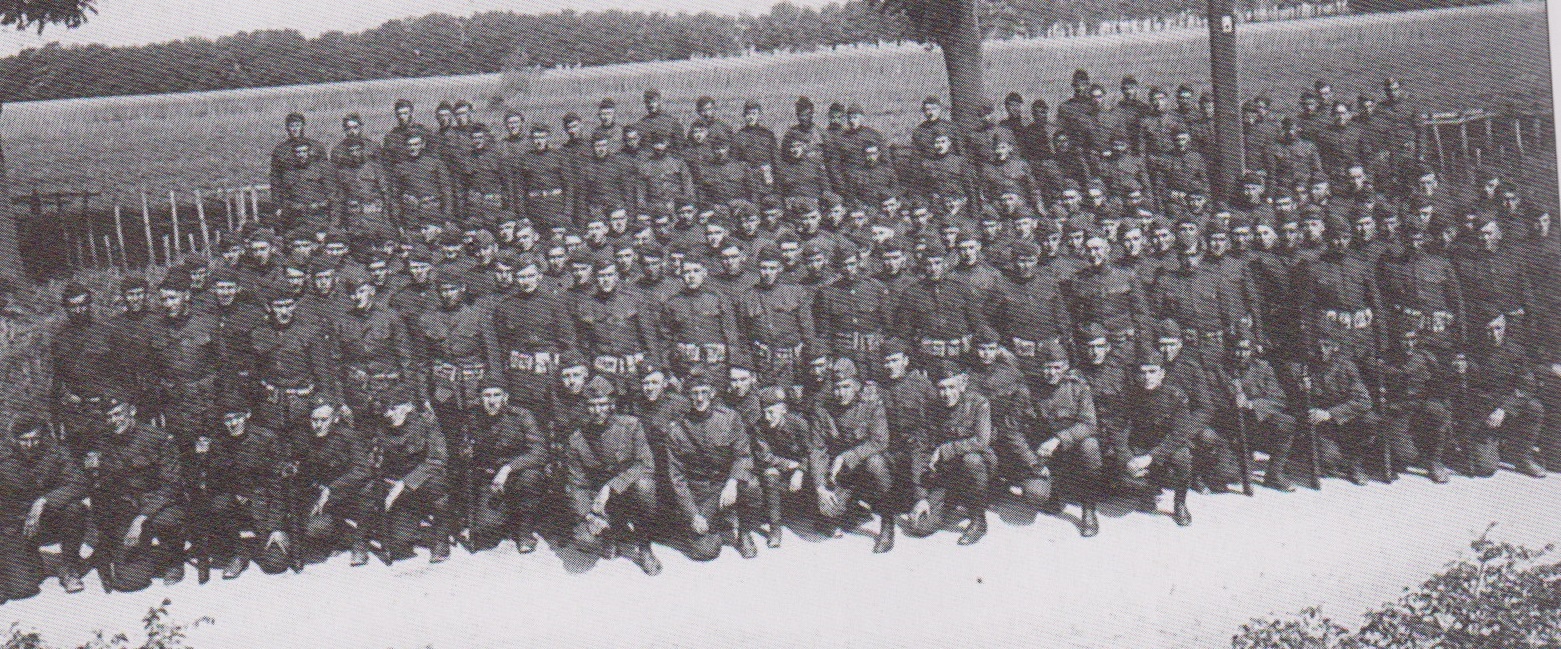
Young men were sent to the front lines in France, including prominent Milfordians Paris T. Carlisle, who died in the war, as well as Drs. William and Samuel Marshall. Milford troops were federalized in 1918 and sent to France with the American Expeditionary Force. One regiment, Co. B. 59th Pioneer Regiment, was led by Major James W. annon and served for a year overseas. They were mustered out and returned home after helping defeat Germany in the trenches of France.

Every man felt an obligation to serve in some way and did not hesitate to answer the call when the United States mobilized. The Marshall brothers left their very lucrative medical practice, serving in the military from 1916 until 1920.
Rallies were held in the plaza where a platform was erected. Charles Varney and Gertrude Akins led Milford residents in singing “Over There,” “Keep the Home Fires Burning,” “Tipperary,” and others.

It was during this time that the Vineyard Shipyard entered into a contract with the US Navy to build sub-chasers.
According to “A History of Milford,” published by the Milford Historical Society, a spy, who had been living like a hermit in Big Stone Beach, was discovered. When he was arrested, police found maps and soundings of the bay.
Casualty lists began to come in and several Milford men were lost in the war. In addition to Carlisle, Private Harry Miller, Corporal Edward Purnell Russell and Private Walter J. West were among the men from Milford to lose their life during the war.
When news came that the war had ended on November 11, 1918, the town was overcome with relief and joy. Whistles blew, bells rang, and a parade organized to celebrate what was then called “the war to end all wars.”
Today, Veteran’s Day is set aside as a time to remember those who have served in the Armed Forces, both past and present. It is a day to thank living veterans for their service and acknowledge their contributions.