
In this series we will look back at the history of the different dominations of churches in Milford. This week, we learn more about the Presbyterian Church.

The first Presbyterian Church in Milford was a small chapel on the old King’s Highway about a quarter of a mile from present-day Milford. It was situated a short distance from the confluence of three branches of the Mispillion, earning it the name “Three Runs Meeting House.”
There are no official records of when the church was first constructed, but it is said to have dated back as far as the early 1600s. It was a frame building with a brick floor. The original congregation was formed by Francis Makemi, an Ulster Scots clergyman who emigrated to the United States in 1682. He is considered the founder of Presbyterianism in America. He established a number of congregations on the Delmarva Peninsula.
In 1772, the Lewes presbytery congregation met there and, a year later, the Reverend Mr. Huston was licensed and preached there. He also served churches at Murderkill, Wicomico, Queen Anne’s, Princess Anne, Nanticoke, Blackwater and Rehoboth. Huston was ordained and installed as a pastor in Murderkill and Three Runs.
Elders at this early church were Dr. John Haslett and John Draper. Huston died in 1785 and it appears some of his records vanished after his death.
“A chasm of two minutes of two sessions which was supoosed to be lost in the plundering of Mr. Huston’s house by refugees,” an account in “A History of Milford,” written by Geroge B. Hynson read. “It is inferred that certain records disappeared during the Revolution and their loss was attributed to Tory vandalism.
The original chapel was abandoned around 1815, although Sunday School continued in the original building until it was no longer functional. Services were held in a building on Montgomery Street for a while. That building was abandoned, yet the Sunday School, started by Hester McColley Marshall continued.
There were many members who wanted to continue the church. The Sunday School and a few loyal Presbyterians called on the presbetery to construct a new church in Milford.
The presbytery of Wilmington sent Reverend. G.W. Kennedy to Milford in the early 1800s, instructing him to organize a congregation. The First Presbyterian Church and Congregation in Milford was incorporated on January 11, 1819. Money was raised to build a house of worship and a parsonage. The building committee consisted of William Tharp, Peter F. Causey, Henry B. Fiddeman, William V. Coulter, Dr. James P. Lofland and John A. Hazzard. The first roll of memberships consisted of seven names.
The deed for the church states that the plot was for the “purpose of erecting a house of worship for the use of the members of the Presbyterian Church of the village of South Milford, in connection with the Presbytery of Wilmington.”
The cornerstone of the church, laid on July 4, 1850, and consisted of bricks taken from the original Three Runs structure. Kennedy served as pastor untill 1856 when the membership increased. Several different pastors served the church until Lewes sent Rev. Cornelius Mustard in 1857 to preach in Milford on alternate Sundays. In November of that year, he was succeeded by Rev. G.W. Mears who left after a few months.
In 1851, the state legislature donated funds for a clock that is still on display. It was how many Milfordians told time many years ago. There is also a painting of the church as it looked in the 1850s.
Reverend J. Garland Hammer came to the church in 1860 and was very successful in growing he membership. In 1863, he was replaced by Reverend Littleton J. Bowen. In 1866, Rev. Richard A. Mallory joined the congregation, remaining until his death in 1872. While he served as pastor, over 100 members were added. He was followed by Rev. George E. Jones and then Rev. A.A. Dinsmore.
In 1870, Rev H. L. Bunstein became the pastor, serving for 47 years. He was well loved by his parishioners and the entire community. When he died in 1927, merchants closed their sotres on the day of his funeral in tribute.
In the early 1900s, Thomas H. Truitt purchased the property in front of the church and constructed a blacksmith shop along with several other “unsightly” buildings. The buildings were not well received by the church members until Peter Causey purchased the land and deeded it to the church.
The church building was remodeled in 1904. The manse occupying the rear of the building was demolished and the space converted into an enlarged sanctuary with classrooms and a kitchen below. Stained glass windows replaced latticed inside shutters. A manse, or parsonage, was purchased several blocks from the church with funds gifted by Elder and Mrs. James Gilchrist.
In 1924, Dr. Frank L. Grier arranged to move the graveyard next to the old Three Runs Meeting House to Milford Odd Fellows Cemetery. Eleven bodies were re-inteerred and placed in plots purchased by Grier which he turned over to the chuch.
In 1951, the present manse was built and occupied by Reverend Kenneth M. Kepler and his family. On the 100th anniversary , Kepler wrote “keep their church in pace with the times so that the light of the Gospel of the glory of Christ might shine even more brightly through First Church.”
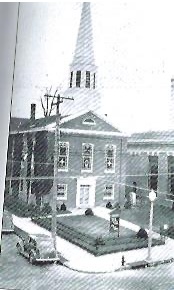
In 1954, the brick front section was added, replacing a courtyard surrounded by a black iron fence. The original front of the church was covered in ivy, according to an account by Dave Kenton.
Today, the church is a thriving central part of the community. Church bells chime for services and other occasions. The current pastor is Rev. Rick Upchurch. The church is located at 101 South Walnut Street in Milford.