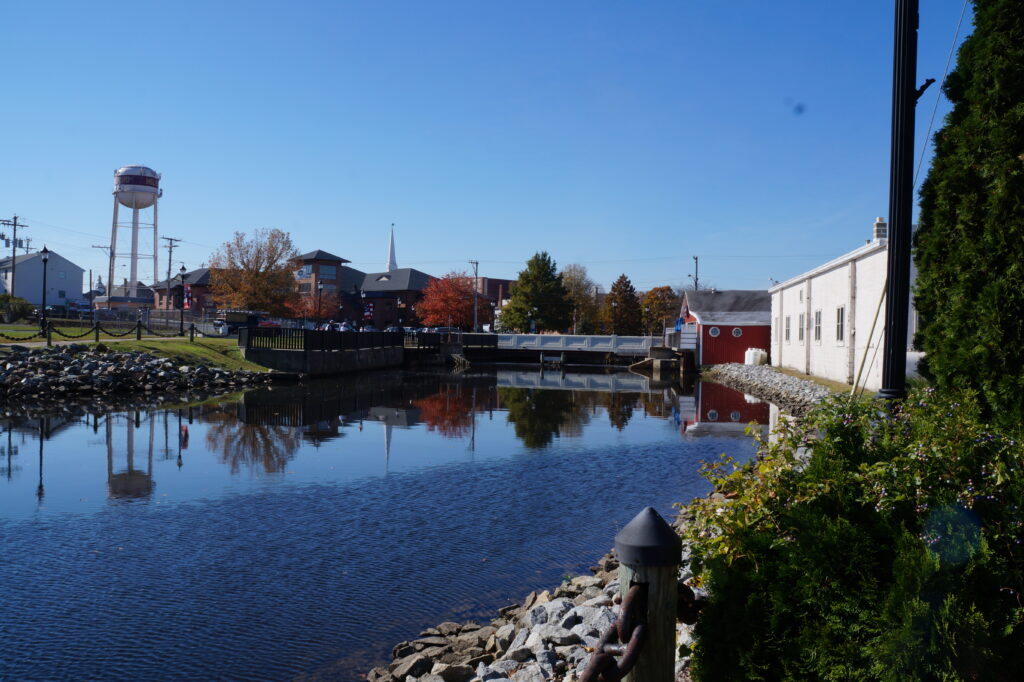


With a summer heat wave bearing down on the Milford area, a look back at how people kept cool before there was air conditioning in every house. One of the most popular ways to cool off was at the recreation area on Marshall’s Pond. The pond, created when a dam was constructed on Herring Branch by Joseph Booth.
Booth constructed a grist mill and sawmill on Herring Branch which later passed to Peter F. Causey and then Daniel Currey. On December 10, 1851, Currey sold the property to his daughter, Mary, who was married to General A.T.A. Torbert. In May 1876, Mary sold the mills to Caleb and Delos Griffin who then sold it to Dr. William Marshall.
Marshall was born in Milton and spent his early years in Georgetown. After graduating in 1847 from Jefferson Medical College in Philadelphia, Marshall opened a medical practice in Georgetown, moving to Philadelphia after about a year and becoming a surgeon in the Gordon Expedition to California. He returned to Delaware in 1951 before joining the Union Army in 1862.
Marshall was wounded at Antietam, he returned to Georgetown and worked to recruit soldiers. He was stationed in Havre de Grace in 1863 and was then sent to Fort Delaware when he was honorably discharged from the Army that year. Returning to Georgetown, Marshall married Hester Angelina McColley, daughter of Trusten McColley. They built a beautiful home on Walnut Street which became known as the Angelina Marshall Jones house, named for the daughter of William and Hester Marshall.
After the mill closed and was subsequently destroyed by fire, Marshall’s Pond became a recreation area, providing ice skating in the winter and swimming in the summer. During the world wars, gas rationing kept Milfordians from traveling to Slaughter Beach in the summer, a popular location to get away from the heat. Edward M. Davis purchased the pond from Hester Angeline Marshall and decided to launch an effort to create a recreation area on the pond.

After a severe rainy spring, the flume at the mill washed out, causing the road over the dam at the pond to deteriorate. Davis rebuilt the flume and assisted the city as well as the county in widening the road with the purpose in mind to create the recreation area. Obstructions that had accumulated in the lake were removed to make it safe for boaters. The plan was to erect two or more bath houses with “a man placed in charge to see that everything was kept in good order. All recreation on the pond was to be free under certain rules. Davis learned to swim in the pond and wanted to preserve it for future generations.
A fund-raising effort began with the city asking merchants to donate. An article published on May 30, 1941, indicated that progress would “end” on the recreation area if “contributions were not forthcoming.”

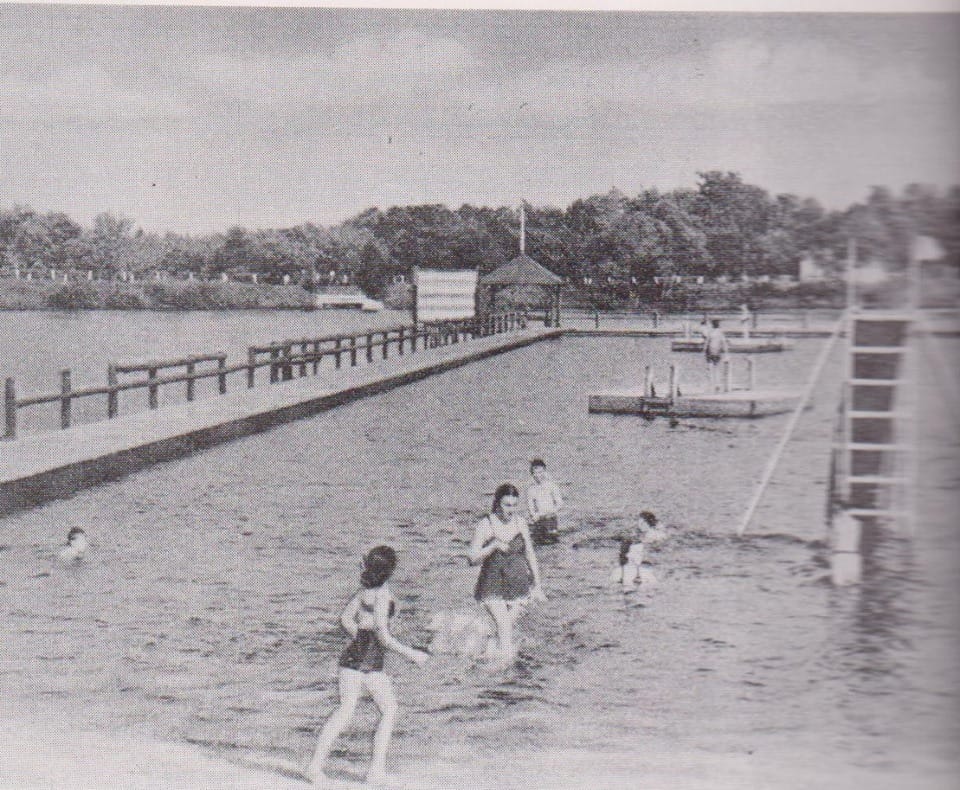
Bringing in sand, likely from Slaughter Beach, they created a beach along the pond, floats were placed in the water for diving and a boardwalk built that ran to the center of the pond. There was also a sliding board just past the shoreline as an added attraction. A pavilion at the end of the boardwalk was a popular site in the summer where Milfordians enjoyed the breezes that came off the water.
In addition to the beach and boardwalk, playing fields were constructed nearby where ball games were frequently held. A concession stand offered an open area with a jukebox where people danced in the evenings. Sunday School picnics were also held on the beach.
When World War II ended, gas rationing was lifted and Milfordians returned to visiting the bay and ocean for their summer entertainment. This reduced the number of people using the recreation center. Even more damaging was run off from a processing plant located upstream on Herring Branch that contaminated the pond and made it unsafe for swimming.