

Over 200 years ago, Milford looked significantly different than it does today. The Mispillion River was much wider and deeper, with boats navigating the river west of what is now Route 113. William Cullen operated a storehouse at a landing known as Cullen Town, located north of Milford Harrington Highway, just across from where Williamsville Road connects now.
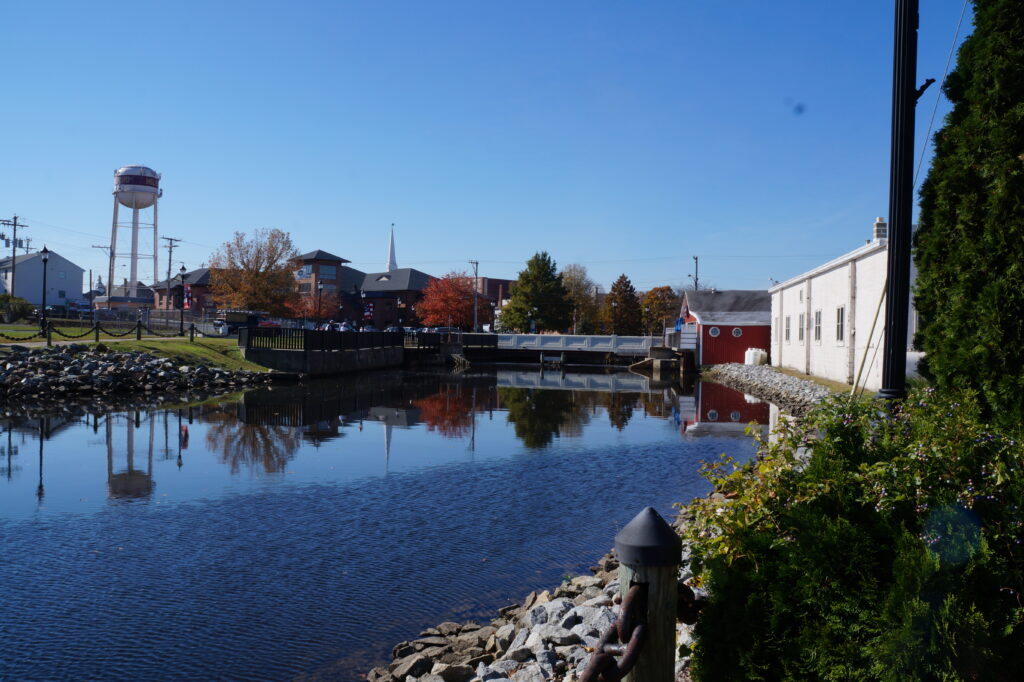
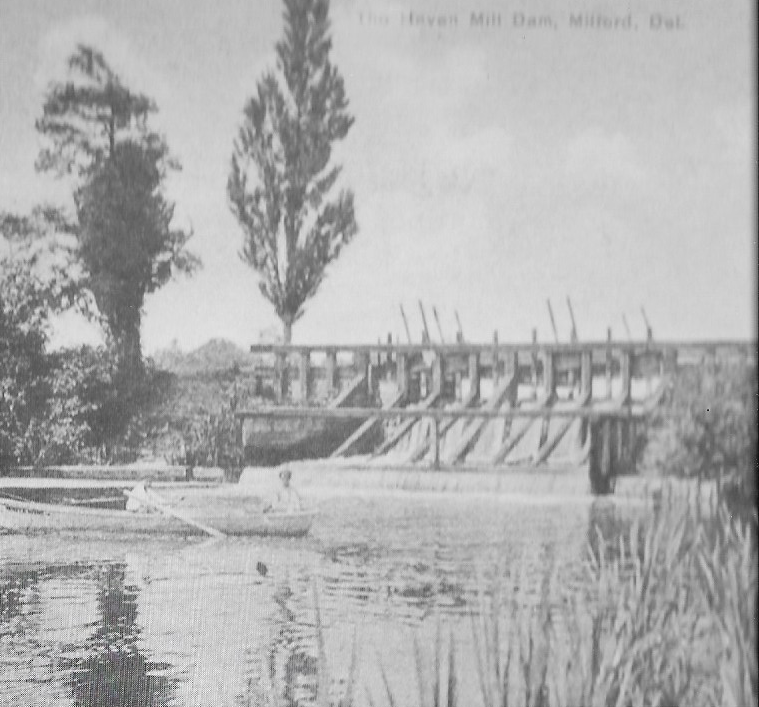
When a dam was constructed on the river which created Haven Lake, navigation was no longer possible to the Cullen Town landing and that small village eventually disappeared. However, with the construction of the dam and a grist mill on Haven Lake, Milford began to thrive. E. Dallas Hitchens, noted Milford historian, believed that the grist mill and dam were constructed by Levin Crapper between 1765 and 1768.
“The mill pond was labeled Crapper’s Pond on a print in 1778,” Hitchens wrote in his history of the town. “The mill is likely known as Crapper’s Mill.”
Crapper, a wealthy businessman, built and habituated what became known as Causey Mansion in 1763. At the time, Milford had two distinct areas, North Milford and South Milford, with Crapper owning much of the land in South Milford. At the time of his death, Crapper’s estimated worth was 37,000 pounds and today would be worth over $867,000.
Haven Lake, like it does today, flowed under the roadway, continuing through Silver lake on its way to the Delaware Bay. It is believed the grist mill was located where Haven Lake ends and Silver Lake begins. Crapper sold the mill but purchased it back, keeping it until his death in 1775. At that time, the mill passed to his son, Molton.
Crapper’s son, Molton, passed away two years after his father and the mill passed to his son, Zaddock. At this time, it was known as Haven Mills. Zaddock sold Causey Mansion to Daniel Rogers and part of the payment was for mill repairs. In 1807, Martin DeWaele sued Zaddock for a debt of 506 pounds, leading to the sale of the mill along with 240 acres of land at sheriff’s sale.
Over the years, the mill was sold several times until Edward Stapleford purchased it for $8,500 in 1819. By this time, the area had greatly improved.
“The houses, outhouses, mill and mill seat, building, barns, stables, ways, woods, waters, water courses” are all mentioned in the sale along with an additional 120 acres of land. John M. Clayton, who served as United States Secretary of State under President Zachary Taylor, owned the mill at one time as well.
The grist mill was not the only industrial business along Haven Lake. In 1872, Governor Peter Causey operated a woolen mill on the river which burned in 1872. It was rebuilt and operated by Hoffecker & Brothers with approximately 30 employees and manufacturing about 5,000 yards of cloth per week. The clothing mill was again destroyed by fire in 1882 and not rebuilt.

R.H. Williams operated a husk factory and a quercitron mill along the pond as well. Thousands of corn husks were bailed and shipped to mattress manufacturers. In the quercitron factory, black oak bark was ground to powder fo ruse in dying and tanning leather. Williams was also known for dealing in hides, bark, leather, country produce, dry goods, boots, shoes and groceries.
George S. Grier operated a foundry and machine shop along the banks of the pond. Grier came to the United States in 1840 from England and established a machine shop in Milford. That was destroyed by fire, and he relocated to Haven Lake. Grier helped design the equipment for processing “pemican” a forerunner of dehydrated food used by the Greely expedition which searched for Admiral Perry. Grier also introduced the first ice making machine in Milford.
In 1918, Pearce Wooten Mills operated on the lake and it was while William A. Pearce owned the mill that electricity was first introduced. Pearce operated a wool garneting operation, converting waste textile fibers to raw material that could be used again.

After Pearce died in 1933, the mill passed to his son, Joseph, who operated it until it closed in 1957.
One interesting find occurred when the lake was drained for bridge construction in 1961. When the water was removed, the site of what appeared to be a former roadway, likely the Kings Highway from Lewes to Dover. It is believed that the river at that point may have been easily forded at that location. Eventually, a bridge was constructed and now carries vehicles along Dupont Highway, constructed in 1924.
Today, the bridge crossing Haven Lake remains a dividing line between Kent and Sussex Counties as well as the dividing line between Milford Hundred in Kent and Cedar Creek Hundred in Sussex.