
Milford has produced eight state governors. In this series, Milford Times will delve into the men and women who led our state who called Milford home. The fifth governor from Milford was Charles Polk. Polk was the first to serve terms in the General Assembly from different counties.

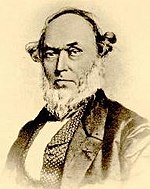
The name Causey has been prominent in Milford for many years but many do not realize that Peter F. Causey served as governor of the state from 1854 to 1859. Not only did he serve as governor, but he also served in the Delaware House of Representatives and the Delaware Senate. Many Milfordians connect him with the Causey Mansion.
The Causey Mansion has not always been owned by the Causey family. The home was built in 1763 by Levin Cropper (also spelled Crapper). The home was designed by an English architect named Mitchell and was significantly smaller. It was also the home of another Delaware governor, Daniel Rogers, who married Moulton Cropper’s widow. Moulton was the son of Levin.
Peter F. Causey was born January 11, 1801, to Peter T. Causey and his wife who came to Milford from Easton, Maryland, in 1815. They opened a mercantile business, and, in 1820, Peter F. expanded the company. He purchased Mill Creek Mills, Marshall Pond Mill, Milford Mills and Haven Mills. He also purchased large quantities of land. The offices of P.F. Causey & Son were located where the former M&T Bank stands today.
Causey took the stage to New York to purchase goods, a journey that took almost a week at the time. Once he ordered goods, they were shipped by vessel to Milford. Much of the business of P.F. Causey & Son were conducted by Causey and his brothers-in-law, Justus Lowery and Raynear Williams.
Not only did the company engage in mercantile sales, Causey also mined iron ore from land he owned in Nanticoke Hundred. The company owned two flour mills, a tannery and shipped products by water to Philadelphia and New York. Causey was very active in Milford and promoted a public school system. He trained and encouraged young men to go into business for themselves. According to Milford historians, people said that Causey was “invariably kind and generous to those less fortunate than himself, something that was a family trait as his children and grandchildren were also known for it.”
Causey took over the business completely in 1826 and added the buying and selling of lime, grain and wood. In 1828, Causey purchased the mill at Marshall’s Pond which included a 100-acre farm located where Herring Branch met the Mispillion River.

Peter F. Causey and his wife, Maria, had nine children but only four survived to adulthood. His first child to survive was William Frederick Causey, who was known as Frederick, in 1833. William married Anna Polk and fathered six children – Anna, Trusten, Foster, Marie, Elizabeth and Mildred. William and his family lived in the Causey Mansion after the death of the governor.
In 1839, Causey owned a wharf near East Street. That same year, the original family home, located at 115 North Walnut Street, was torn down. Also that year, a second son, Peter F. Causey II was born. Peter married Elizabeth Dickinson and they had five children – Virginia Bryan, Elizabeth Alice, Peter Foster Causey III, Edward Handy, and Henry Dickinson. Peter II was the driving force behind the Milford Classical Academy. He was also instrumental in the creation of the Methodist Chapel in South Milford which was then located on South Washington Street. The chapel was created for working class families who would not attend Avenue Methodist Church after 1875.
In 1840, Causey was a delegate to the Whig convention and in 1841, his son John William was born. William managed most of the farmland left by his father after his death. He built a home next to his brother, Peter, which eventually became the home of Dr. Samuel Marshall.
In 1844, Peter Causey again served as a delegate to the Whig convention. He began his political career as a Jacksonian Democrat and with the collapse of the Whig party, he signed onto the temperance movement under the American Party.
In 1847, Elizabeth Marie was born. Elizabeth married prominent businessman Robert Hill Williams in 1872 and they moved into the Williams home on the site of what is now City Hall. They had three children – Foster Causey, Elizabeth and Raynear. Elizabeth married Ruby Ross Vale, a teacher, and they owned a beautiful mansion on what is now the City Hall property.
In 1848, Causey purchased Milford Mill and the following year purchased a lumberyard. In 1860, he purchased the Cropper mansion and began making major architectural changes. He reversed the front entrance to face the town and the wharves that existed then. He added wings on the east and west ends of the house and modified the porticos and windows to reflect the latest Greek revival styling. He also added the lawn and trees seen today.
In 1854, Causey was elected governor, defeating William Burton, another Milfordian. At the time, Causey was part of the “Know Nothings,” a short-lived political party that was also known as the Native American Party. Members of the party were required to say “I know nothing” whenever they were asked about specifics by outsiders. Interestingly, at the same time Causey served as governor of Delaware, his nephew. Trusten Polk, served as governor of Missouri.

An article in the Smyrna Times, published March 27, 1901, talked about concerns the press had with Governor Causey.
“The exercise of the power of appointment has heretofore n the history of our state one of the most important functions of the Governor’s office. For good or for evil, that power has been largely transferred to the people. But until today, it has been a crucial test of the fitness of the fitness of the Executive for his trust. How well Governor Causey stood that test can be shown by recalling a few of the commissions that came from his hand. Samuel M. Harrington, Chief Justice and afterwards Chancellor; Edward W. Gilpin, Chief Justice on the appointment of Judge Harrington to the Chancellorship; Joseph P. Comegys, United States Senator to fill the vacancy caused by the death of John M. Clayton and John W. Houston, Associate Judge. Prior to his election as Governor, he had been representative and state senator; he was a delegate to the National Convention which nominated General Harrison to the Presidency and to the one which nominated Henry Clay. He closed his useful life February 15, 1871.”
Causey was also instrumental in bringing the railroad to Milford after he left office in 1859. The railroad arrived in Clark’s Corner, or what is now known as Harrington, in 1856, but it was not until 1859 that the Junction & Breakwater arrived in Milford. When it did, Causey was named as the president of the railroad while Hiram McColley was named secretary/treasurer. John Houston, Daniel Curry and Trusten McColley; William Coulter, Henry Fiddeman, Curtis Watson, Caleb Layton and Richard France served as directors.
Prior to the railroad arriving in Milford, people had to travel to Clark’s Corner to get on the train. According to historians, this was not a pleasant trip.
“Trains began running between Harrington and Milford, replacing the four-horse stage that had to drive over nine miles from Milford to reach the train in Clark’s Corner,” George Hynson wrote. “This carriage road soon stayed from rains and continuous heavy travel in a “wretched condition.” From the Wolcott Farm to past Delaner’s Tavern, which is now Houston, it was an “uninterrupted slough that reached the fields on both sides and of a depth that forbade and pace faster than a walk. At the Pennewill farm, ruts were cut so deep that the stage axles almost touched the surface, and passengers expected every moment to be overturned. Many refused to make the trip for fear they might be killed. The stage fare to Clark’s Corner was as much as the railway fare from there to Wilmington.”
In 1861, the Civil War was looming, and the leaders of Milford felt the pull of loyalty on both sides. Causey was a friend and correspondent of Jefferson Davis. His friend, William Burton, who was the governor at the start of the war struggled to resist the encroachments of the federal government. Hynson wrote about the turmoil in Delaware during the era.

“The federal government was determined to keep Delaware in the Union, sending 3000 troops under Major General Schenk to the state,” Hynson wrote. “The National Hotel where polls were located was barricaded by soldiers with crossed bayonets and no one was allowed to vote who would not take the “so called iron clad oath to support the federal government. In some places, people were chased from the polls at bayonet point and. In others the infuriated citizens attacked the soldiers.”
Causey’s son, Peter, built an Italianate home on the corner of South Walnut Street and Causey Avenue where Jesus Love Temple stands today. The home was moved in 1922 for the construction of the Plaza Theater. Today, the home is the Plaza Apartments. Peter and his wife raised three children there while his brother, William, lived in the family mansion.
Causey suffered a debilitating stroke in 1865 and returned to the mansion. He died in 1871.
The Causey family’s legacy remained at the forefront in Milford with newspapers reporting on the milestones of the family as late as 1926. An article in “The Evening Journal” on September 26, 1926, provided information on the granddaughter of Peter F. Causey.
“Of interest to many throughout the state is the wedding at 6 o’clock this evening in the Avenue M.E. Church, at Milford, of Miss Elizabeth Newberry Aldred, daughter of Mr. and Mrs. William Aldred and David Wilfred Wallace of Wayne, PA. The bride is a granddaughter of the late Governors Peter F. Causey of Delaware and Trusten Polk of Missouri. Mrs. James A. Draper, of this city, is a great aunt of the bride. Mr. Wallace is a graduate of Harvard and will teach at Wayne, PA this year. Mr. and Mrs. Wallace will make their home in Rosemont.” The Evening Journal, Sept 26, 1926.”