
Milford has produced eight state governors. In this series, Milford Times will delve into the men and women who led our state who called Milford home. The third governor from Milford, Joseph Haslet, was the first to serve twice as governor of Delaware.

Joseph Haslet, the son of Revolutionary War hero Colonel John Haslet who died at the Battle of Princeton, was the first to serve two terms in the office of governor. He was first elected in 1811 and won his second term in 1823.
Haslet’s father immigrated from Ireland after the death of his first wife, who died in childbirth having their daughter, Mary, who was known as “Polly.” According to an account written by E. Dallas Hitchens and E. Millis Hurley in “Milford Delaware & the Milford Area After 1776,” John Haslet, who was a doctor, helped a man named John Brinckle write his will on his deathbed. Brinckle was married to Jemima Molleston Brinckle, but he changed his will, leaving everything to his nephew, Spenser Cole.
Jemima challenged the will with Caesar Rodney, Register of Wills, who determined that since the will had no valid witnesses, it was not a will. A few months later, John Haslet married the widow of John Brinckle. According to “John Haslet: A Useful One” by Fred. B. Walters, Jemima and her first husband were unable to have children, and Jemima believed she was unable to bear children. However, in 1769, Jemima gave birth to Joseph and an account of his birth in Walters’ book provides details.
“Haslet arranged for a midwife from the neighborhood to attend the birth, the common practice in those days,” the book reads. “Haslet waited with Polly in the kitchen as the women attended to Jemima upstairs. Besides Mrs. Manlove, the midwife, there was Jemima’s favorite servant, Bett, and another slave, Sarah. Memories of his first wife’s death in a similar scene more than a dozen years ago, inevitably filled Haslet with concern, but he kept it to himself.”
A few hours later, Sarah arrived in the kitchen to let Haslet know he had a son which he named after his father, Joseph. Haslet’s father was a clergyman, veteran of the French and Indian War as well as a doctor. During the Battle of Princeton in 1777, when Joseph was just eight years old, the colonel attempted to rally the brigade of General Hugh Mercer who was wounded when he was shot in the head. There were reports that General George Washington wept when he came across the elder Haslet’s body after the battle.
Walters reports that a rider was sent to the Three Runs Presbyterian Church where he found Reverend Alexander Houston in the yard with several young boys. The rider informed the pastor that John Haslet had died in the war. One of the young boys with the pastor was Joseph Haslet, attending school at the church, who then rode with the rider and the pastor to the family home known as Longfield to inform his mother. Jemima collapsed and Bett, who had helped deliver Joseph, informed the pastor that Haslet’s mother had not been well. They helped Jemima to bed where she remained until she died two weeks later. Polly became the woman of the house, raising Joseph and his siblings John, Ann, Lydia and Jemima with the assistance of their guardian, Chief Justice William Killen.
The Haslet’s owned a large plantation known as Longfield which was located along Swan Creek just north of Milford. It was on this land that Haslet grew up
Records show that Haslet learned the trade of watchmaker in Wilmington under the direction of Ziba Ferris, but never practiced the profession. His occupation is listed as miller at Cedar Creek Mills soon after he came of age and, in 1794, purchased just under 167 acres of land from Curtis Besick in Cedar Creek forest near Turkey Branch.

Haslet married Mary Draper, the daughter of Alexander Draper, on December 31, 1789, and they had one child, Nehemiah. The land and mill in Cedar Creek had been in the Draper family and in existence before 1769. Alexander Draper’s will and orphan’s court records show that when he died in 1774, he left 822 acres, a mill and a mansion house to his daughter, Mary. In addition, Draper ran a mercantile establishment that were also left to Mary, making her a very wealthy woman.
Mary passed away and Nehemiah only lived to the age of 20. Haslet remarried Rachel Hickman, the daughter of John and Elizabeth Hickman. They had three children Ann, Jemima and Joseph.
In 1804, Haslet ran unsuccessfully for governor as a Democrat-Republican, losing to the Federalist candidate, Nathaniel Mitchell. He ran again in 1807, losing once again to the Federalist candidate, Daniel Rodney, a distant relative of Caesar Rodney. In 1811, Haslet was finally successful in his quest for the governorship.
On January 25, 1811, it was recorded by the General Assembly that Joseph Haslet was elected governor on the first Tuesday of October “to serve three years from the third Tuesday of this present month.”
The War of 1812 was front and center during his governorship. The Federalist Party was unwilling to enter the war, but Haslet called a special session of the General Assembly to raise militia at the request of the federal government. One of his famous quotes was “The State of Delaware will never hesitate to cooperate with her sister states in defending the common rights of the nation.”
Raising a militia in a state with a population of less than 73,000 people was difficult. At the time, Sussex County had the highest population which meant the citizens of that county were asked to raise the most militiamen. Throughout the state, more than 8,000 militiamen were called out, but Sussex County was the only one of the three to see battle during the war.
It was during his service as governor that the British sent ships to the Delaware and Chesapeake Bays. Lewes was bombarded during the war although there was little damage. The British attempted a landing in Lewes but were kept off the land. In June, the British simply landed in Milford and took what supplies they wanted.
In addition, during his time as governor, Haslet oversaw the formation of the Farmer’s Bank of Delaware. He was unable to run for re-election as the Delaware Constitution at the time banned a governor from succeeding themselves. He left office in 1814 and returned to farming.
At the time he was elected, it is believed that he was living near Lincoln, but still owned the land known as Longfield while serving as governor. It is likely he was leasing the mansion on Longfield as his sister, Polly, was married to Robert McGarmant while his sister Jemima was married to George Monro and living in Wilmington.
In 1822, Haslet once again ran for office and won re-election, the first to serve two terms in the office. This time, he won a campaign against Federalist James Booth in an election that was contentious. Booth was accused of being a loyalist during the American Revolution while Haslet was accused of being a former slave owner and neglecting Lewes during the 1813 attacks. Haslet won by less than 100 votes.
During his term, Haslet issued several pardons and made key commission appointments. He died in office just five months after his election on June 20, 1823, at just 54 years old. His oldest child was just 12 years old at the time of his death.
Hurley and Hitchens report that the State Assembly passed an act providing for the sale of “mills, mill seat, messuage and tract of land in Cedar Creek Hundred, Sussex County, belonging to Ann Haslet, John Haslet, Jemima Haslet and Joseph Haslet, minor children of Joseph Haslet.” Benjamin Potter, guardian of the Haslet children, told the assembly that the children were in possession of about 600 acres between Lewes and Milford.
According to records, the mills were in “dilapidation requiring rebuilding and need immediate repair to preserve them and a sale of said property would be of great benefit of said children all of whom are minors.”
Longfield had been willed to Haslet by his father and it appears he held onto ownership of that land until he was elected governor when he sold it to Levin Hill, although Hill died before the deed was finalized. The land then went to Hill’s wife Rachel, Betsy Hill Armstrong, John Hill, Nancy Hill Truitt, Mary Hill and Joshua Hill. The land was sold for $5,800.
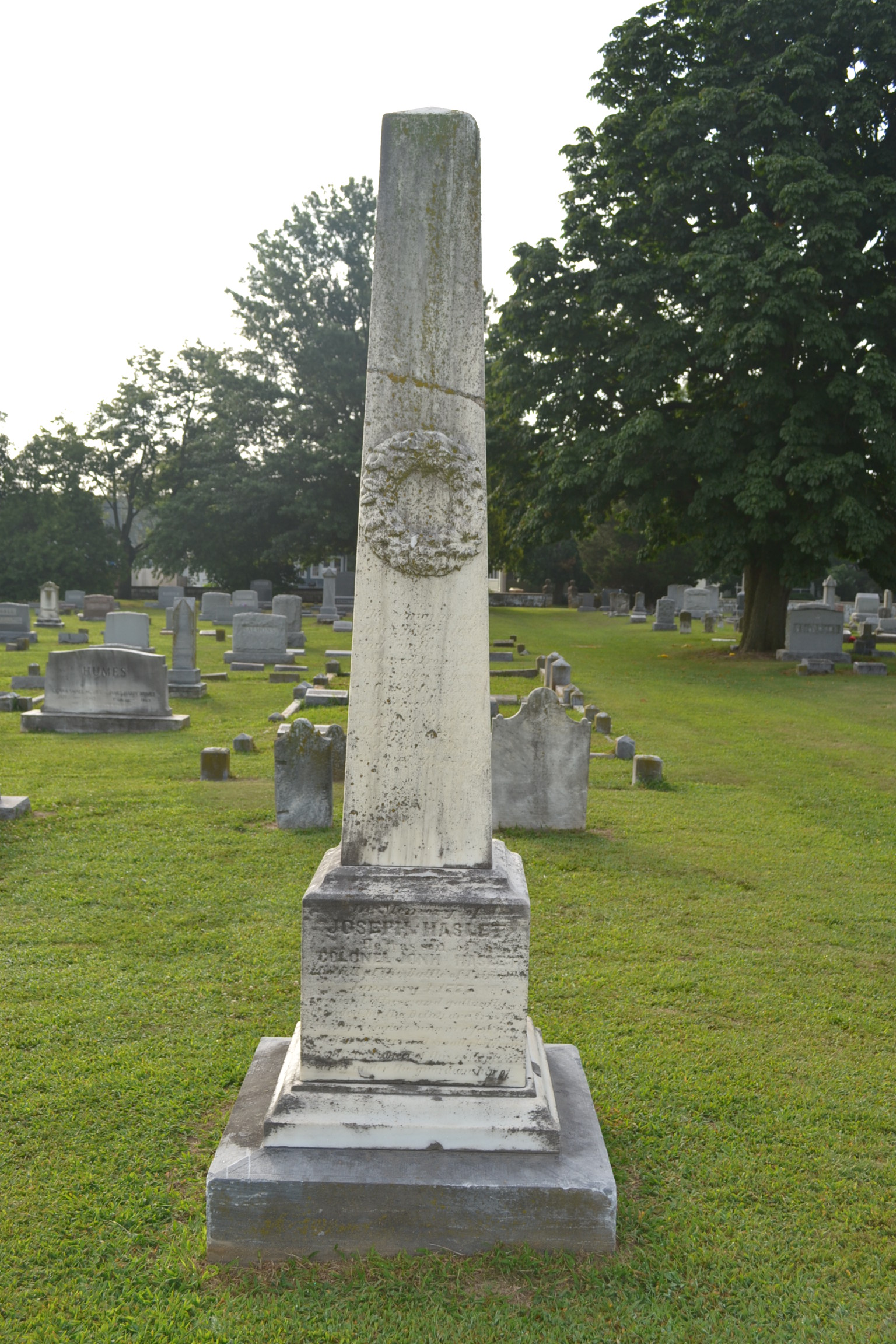
Haslet is buried in Odd Fellows Cemetery in Milford. He was succeeded as governor by Charles Thomas who was president of the Delaware Senate.